by Caroline Huang | Aug 29, 2016 | Daily Paper Summaries
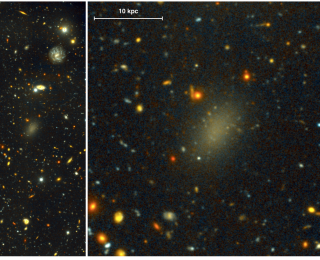
Astronomers have recently discovered a number of galaxies made almost entirely of dark matter. Today’s astrobite takes a closer look at one of them.
by Ben Cook | Aug 23, 2016 | Daily Paper Summaries
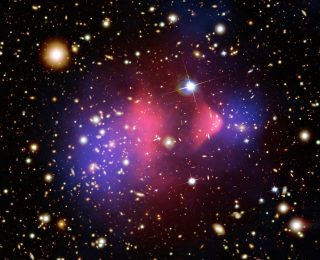
That’s quite a sonic boom, particularly given that the speed of sound in the hot plasma is around 2 million miles per hour!
by Andrew Emerick | May 19, 2015 | Daily Paper Summaries
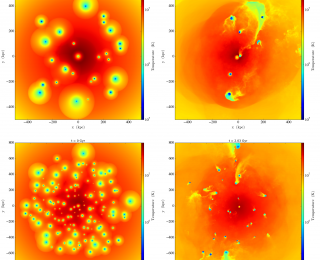
The evolution of a galaxy is strongly dependent upon the environment the galaxy lives in. Galaxies moving through galaxy groups and galaxy clusters can get stripped of their gas that would otherwise be used to form stars. Today’s astrobite discusses simulations of the stripping and removal of the hot, gaseous coronae that surround galaxies.
by Andrew Emerick | Jul 8, 2014 | Daily Paper Summaries
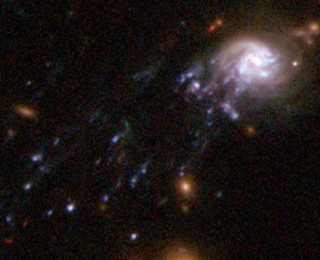
The evolution of galaxies from one type to another is not well understood. A galaxy’s environment plays a key role in its evolution. This is especially important for galaxies in galaxy clusters, which can strip them of their gas. The authors in today’s Astrobite explore six new, dramatic examples of galaxies being stripped of their gas.
by Andrew Emerick | Jun 10, 2014 | Daily Paper Summaries
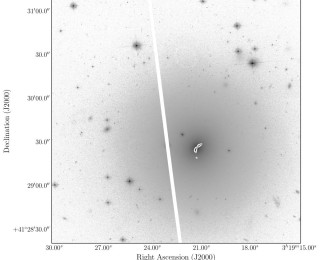
The diffuse gas contained within galaxy clusters can dramatically affect the galaxies moving within it. This includes bending the jets coming out of active galactic nuclei in galaxy clusters. The authors in today’s Astrobite report on extremely bent jets recently discovered in galaxy NGC 1272.
by Dan Gifford | Mar 23, 2012 | Daily Paper Summaries
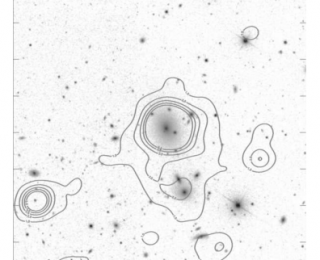
Title: The XMM Cluster Survey: The Stellar Mass Assembly of Fossil GalaxiesFirst Author: Craig D. HarrisonFirst Author Institution: University of MichiganHow do you describe a fossil? Old? Imprinted? Dead? Pristine? A link to the past? As it turns out, the word fossil has been used to describe a distinct population of galaxies and systems of galaxies in our universe. Hierarchical structure formation models indicate that small things build larger things over cosmic time. When groups and clusters of galaxies form, dynamical friction causes the galaxies to lose momentum and kinetic energy, which can ultimately lead galaxies to merge. This dynamical friction has the greatest effect in high density regions, which causes mergers to create a large brightest cluster galaxy (BCG) at the center of these systems. Observations have identified a population of clusters that have a very large BCG, but not very many bright companions (ie, a magnitude gap exists) and called these Fossil Galaxies in Fossil Systems. The use of word fossil here is perfect because the BCG appears to live in a “dead” or depleted environment, and the entire merger history should be imprinted in its stellar population.So what can we learn from these fossil systems? Because of small samples, much of what we already know has come from simulations. These simulations indicate that fossil systems gain a large fraction of their mass at high redshift and earlier than non-fossil groups. One hypothesis is that growth of fossils was dominated early by in-fall of massive satellites which boosted the size of the fossil galaxy relative to its cousins in non-fossil systems, which evolved slightly more passively. Another...
