by Sandy Chiu | Aug 15, 2025 | Classics, Daily Paper Summaries
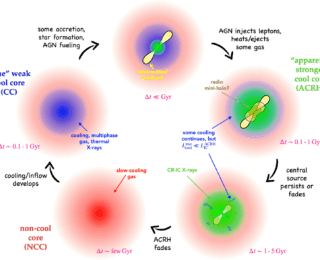
It is generally believed that the X-ray emission from cold-core clusters comes from hot gas, where there is a delicate balance between gas cooling and feedback from active galactic nuclei. This paper explores another possibility: are these X-rays simply an illusion of inverse Compton scattering by cosmic rays?

by Sandy Chiu | May 7, 2025 | Daily Paper Summaries
Using X-ray observations from XMM-Newton, this paper studied the chemical makeup of the hot gas around the galaxy M86, which is being stripped as it moves through a cluster. They found that the galaxy’s core still holds onto its enriched gas, and that part of the stripped material likely comes from a past galaxy collision—not just the core being peeled away.
by Guest | Oct 3, 2024 | Daily Paper Summaries
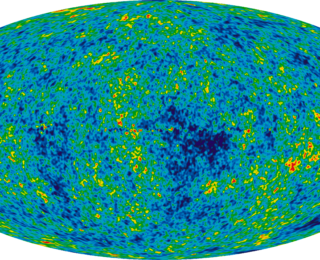
In today’s Bite, guest author Catherine Chaison discusses the CLONE simulation and its use in simulating galaxy clusters!

by Ryan Golant | Feb 19, 2022 | Daily Paper Summaries
How have magnetic fields in galaxy clusters evolved throughout cosmic history, and what can these fields tell us about magnetism in the early Universe? Thanks to a few tricks from radio astronomy, today’s authors have some answers.
by Lukas Zalesky | Jul 16, 2020 | Daily Paper Summaries
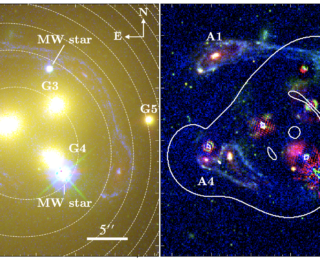
If dark matter did not exist, the visible matter in the universe should be able to explain all gravitational phenomena. But can it?
by Ben Cook | Nov 28, 2016 | Daily Paper Summaries
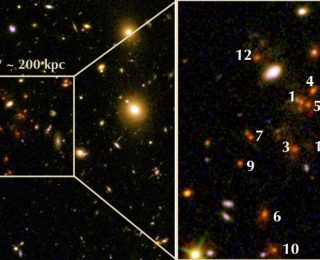
While ClJ1446 is smaller and less massive than most present-day clusters, it is probably very similar to what they looked like 10 billion years ago. Therefore, this work can help improve our understanding of how our nearby galaxy clusters likely evolved.
