by Elizabeth Lovegrove | Feb 13, 2012 | Daily Paper Summaries
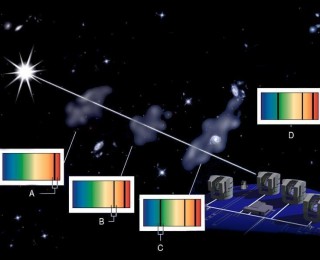
When the light from a distant quasar finally arrives at Earth, it often carries far more information than it did when it was emitted – the shadows of gas and galaxies that have intervened over the cosmic distances between us and the source. These features can tell us how the universe evolves in both space and time, by allowing us to sample both low and high redshifts for structures that would not otherwise be visible. This paper uses a new IR spectrograph, FIRE, deployed on the Magellan 6.5 m telescopes, to present the first high-redshift sample of Mg II absorption systems, including the most distant Mg II system yet found (z = 5.33). The authors show that the number of strong Mg II systems appears to peak and decline in number along with the star formation history of the universe, suggesting a correlation between the two, while weak Mg II systems stay mysteriously constant.
by Allison Strom | Feb 10, 2012 | Daily Paper Summaries
Using the unique chemical composition found in every star’s atmosphere, the authors identify potential members of a dissolved star cluster in the Sextans dwarf spheroidal galaxy and investigate the origin of dwarf galaxies in the Milky Way halo.
by Nick Hand | Jan 21, 2012 | Daily Paper Summaries
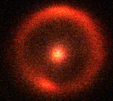
A new dwarf galaxy has been detected a record-breaking 10 billion light years from Earth, using a method based on gravitational lensing. The satellite galaxy is composed mainly of dark matter and is too faint to be observed directly with the current generation of optical telescopes.
by Elisabeth Newton | Nov 9, 2011 | Daily Paper Summaries
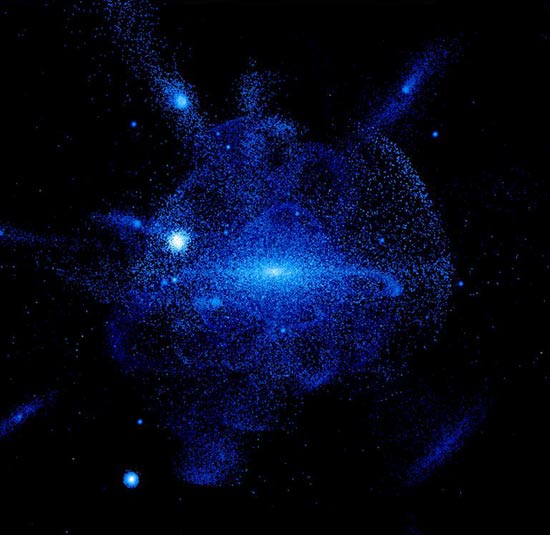
The Milky Way’s stellar halo – a roughly spherical distribution of stars surrounding our spiral galaxy – is a valuable tool for probing the early evolution of our galaxy. The stellar halo contains some of the oldest stars in our galaxy, whose properties reflect that of the environment in which they formed. This paper focuses on using cosmological simulations of galaxy formation to match the observed structure and kinematics (how the stars move) of stars in Milky Way’s halo.
by Elisabeth Newton | Jan 24, 2011 | Daily Paper Summaries
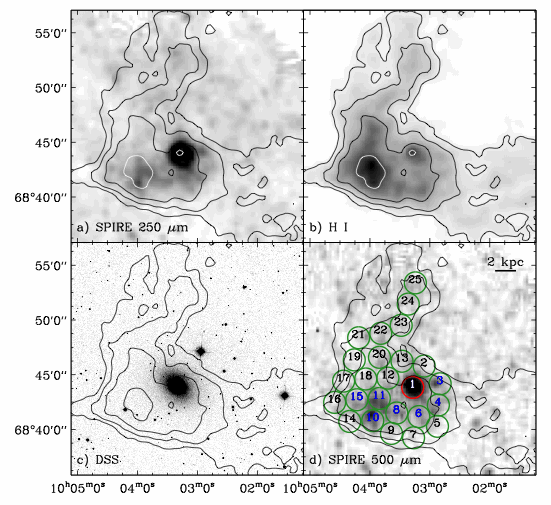
The interacting galaxies in the M 81 triplet are interconnected by tidal features. In this work, the authors study dust in the NGC 3077 tidal stream and discuss its implications.
