by Ryan Foltz | Feb 3, 2013 | Daily Paper Summaries
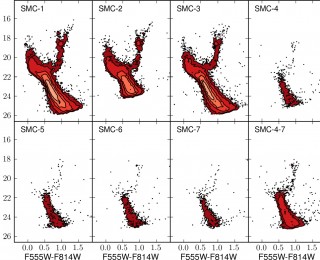
TITLE: Comparing the Ancient Star Formation Histories of the Magellanic Clouds AUTHORS: Daniel R. Weisz, Andrew E. Dolphin, Evan D. Skillman, Jon Holtzman, Julianne J. Dalcanton, Andrew A. Cole, Kyle Neary AUTHORS’ INSTITUTION: University of WashingtonThe evolution of galaxies can be investigated in two ways: we can observe galaxies at farther distances to get a picture of how galaxies appeared at earlier times (since the light from these distance sources requires time to reach our telescopes), or we can study the remnants of past events in our nearby universe. This paper is an example of the latter approach. Using archival data from the Hubble Space Telescope, the authors try to piece together the detailed history of how the Large and Small Magellanic Clouds formed their stars.The Large Magellanic Cloud and Small Magellanic Cloud (LMC and SMC) are two of the closest neighbors to our home galaxy, the Milky Way. In fact, they’re so close that they’re classified as satellite galaxies, meaning they’re gravitationally bound to the Milky Way in the same way the Earth is gravitationally bound to the Sun. They’re also rather smaller, less-thoroughly formed, and irregularly shaped than our own galaxy, being examples of dwarf galaxies. If you want to study populations of stars and how they form, it’s hard to find better subjects than the Magellanic clouds; they’re close enough that we can make out the individual stars (especially with a telescope with Hubble’s resolution) and they’ve been extensively investigated over the years, giving us a solid understanding of their sizes and distances and other properties.The stars that make up the LMC and SMC were formed over a period of many...
by Nick Hand | Jan 26, 2013 | Daily Paper Summaries
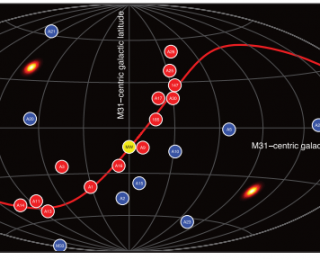
The authors have identified several satellite galaxies confined to a plane in their orbits around our nearest neighbor, the Andromeda Galaxy. Such a planar structure is perhaps at odds with our current understanding of galaxy formation.
by Lucia Morganti | Nov 16, 2012 | Daily Paper Summaries
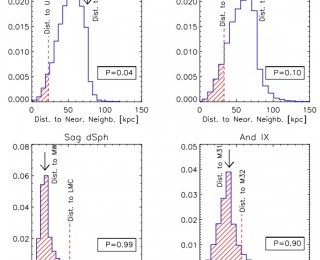
Pairs of dwarf galaxies in the Local Group are much more common than what expected from N-body/semi-analytic models of galaxy formation.
by Allison Strom | Jun 15, 2012 | Daily Paper Summaries
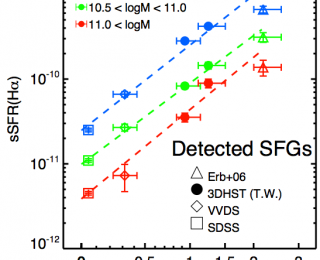
Astronomers in Leiden have measured star formation rates across a large range in redshift with H-alpha spectroscopy for the first time, which is a huge leap forward in our ability to compare the local Universe with high-redshift.
by Evan Schneider | Jun 2, 2012 | Daily Paper Summaries
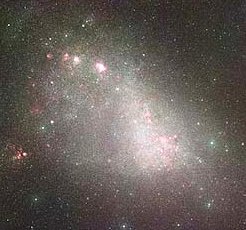
In this paper, the authors describe a new galaxy simulation that includes molecular hydrogen, the site of star formation, and discuss what happens with and without it.
by Allison Strom | Mar 12, 2012 | Daily Paper Summaries
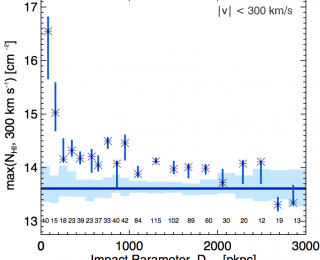
Researchers at Caltech have used data from the Keck Baryonic Structure Survey to place quantitative constraints on the circumgalactic medium around galaxies at z~2. Measurements like these help us fine-tune our understanding of the interplay between gas and galaxies and, ultimately, galaxy formation and evolution.
