by Allison Strom | Feb 16, 2013 | Daily Paper Summaries
A team of astronomers working on the 3D-HST survey make use of the Hubble Space Telescope’s grism to observe star formation as a function of radius in a large sample of galaxies at intermediate redshift.
by Elizabeth Lovegrove | Jun 8, 2012 | Current Events
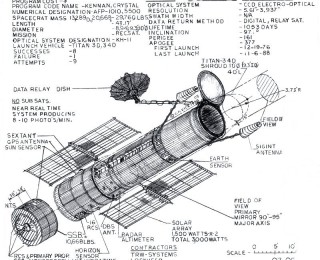
Today the National Reconnaissance Office (NRO) announced that it has given NASA not one but two fully-constructed space telescopes, roughly equivalent to Hubble with a wider field of view. The telescopes, which were offered to NASA about a year ago (a team of scientists has been considering whether to accept them in the meantime), come with all their hardware minus instruments – a total value to the agency of hundreds of millions of dollars plus years of lead time.
by Elisabeth Newton | Nov 23, 2011 | Daily Paper Summaries
Lensing occurs when the mass of a foreground object distorts and magnifies the light from a background galaxy or quasar, sometimes even creating multiple images. It probably isn’t a stretch to say that the neatest thing about lensing is that you can typically see two to four images of the same galaxy. But something else that’s cool is that these distant background objects are magnified, making it possible to study them in detail when otherwise they might not be seen at all: in this way, gravitational lenses act as natural cosmic telescopes.
by Katherine Rosenfeld | Oct 28, 2011 | Daily Paper Summaries
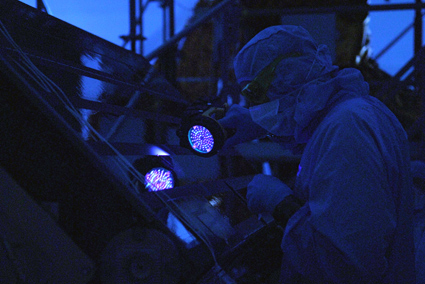
There is much more to a telescope than the size of its mirror. Instruments are often built and optimized with a particular science goal in mind.
by Nathan Goldbaum | May 18, 2011 | Daily Paper Summaries
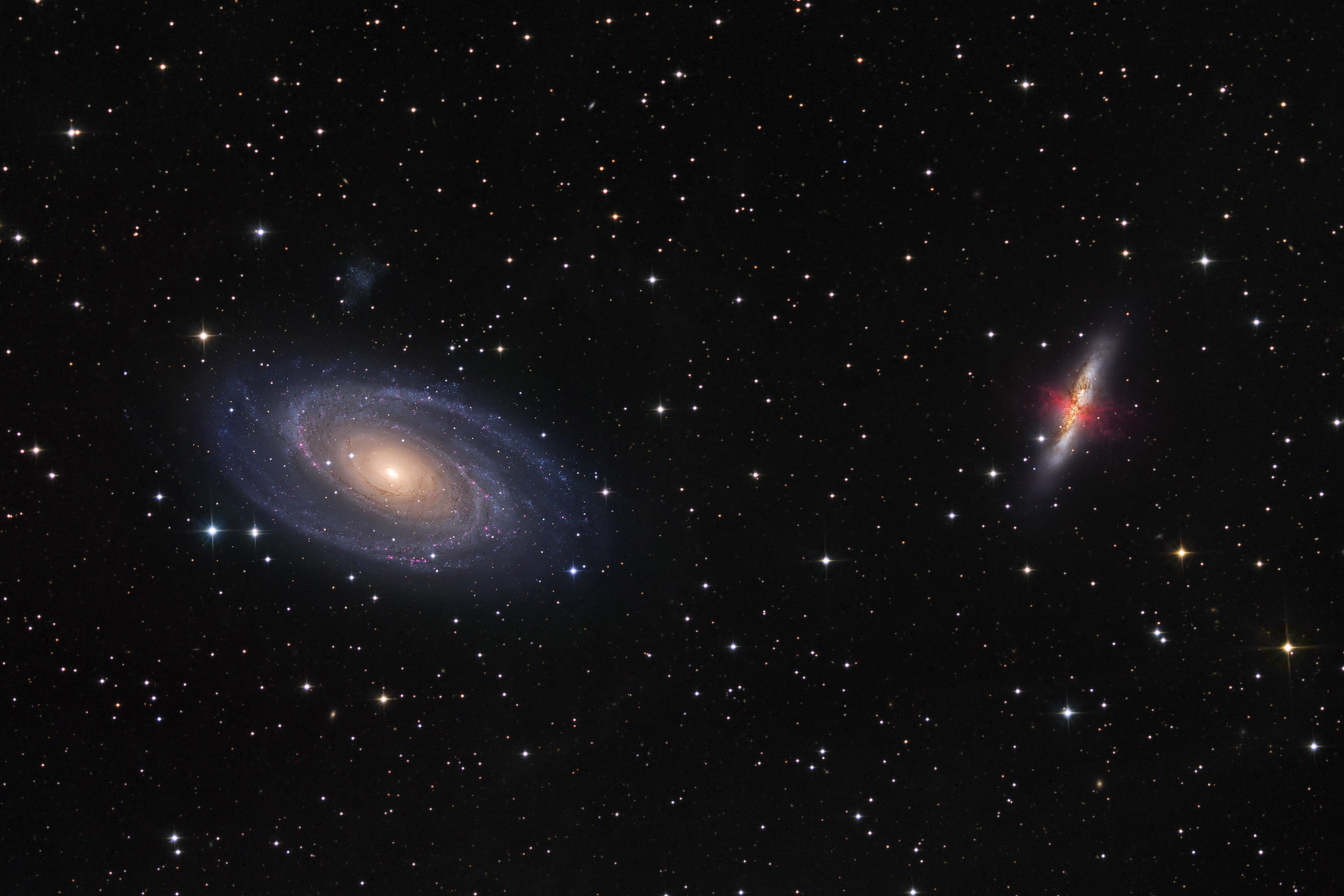
Title: The History of Star Formation in Galaxy Disks in the Local Volume as Measured by the ACS Nearby Galaxy Survey Treasury Authors: Benjamin F. Williams et al. Affiliation: Department of Astronomy, University of Washington The star formation history of the universe is an area of active research. As galaxies consume their gas into stars, newborn massive stars emit copious amounts of ionizing radiation and explode in powerful core-collapse supernovae. Both of these radiative and mechanical feedback mechanisms can significantly affect the development of galaxies, resulting in the galaxy populations we see today. Deep photometry from space and ground-based observatories have allowed astronomers to directly measure the in situ star formation history of the universe by counting the number of star forming galaxies we see at earlier epochs of the universe’s evolution. One could alternatively observe the age and mass of resolved stellar populations in nearby galaxies to infer the star formation history of these systems. These two disparate measurements should agree, except for departures due to cosmic variance. In this paper, the authors use deep Hubble observations of a volume-limited sample (the ACS Neaby Galaxy Treasury Survey, ANGST for short) of nearby galaxies to measure the star formation using stellar population synthesis modeling.Measuring the star formation history of a resolved stellar population requires detailed models for the positions of stars in a color-magnitude diagram (CMD for short). A CMD is just an observer’s version of the more commonly discussed Hertzprung-Russell diagram. Models of stellar evolution and synthetic spectral modeling of the model stars are sufficiently advanced that the luminosity and color of practically any star can be predicted...
by Dan Gifford | Mar 22, 2011 | Daily Paper Summaries
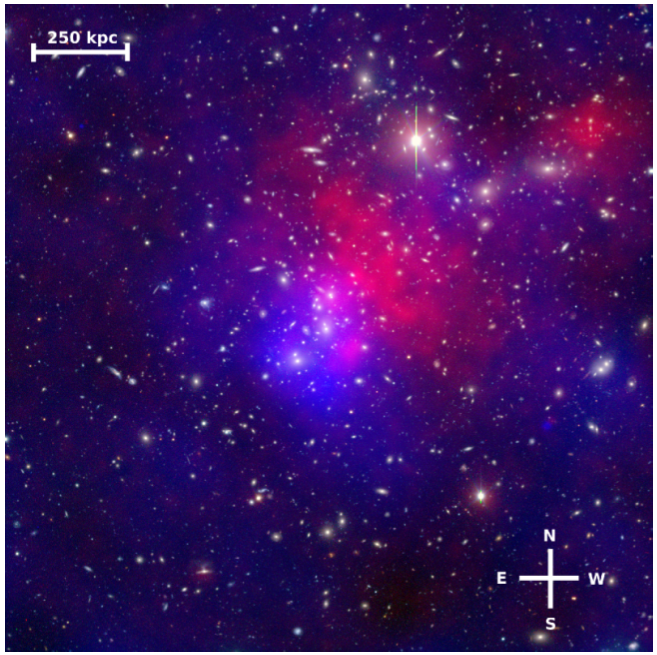
Where can you find ‘ghost’, ‘dark’, ‘stripped’, and ‘bullet’ clusters? The Pandora Cluster, which has become an excellent laboratory for studying the nature of other shady characters in our universe like dark matter.
