by Caitlin Doughty | Apr 26, 2019 | Daily Paper Summaries
The circumgalactic and intergalactic media may contain the majority of baryonic matter in the universe, but their low density makes them extremely faint. Can an instrument designed to image low surface brightness objects help shed light on these ghostly structures?

by Amber Hornsby | Jan 9, 2018 | Career Navigation, Current Events
Outreach extraordinaire, Lawrence Rudnick, employs both radio and x-rays to investigate the dynamics of the intercluster medium. Be sure to read this interview before his plenary talk at #AAS231 on Wednesday!
by Joshua Kerrigan | Apr 7, 2017 | Daily Paper Summaries
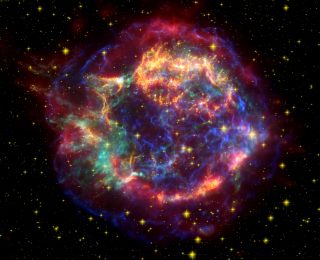
What provided heat to the IGM prior to reionization? X-rays have been the favorite, but today we explore cosmic rays as a source.
by Benny Tsang | Oct 13, 2016 | Daily Paper Summaries
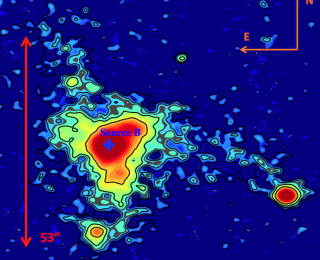
The biggest and the brightest Lyα nebula is discovered! What can we learn from this giant?
by Jesse Feddersen | Sep 16, 2015 | Daily Paper Summaries
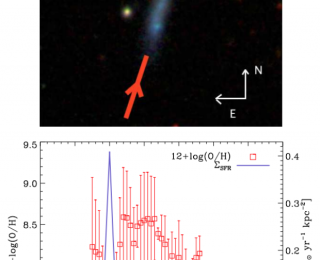
Observations of dwarf galaxies show that sites of active star formation have fewer metals. These galaxies may have been diluted by the impact of pristine gas from the cosmic web.
by Elisa Chisari | Sep 18, 2013 | Daily Paper Summaries
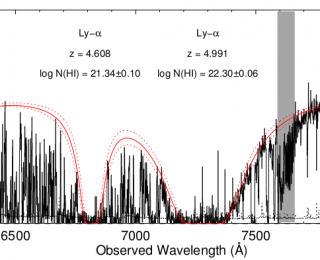
Gamma-ray bursts are the most energetic explosions in the Universe. Today, we discuss how to use one GRB as a beacon to study the properties of a high redshift galaxy, the composition of the gas in the intergalactic medium at high redshift and the formation of dust in the Universe.
