by Elisabeth Newton | Nov 29, 2012 | Daily Paper Summaries
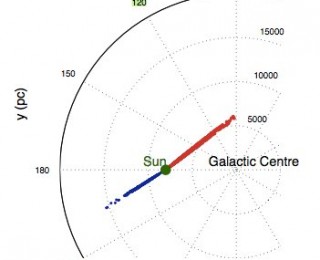
“Galactic archaeology” is the term that has come to refer to using the motions and chemical compositions of stars of different ages to learn about the history of the Milky Way. It seems to me that “galactic paleontology” might be a bit more accurate. I hope to see galactic archaeology v. galactic paleontology fought out in the comments!
by Chris Faesi | Sep 2, 2012 | Daily Paper Summaries
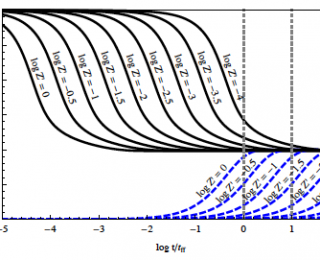
Stars forming in atomic gas?? Maybe so, if the metallicity is low!
by Elizabeth Lovegrove | Jul 31, 2012 | Daily Paper Summaries
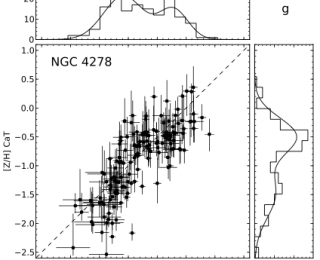
In this paper, the SLUGGS team explores an alternate way to determine the metallicity of a globular cluster based on the calcium triplet rather than color. Previous studies have shown what appear to be two peaks in the metallicity of the population of globular clusters surrounding early-type galaxies – a bimodal distribution – but some astronomers have pointed out that the way we measure metallicity in globular clusters can make a unimodal distribution in metallicity appear as a bimodal one. The SLUGGS team recalibrates the calcium triplet relation and surveys 903 clusters around 11 galaxies, and finds a similar bimodal distribution, implying that most massive galaxies undergo at least two star formation episodes.
by Kirit Karkare | Jul 17, 2012 | Daily Paper Summaries
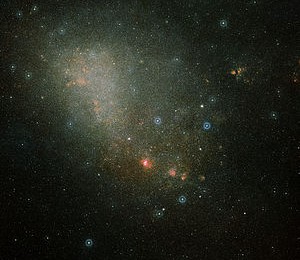
What can a nearby dwarf galaxy tell us about the the chemical evolution of the universe?
by Adele Plunkett | May 25, 2012 | Daily Paper Summaries
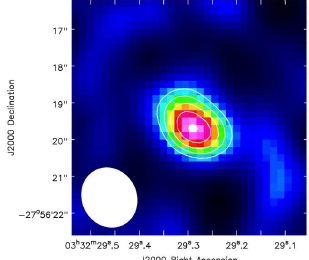
This paper presents ALMA observations of the first ever measurement of both ionized nitrogen and carbon for the galaxy “LESS J0332”, which is determined to be at a redshift of 4.76 and have a metallicity similar to that of our sun. This suggests that the galaxy at a much earlier time in the universe had already evolved quite a bit.
by Nathan Sanders | Apr 17, 2012 | Daily Paper Summaries
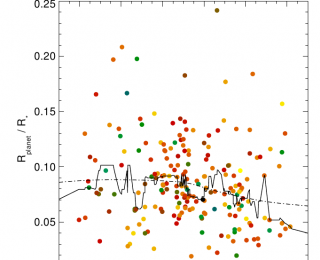
Sarah Dodson-Robinson identifies a correlation between planetary radius and stellar metallicity among gas giants in the Kepler catalog that may indicate a change in the structure and formation mechanism of planets over cosmic time.
