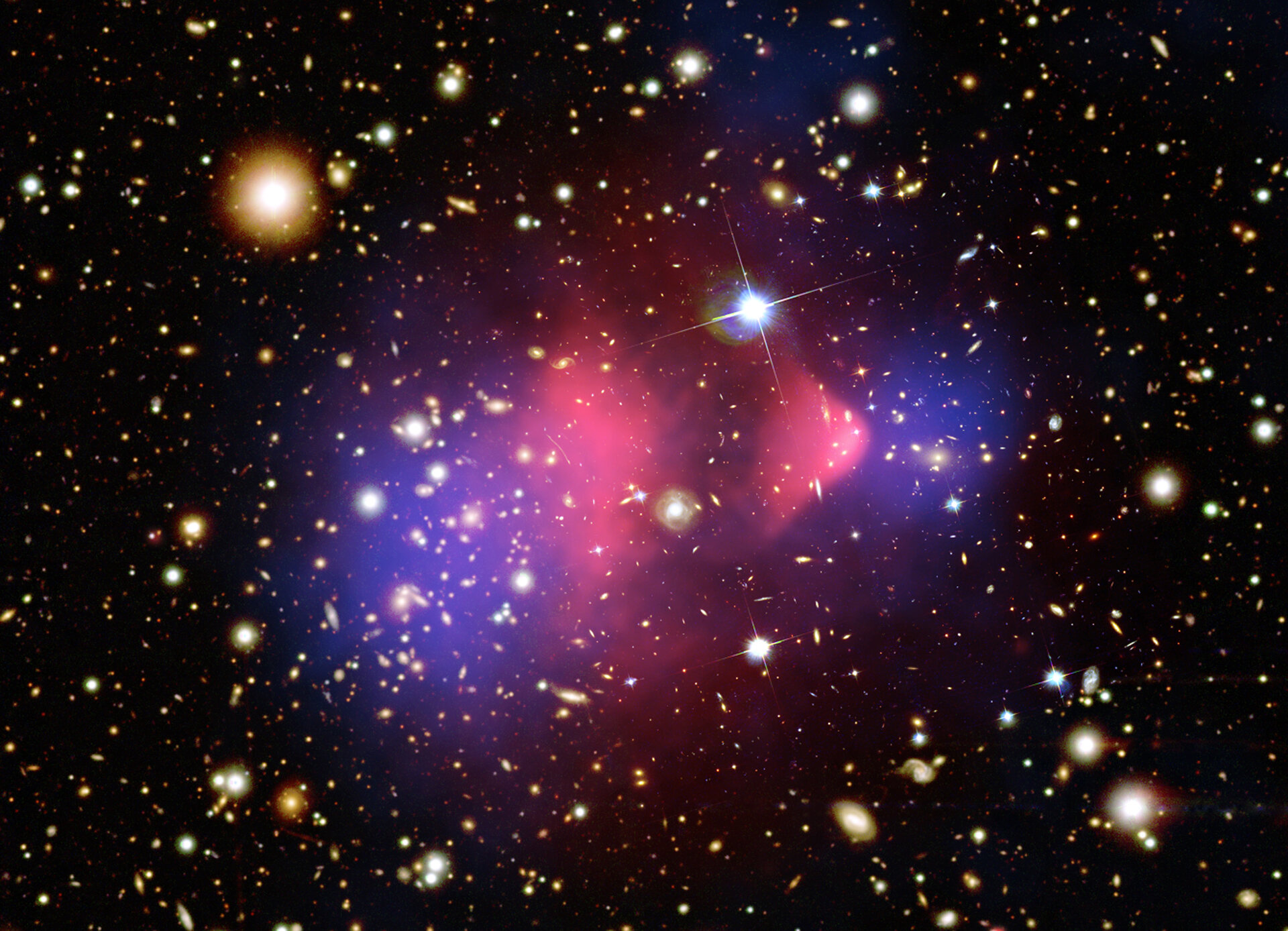
Less than meets the eye: measuring the bias in galaxy cluster observations
Today’s authors come up with a new way to account for foreground and background galaxies in galaxy cluster measurements.

Today’s authors come up with a new way to account for foreground and background galaxies in galaxy cluster measurements.

Radio observations of the Galactic center reveal striking filaments of synchrotron emission, formed as cosmic ray (CR) electrons travel along magnetic fields. Researchers tested different CR transport models and found that a combination of diffusion and streaming best explains the observed filament structures. This study not only sheds light on how CRs move through space but also provides a new way to probe the magnetic environment of our galaxy.
MOND and Dark Matter are both proposed theories to explain the flat rotation curves of galaxies…can we use simulations to tell us more about which might be the better theory?
Today’s authors show that including nonlinear modes improves the black hole ringdown model and could be very important for gravitational wave data analysis.
Just before going supernova, some stars tend to have some gas problems, so why not simulate how?
What will JWST reveal about the obscured early Universe? Today’s authors process simulations to find out