by Courtney Dressing | Jan 19, 2012 | Daily Paper Summaries
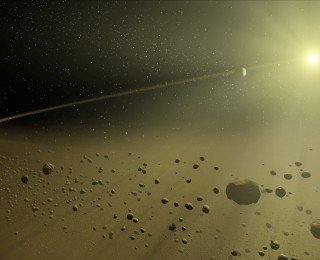
Where should astronomers look to find terrestrial planets? Raymond et al. argue that debris disks are signposts of terrestrial planet formation.
by Courtney Dressing | Jan 6, 2012 | Daily Paper Summaries
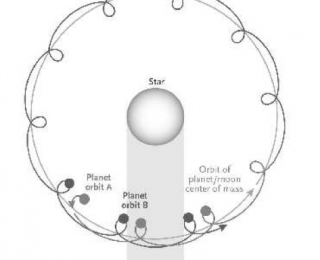
Moons in other solar systems are common in science fiction. Are they common in the universe as well? Kipping et al. are using Kepler data to find out.
by Adele Plunkett | Jan 6, 2012 | Daily Paper Summaries
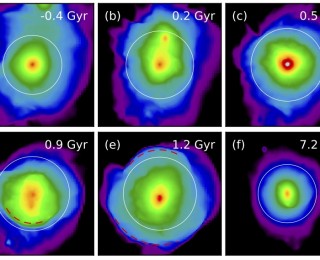
Galaxy clusters trace the matter density of the universe, and by counting clusters as a function of mass and redshift, cosmologists can learn about the expansion rate of the Universe
by Kim Phifer | Dec 18, 2011 | Daily Paper Summaries
Nordhaus et al perform simulations to show that normal type II supernovae can produce pulsar kicks which match the observed velocities of neutron stars.
by Courtney Dressing | Dec 14, 2011 | Daily Paper Summaries
Today, Mercury rotates only three times in two Mercury years. How did the planet get to this state? Was Mercury tidally locked in the past?
by Nathan Goldbaum | Nov 13, 2011 | Daily Paper Summaries
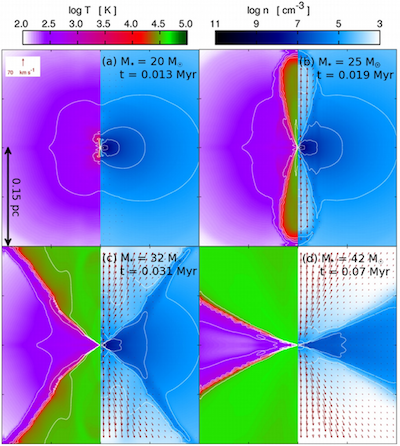
Paper title: Protostellar Feedback Halts the Growth of the First Stars in the Universe Authors: Takashi Hosokawa, Kazuyuki Omukai, Naoki Yoshida, Harold W. Yorke Author’s Affiliation: Jet Propulsion Laboratory; Department of Physics, Kyoto UniversityThe problem of understanding the formation and evolution of the first to form stars in the universe lies at the intersection of many fields of astrophysics. Since the first stars could only have formed once their host dark matter halos had begun to collapse, one must understand the formation of these stars in a cosmological context, tracking gas from extremely low intergalactic densities (~10-27 g cm-3), to extremely high, stellar densities (~1 g cm-3). Since all the metal content of the universe had not yet been synthesized in the cores of stars, the gas that collapsed to form the first stars would have been metal-free and thus possessed very different thermal properties compared to the interstellar and intergalactic gas in the local universe that can cool via metal line emission.Many studies of first star formation have focused on the cosmological piece of the puzzle: starting with a simulation of cold dark matter and gas in a ΛCDM cosmology, they look for the first ~106 solar mass dark matter halo to collapse, and then follow the collapse of first the dark matter and then the gas to very high densities. Due to the extremely large dynamic range in these simulations, it becomes prohobitively expensive to reach stellar densities and impossible to directly model the evolution of the first star. For reference, a recent simulation of the formation of the first stars followed the collapse to densities just above 10-8 g cm-3, far below typical stellar...
