
Bars Rejuvenating Bulges?
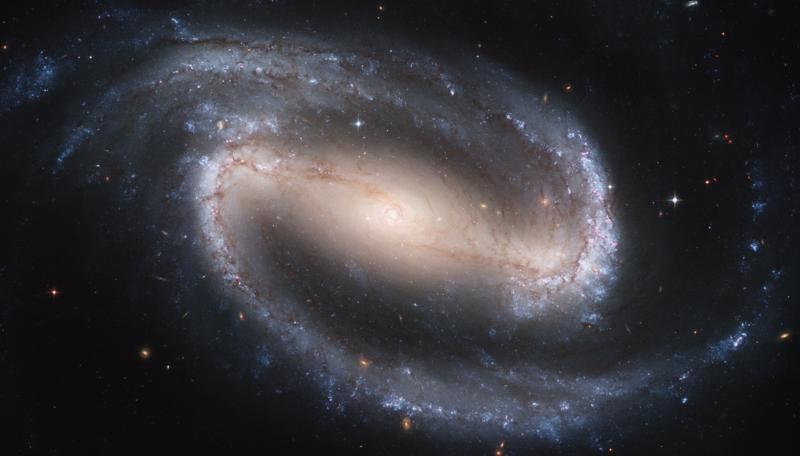
Paper title: Bars rejuvenating bulges? Evidence from stellar population analysis Authors: Paula Coelho and Dimitri A. Gadotti First author’s affiliation:Núcleo de Astrofísica Teórica, Universidade Cruzeiro do Sul, São Paulo, Brasil SummaryAs you may recall from Nathan Sanders’ April post, some spiral galaxies have central bulges with high concentrations of stars. Coelho and Gadotti examine a sample of 575 of these galaxies to investigate whether the presence or absence of a bar (a bar-shaped overdensity of stars) influences the rate of star formation in the central bulge. Astronomers expect to see a higher star formation rate in the bulges of barred galaxies because bars can transport gas from the outer regions of the galaxy into the center and supply fuel for growing stars. Previous detections of star-formation indicators (such as enhanced Hα emission) have indicated that the current star formation rates are higher in barred spirals than in unbarred spirals, but Coelho and Gadotti take the alternative approach of determining the ages of the stellar populations in the bulges. They find that the bulges of barred galaxies are systematically younger than the bulges of unbarred galaxies, which is consistent with the expectation that bars should promote star formation. The Galaxy SampleIn a previous paper, Gadotti derived stellar masses, bulge stellar masses, bar properties, and other parameters for a sample of face-on galaxies observed by Sloan Digital Sky Survey (SDSS). All of the galaxies had stellar masses above 10^10 solar masses and redshifts between 0.02 and 0.07. Selecting face-on galaxies reduced the effect of dust and simplified the process of identifying bars and bulges in the galaxies. In this paper, Coelho...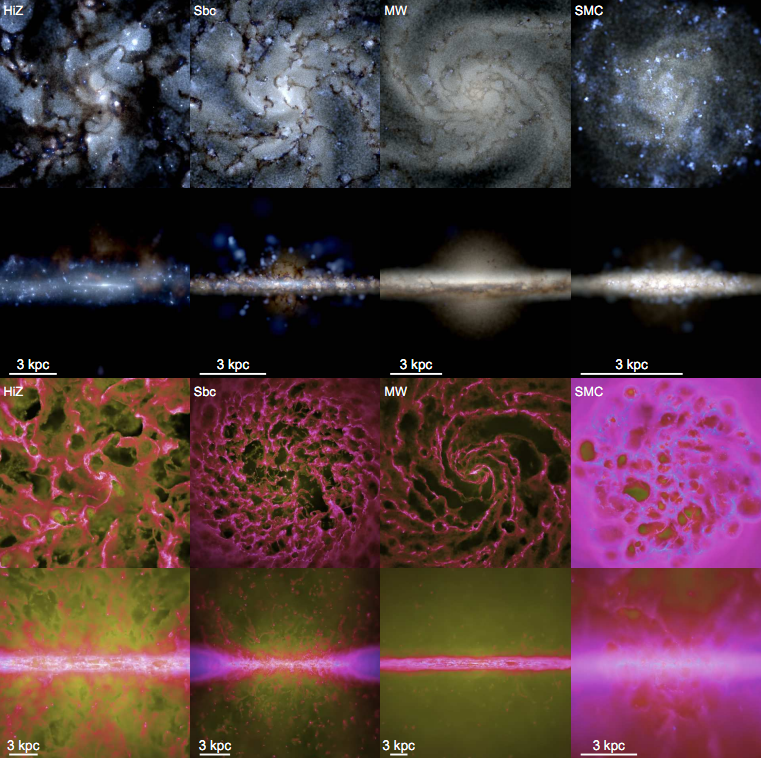
Lighting up Simulated Galaxies
For today’s astrobite, we will be discussing some of the highest-resolution simulations of isolated galaxies performed to date. Not only are these simulations high resolution, but they also include prescriptions to model several physical effects that previous galaxy evolution simulations have mostly ignored.
The Case of the Disappearing Star: Un-novae and Ultra-long Gamma-ray Transients
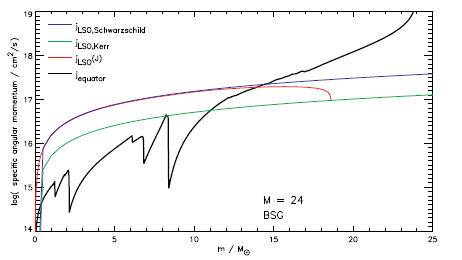
The collapsar model of gamma ray burst production posits that a black hole forms at the center of the star and sucks in the rest of the star’s mass, but that the inner regions have sufficient angular momentum to form an accretion disk which then radiates some fraction of its power in the form of a relativistic jet of matter beaming out of the star. But what if it were the outer, not the inner, layers of the star that had most of the angular momentum? The answer is a very different sort of gamma-ray transient.
Windy Massive Stars and Observations of Gamma-Ray Bursts
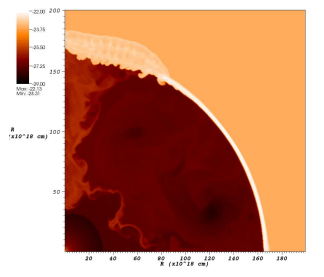
How can the medium immediately surrounding massive stars affect our observations of Gamma-Ray Bursts?
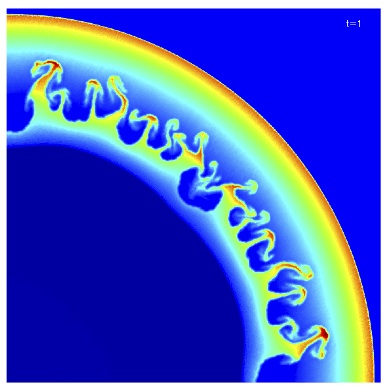
The Limitations of Smoothed Particle Hydrodynamics
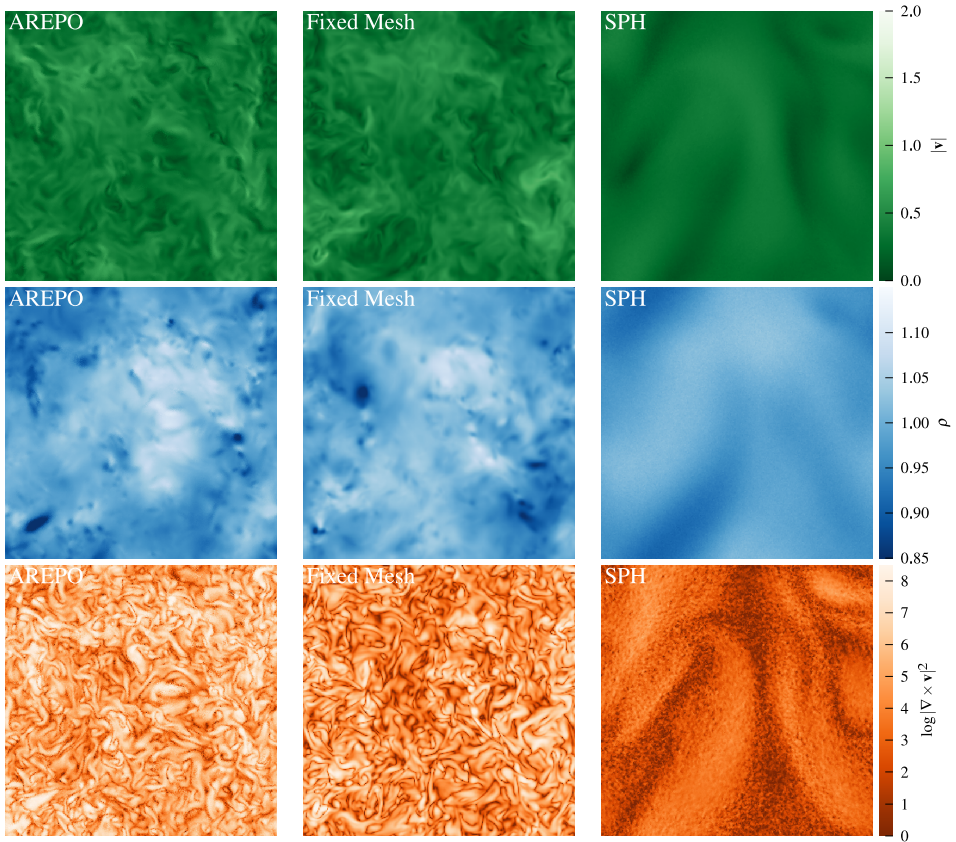
Smoothed Particle Hydrodynamics (SPH) is one of the most commonly used techniques for simulating astrophysical fluids. This particular paper focuses on a regime of gas dynamics that is often neglected in astronomy: subsonic turbulence. Just as the air in the upper atmosphere exhibits random motions that can buffet an airplane cabin, the gas in interstellar space also exhibits random, turbulent motions.