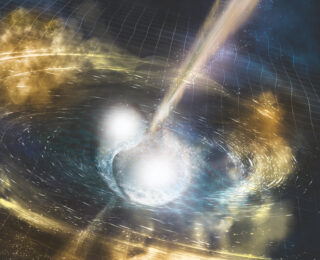
This just in: Multi-messenger merger made meticulously on massive supercomputer!
In this Astrobite, the authors study the incredible physics of a binary neutron star merger by performing the longest ever simulation on a supercomputer!

In this Astrobite, the authors study the incredible physics of a binary neutron star merger by performing the longest ever simulation on a supercomputer!
Today we interview Dr. Stella Offner, who is a professor at the University of Texas at Austin and one of this year’s #AAS245 Plenary speakers!
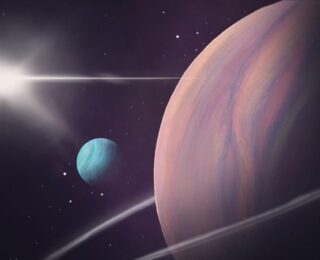
Every exomoon deserves the chance to fly!
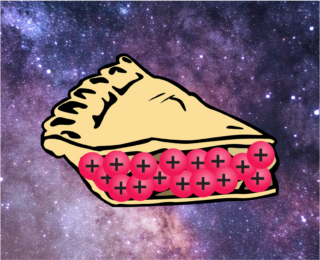
Proton ingestion events in AGB stars are thought to trigger i-process nucleosynthesis. Today’s authors construct detailed stellar models to investigate this phenomenon!
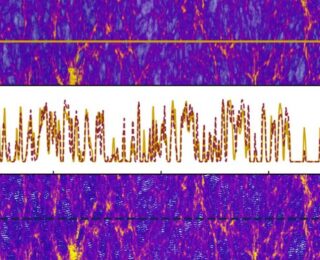
In today’s astrobite, we examine an application of machine learning in astronomy that may enable new breakthroughs in simulations of large scale structure.
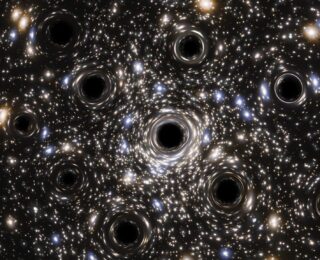
In today’s Astrobite, the authors create a mock massive black hole data set to test whether their LISA analysis pipeline can recover their mock data.