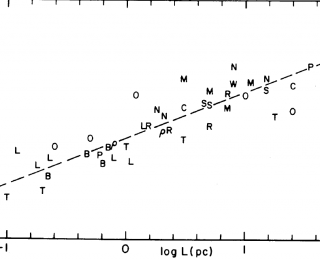
Astrophysical Classics: Larson’s “Laws”
This paper presents three famous relations very important for understanding the inner workings of molecular clouds and star formation processes.

This paper presents three famous relations very important for understanding the inner workings of molecular clouds and star formation processes.
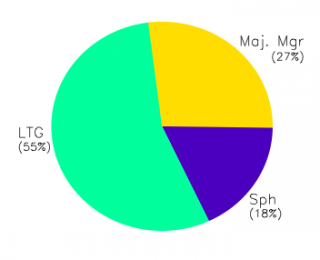
In this study, Kaviraj et al. find that major mergers only contribute a small percentage (17-27%) of the total star formation at a redshift of 2, when the Universe was 3.3 billion years old and vigorously creating new stars. This goes against what we once thought, and leaves the door open for other mechanisms to drive the global star formation rate in the early Universe.
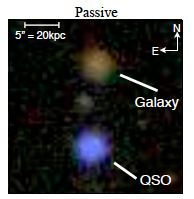
Astronomers often refer to elliptical galaxies as “red and dead” because they appear red in color and aren’t currently forming stars. In this paper, the authors present evidence that elliptical galaxies might not be as dead as we assume.
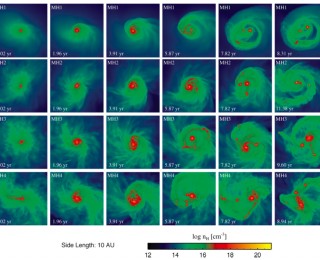
In a recent paper, Stacy et al. reveal the detailed internal structure of the seeds of four of the first stars, and demonstrate for the first time that they are rapidly spinning throughout. Their results bring us one step closer to a coherent story of the lives and deaths of Population III stars.
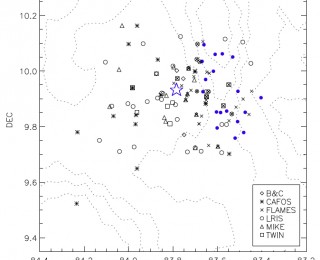
A wealth of observations tell an active accretion story within the Lambda Orionis Star Forming Region, at the head of the Orion constellation.
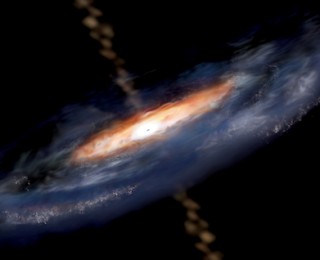
Active galactic nuclei are some of the most luminous objects in the universe. This paper explores how feedback from AGN could trigger star formation in their host galaxies.