by Elisabeth Newton | Mar 14, 2012 | Daily Paper Summaries
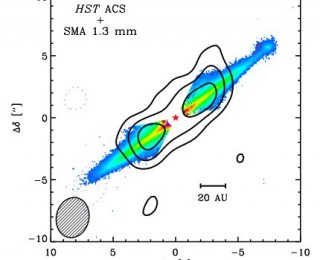
AU Mic is a low mass star that undergoes unpredictable brightening events, called flares. It’s located just 10pc and has a circumstellar disk. In this paper, Wilner et al. report on observations of the disk at millimeter wavelengths and find evidence for a planetesimal ring.
by Shannon Hall | Mar 12, 2012 | Daily Paper Summaries
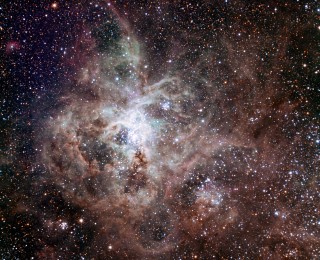
This paper discusses the propagation characteristics of cosmic-ray electrons and nuclei in 30 Doradus as well as the Large Magellanic Cloud. Two major correlations are found. For 30 Doradus there is a correlation between the radio and infrared emission. For the LMC there is a link between the cosmic ray electron propagation length with the star formation rate.
by Nathan Goldbaum | Feb 21, 2012 | Daily Paper Summaries
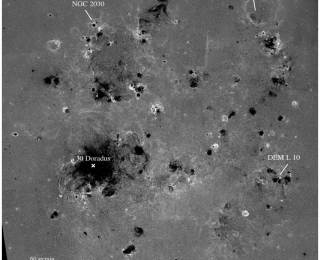
Title: The Optical Depth of H II regions in The Magellanic Clouds Authors: E. W. Pellegrini, M. S. Oey, P. F. Winkler, S. D. Points, R. C. Smith First Author’s Institution: Department of Astronomy, University of MichiganIt’s a common theme on astrobites that massive stars play a far more important role in galaxy evolution than one might casually assume based on their numbers alone. One of the main reasons massive stars are so important is their copious production of radiation that can ionize hydrogen gas. These energetic photons can photoionize and photodissociate atomic and molecular gas, creating hot, ionized gas that will not collapse to form new generations of stars. The hot, overpressured gas created by ionization, which astronomers refer to as an H II region, drives an ionization front capable of sweeping up and stirring gas throughout a star forming region. For particularly massive star clusters, which may contain hundreds or thousands of massive stars, the ionized region surrounding the central cluster, can extend for many hundreds of parsecs, visible to us as beautiful nebulae, like the 30 doradus star forming region in the Large Magellanic Cloud (at right). Massive clusters can also directly ionize intergalactic space, producing the diffuse ionized IGM that we know has been in place since the universe was about a billion years old. Today’s astrobite takes a close look at our nearest galactic neighbors, using a novel technique to infer the state of ionized gas and ionizing photons the Magellanic Clouds.Pellegrini and collaborators make use of imaging of the Magellanic clouds in narrowband filters centered on two emission lines of oxygen and sulfur. These particular emission lines are produced when...
by Elisabeth Newton | Feb 15, 2012 | Daily Paper Summaries
The basis for something called the “G dwarf problem” is the comparison between observations and a simple model for chemical evolution in a galaxy. To cut to the chase, there are fewer very metal poor G dwarfs than are predicted by this basic understanding. This discrepancy has been shown to hold for the Milky Way as well as for other galaxies. It also holds for K dwarfs in the Milky Way – and now for M dwarfs as well.
by Michelle Kislak | Feb 15, 2012 | Daily Paper Summaries
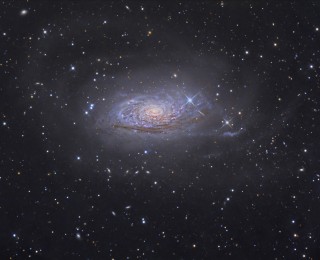
A picture of galaxy construction emerges by comparing the relative sizes of star-formation and stellar continuum emission from 57 z=1 galaxies.
by Kim Phifer | Feb 14, 2012 | Daily Paper Summaries
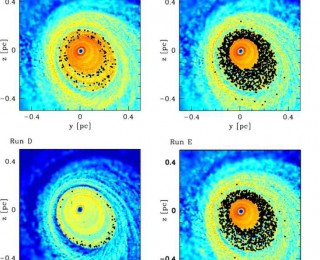
The Center of our Galaxy is one of the most extreme dynamical environments we can observe in detail because individual stars can actually be resolved using adaptive optics. Over time, monitoring individual stellar orbits has firmly established the presence of a supermassive black hole of about 4 x 10⁶ M☉ (check out this video too). Further examination of these fast-moving stars’ properties (via infrared spectroscopy) revealed a surprising detail — many of these stars are young!
