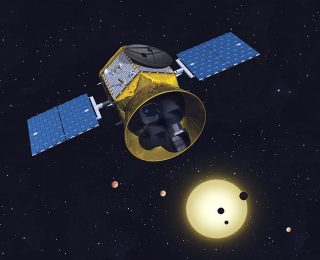
TESS Spies, with its Little Eye, Something Multi-planetary
TESS spots the brightest multi-planet host yet (not including the Sun)!

TESS spots the brightest multi-planet host yet (not including the Sun)!
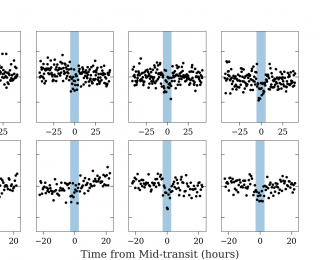
Statistical confirmation of long-period, low SNR candidates should be taken with a grain of salt. The reliability is too low to confirm individual systems without followup observations and the 99% confidence validation of Kepler-452b is likely closer to 90%.

Using a laser we can carefully edit the telltale signs of the Earth’s presence, hiding ourselves away or announcing our presence to other life in the universe. But doing so may be fraught with unknowable consequences that we can never undo. Maybe it’s best to just stay behind the galactic sofa.
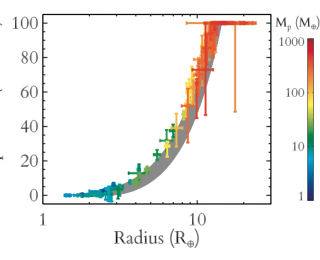
Planetary radius is found to depend strongly on planet composition. The observed planet radius distribution can be recast as a composition distribution, with implications for the way planets form.
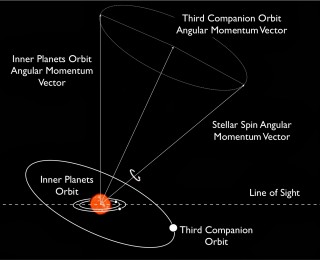
Our Solar System is pretty straightforward. Roughly speaking, all the planets orbit in the same plane, most spin on their axes in the same direction in that plane, and even the Sun rotates in a manner consistent with all this. The small, rocky planets are closer to the Sun, and the big, gaseous planets are farther from the Sun. Simple. Now that we are finding planets orbiting other stars, many are turning out to be multiplanet systems like our own Solar System.
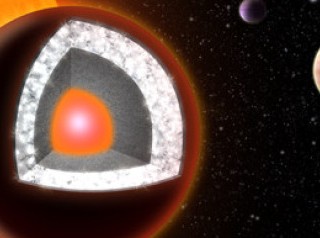
A team of astronomers and geologists have teamed up to study the composition of a rocky super-Earth which likely contains a layer of carbon in the form of diamond and graphite.