• RSS
  • Submit a Guest Post
  • Undergraduates: Submit your Research!
  • Suggest a Paper Topic!
astrobites
  • About
    • About Astrobites
    • Meet the Authors
    • Statement of Inclusivity
    • Copyright & Permissions
  • Latest Research
    • Daily Paper Summaries
    • Classics
    • Undergrad Research
    • Physical Review Coverage
  • Beyond astro-ph
    • Beyond astro-ph Library
    • Interviews
    • Career Navigation
    • Personal Experiences
    • Current Events
    • Teaching with Astrobites
  • Guides
    • EM Spectrum
    • Galaxies & AGNs
    • Spectroscopy and Spectral Lines
    • Adaptive Optics
    • Gravitational Waves
    • Transient Astronomy
    • Astrophysical Software
    • Graduate School
    • Writing a personal statement for grad apps
    • First Observing Run
    • …More Guides!
Select Page
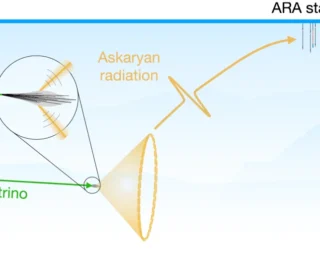
High-energy particles make radio signals in ice

High-energy particles make radio signals in ice

by Julie Kiel Holm | May 30, 2026 | Daily Paper Summaries, PRJ

Ultrahigh-energy neutrinos can be our gateway to studying some of the Universe’s most energetic but least understood phenomena. Today’s paper presents a proof-of-concept for a new, promising way to detect these ultrahigh-energy particles.

Looking at Ultrahigh-Energy Cosmic Rays From Many Angles (Specifically, 0 ≤ θ ≤ 80° and -90° ≤ δ ≤ 44.8°)

Looking at Ultrahigh-Energy Cosmic Rays From Many Angles (Specifically, 0 ≤ θ ≤ 80° and -90° ≤ δ ≤ 44.8°)

by Sarah Stevenson | Mar 21, 2026 | Daily Paper Summaries, PRJ

If you have a cosmic mystery on your hands, surely it helps to examine it from as many angles as possible? Today’s authors do that, literally, while investigating the highest-energy particles in the universe.

Hiding in the Shadows: The KM3NeT Search for the Sun and Moon

Hiding in the Shadows: The KM3NeT Search for the Sun and Moon

by Isha Loudon | Mar 16, 2026 | Daily Paper Summaries

It’s looking a little (cosmic) rainy today! And the KM3NeT collaboration make the most of the muon downpour, testing for the presence of some familiar celestial bodies in their data.
A tale of two toy models: towards understanding the geometry of cosmic rays in the Milky Way

A tale of two toy models: towards understanding the geometry of cosmic rays in the Milky Way

by Caroline von Raesfeld | Jan 10, 2026 | Daily Paper Summaries, PRJ

Today’s astrobite looks at how we can use observations of gamma-rays and neutrinos to test our models of cosmic rays.
What doesn’t kill them makes them (marine microplankton) stronger

What doesn’t kill them makes them (marine microplankton) stronger

by Ryan White | Oct 15, 2025 | Daily Paper Summaries

As the Sun bobs its head above and below the Galactic plane, the Earth’s marine microplankton flock in crowds to see the beautiful view.
KM3-230213A is looking for its cosmic-ray parent

KM3-230213A is looking for its cosmic-ray parent

by Guest | Sep 3, 2025 | Daily Paper Summaries

How do you produce ultra-high-energy neutrinos like KM3-230213A? Guest author Domenik Ehlert explains how cosmic rays may be behind it!

« Older Entries

Loading

Follow our socials

  • Bluesky
  • Facebook
  • Instagram
  • RSS Feed

More Posts About

AAS AGN astronomy astrophysics binary stars black holes cosmology dark matter dwarf galaxies exoplanets galaxies galaxy evolution gravitational waves habitability JWST Kepler Milky Way observations planetary science planet formation protoplanetary disks radio astronomy simulations solar system spectroscopy star formation stars stellar evolution supernovae theory

Posts by Category

  • Accessibility
  • Applications
  • Beyond
  • Book Reviews
  • Career Navigation
  • Classics
  • Climate Change
  • Course Assignments
  • Crossposts
  • Current Events
  • Daily Paper Summaries
  • Game Reviews
  • Guides
  • Historical Astronomy
  • Instrumentation
  • Interviews
  • Outreach
  • Personal Experiences
  • PRJ
  • Quick Notes
  • Satellites
  • Teaching
  • Undergraduate Research

More Astronomy

  • AAS
  • AAS Nova
  • astro-ph
  • AstroBetter
  • APOD

Read Astrobites in Other Languages

  • Astrobitos (Spanish)
  • Astropontos (Portuguese)
  • staryab (Farsi)

Listen to Astrobites

  • astro[sound]bites

Discover More Incredible Science

  • ScienceBites Network
  • RSS

© 2026 Astrobites | All Rights Reserved | Supported by AAS | Designed by Elegant Themes | Powered by WordPress