
Title: Observation of In-Ice Askaryan Radiation from High-Energy Cosmic Rays
Authors: N. Alden, S. Ali, P. Allison, S. Archambault, J. J. Beatty, D. Z. Besson, A. Bishop, P. Chen, Y. C. Chen et al. (ARA Collaboration)
First Author’s Institution: Dept. of Physics, Dept. of Astronomy and Astrophysics, Enrico Fermi Institute, Kavli Institute for Cosmological Physics, University of Chicago, Chicago, IL 60637
Status: Published in Physical Review Letters [closed access]
Ultrahigh-energy neutrinos can be our gateway to studying some of the Universe’s most energetic but least understood phenomena. But their rarity and reluctance to interact with other particles make detecting them a steep challenge. Today’s paper presents a proof-of-concept for a new, promising way to pry cosmic secrets from these ultrahigh-energy particles.
Detecting high-energy neutrinos
When a charged particle in some medium travels faster than the speed of light in that medium1, it creates the electromagnetic equivalent of a sonic boom, called Cherenkov radiation. It consists of photons of all wavelengths, but with higher intensity in the high-frequency (blue and UV) end of the spectrum.
This is what happens when a high-energy particle from space hits a water molecule in the Antarctic ice. The triggering particle can be a neutrino or a cosmic ray, which is an atomic nucleus (often just a proton) that has been accelerated to very high energies somewhere and flung towards the Earth. The particle’s interaction with the ice causes an explosive shower of new, lower-but-still-high-energy particles that continue through the ice. The incoming high-energy particle, even with a mass as low as a neutrino, packs a punch so large that the resulting shower particles initially travel faster than the speed of light in the ice, producing Cherenkov radiation.
High-energy neutrino detection is a serious game, and the heavyweights, IceCube and KM3NeT, are both optical detectors, meaning that they register the optical Cherenkov light that is produced in the water or ice in which the detector is submerged. The downside to this is that optical light doesn’t travel very far in these media, and the detector has to be within the reach of the optical photons to detect an interaction. The IceCube detector covers about a cubic kilometre of ice, which is enough to spot regular high-energy neutrinos. But the more energetic the neutrino, the more unlikely an interaction is, and the larger a volume you need in order to have a realistic chance of seeing it happen. And for the ultrahigh-energy neutrinos, the likelihood of them interacting with one atom in IceCube’s trillion litres of ice is negligible. We’re gonna need a bigger boat.
Askaryan Radiation
While water-ice stops optical photons over short distances, it is transparent to radio waves. This means that a radio detector is sensitive to emissions from interactions many kilometres away, so a few detectors can cover a huge volume of ice. And luckily, ultrahigh-energy neutrinos have a way of creating radio waves!
When a high-energy particle interacts with an ice atom, it produces a whole shower of particles, each of which emits its own Cherenkov radiation across all wavelengths. The particles, which are mainly electrons, positrons, and photons, move together in a narrow clump with a length of a few centimetres. The high-energy photons knock electrons loose in the ice molecules, adding negatively charged particles to the shower, while the positrons annihilate with electrons from the ice, removing positive charge from the shower. These two effects cause the clump of particles to have a net negative charge.
This means that, on large scales, the particles behave coherently as one giant negatively charged particle. For Cherenkov waves with wavelengths much longer than the size of the clump (few cm, meaning microwaves and radio waves), the small differences in individual positions of the particles are negligible, and their radiation adds together, interfering constructively to form one large radio wave. The power of this wave increases with the number of particles squared, so even if the Cherenkov spectrum of the individual particles is weak in the radio, the combined signal of the whole shower becomes large enough to measure. This effect, named after Gurgen Askaryan, who came up with the theory, is what the Askaryan Radio Array (ARA) aims to detect.
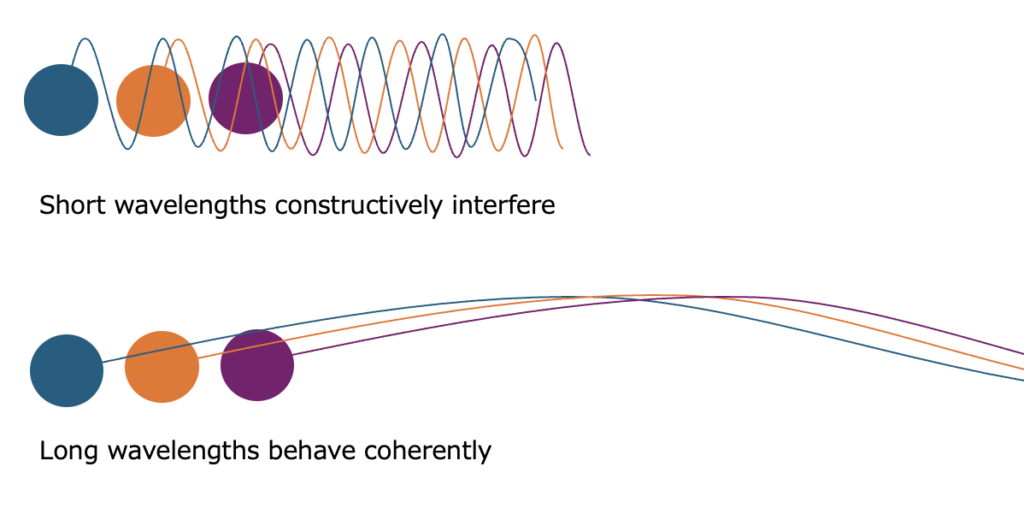
Figure 1. Illustration of the Askaryan effect. When multiple particles emit similar radiation, the electromagnetic waves will interfere with each other. For short waves, the distance between the particles means that the waves are out of phase and interfere destructively. In contrast, the phase shift is negligible relative to the longer waves, so they interfere constructively.
What’s actually in the paper
The ARA currently consists of 5 radio detector stations, buried 150-200 m in the Antarctic ice roughly 2 km apart. Each detector has 16 radio antennae, polarised horizontally or vertically. The station that produced the data for today’s paper also has a compact array of 7 horizontally polarised antennae in the middle. These allow for a much more detailed triggering system, reducing contamination from background radiation.
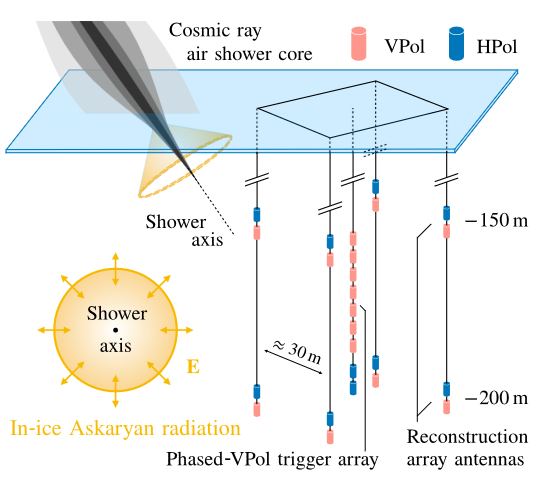
Figure 2. A schematic of the ARA observatory. The red VPol cylinders mark the vertically polarised antennae, and the blue HPol are horizontally polarised. In the centre, they show the additional trigger array. This is Figure 1 in today’s paper.
The problem with radio signals is that so many things produce them. The nearby science station, any vehicles in the vicinity, aeroplane radars, even the snow blowing across the icy surface can produce a radio signal detectable by the ARA antennae, muddying the data. The challenge therefore becomes separating the wheat from the chaff, which requires detailed modelling and heavy statistics.
Back in 2019, using only one of the antennae, the ARA recorded 13 candidate high-energy particle events, which is what the collaboration has analysed in today’s paper. The energy of such events is estimated to be of the order 10^17 eV, which is about what you get dropping a ping-pong ball from as high as you can reach. KM3NeT recently detected a single neutrino of that energy magnitude (we wrote a Bite about it), but that’s the only one we’ve seen above a few PeV (10^15 eV) with either KM3NeT or IceCube. The hope is that radio detectors like ARA will detect neutrinos with energies above an EeV (10^18 eV). While neutrinos of this energy are still only theoretical, we have detected cosmic rays with energies as large as 10^20 eV (there’s a Bite about it). This is equivalent to a hard serve in tennis – all carried by a single, subatomic particle. Woosh.
The authors of today’s paper carefully model everything including event rate, radiation arrival directions, signal shape, spectral information, electric field polarisation, and angular radiation pattern. They are able to say that the signals are not background with a statistical certainty of 5.1 sigma (corresponding to a probability of this event being background noise less than 1 in 3.5 million).
They can also tell that all 13 events are likely from cosmic rays rather than neutrinos. This is because cosmic rays, being much more likely to interact with the ice, only penetrate a few meters into the ground before setting off the particle shower. Neutrinos will reach much further before interacting and can trigger a shower from anywhere in the ice. The team can tell from the arrival directions that all 13 events arise in the top of the ice sheet, making them probable cosmic rays.
The radio detection of an ultrahigh-energy neutrino would make a greater splash (and is the grand goal of the ARA), but this statistically significant detection of cosmic rays through their in-ice Askaryan radiation is solid proof that the method works. There is a new, much larger data release on the way, which the collaboration expects will contain more than a hundred similar events – and, if the stars align, a handful of ultrahigh-energy neutrinos from distant cosmic accelerators.
Astrobite edited by Joe Williams
Featured image credit: P. Windischhofer/University of Chicago
- Nothing can travel faster than light in vacuum. Faster-than-light travel is allowed in other media, like water, where the photons move slower than they would in vacuum. ↩︎
