by Kim Phifer | Oct 23, 2011 | Daily Paper Summaries
Astronomers study light, but as it turns out, not all objects that we are interested in are observable in any part of the electromagnetic spectrum. In cases such as these, we have to turn to indirect detection methods.
by Susanna Kohler | Oct 23, 2011 | Daily Paper Summaries
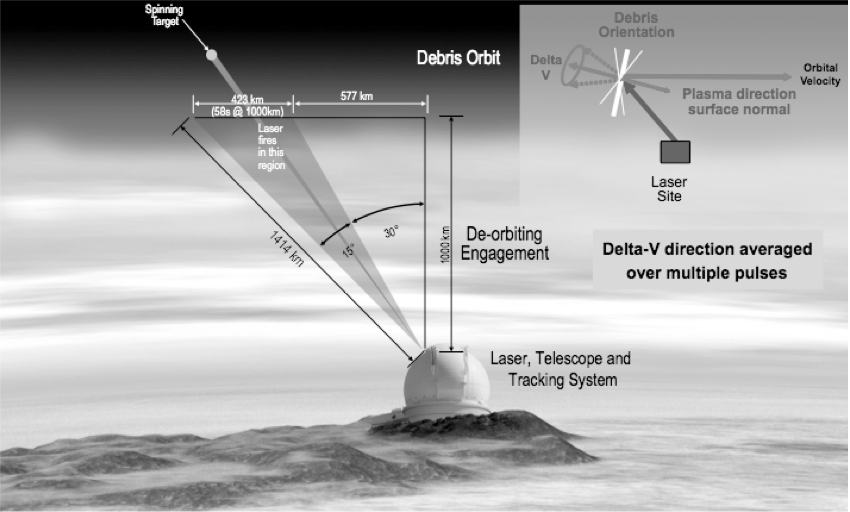
The authors of this paper figure out the most effective way to shoot lasers at space junk. I am clearly in the wrong field of research.
by Ian Czekala | Oct 20, 2011 | Daily Paper Summaries
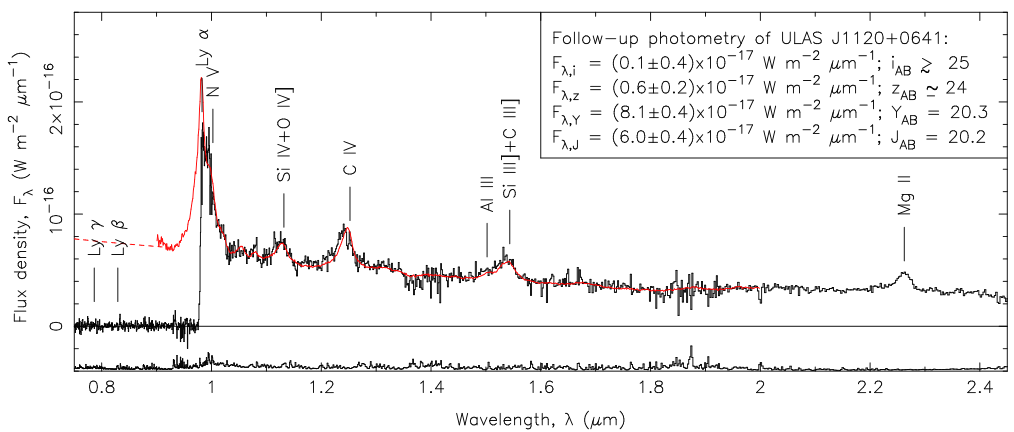
While high-redshift quasars are very interesting objects in their own right, their incredible luminosities allow them to act as background light sources that illuminate the intervening universe on our line of sight. One could think of quasars as giant flashlights that the universe uses to make really interesting spectroscopic shadow puppets back here on Earth.
by Maria Drout | Oct 19, 2011 | Daily Paper Summaries
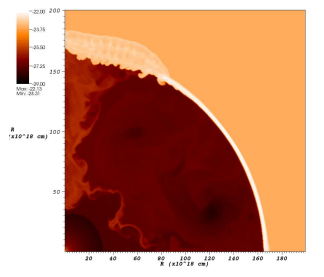
How can the medium immediately surrounding massive stars affect our observations of Gamma-Ray Bursts?

by Sukrit Ranjan | Oct 19, 2011 | Daily Paper Summaries
• Paper title: Modeling the Infrared Spectrum of the Earth-Moon System: Implications for the Detection and Characterization of Earthlike Extrasolar Planets and their Moonlike Companions (arXiv:1110.3744v1) • Authors: Tyler D. Robinson • First Author’s Affiliation: University of WashingtonIntroduction The holy grail of exoplanet scientists is the detection and characterization of a true Earth-analog, an “Earth-twin” orbiting another star. A number of great studies have been done towards this goal; see for example the EPOXI mission, which turned the sensors on Deep Impact back towards Earth to see what we could learn about its atmosphere from remote observation alone. Yet many of these studies consider the Earth in isolation. They ignore the fact that we have a very significant companion in the form of the Moon. Given how close the Earth and Moon orbit, it is unlikely that any exoplanet characterization mission we can envision will be able to resolve an Earth-Moon system analog (the Earth-Moon separation would be 5 milliarcseconds at just 5 parsecs). Therefore, any spectra we take of a terrestrial planet would likely include flux from unseen companions. Recent planet formation modelling suggests that impacts of the kind that formed the Moon may be common. What would be the effect of a lunar companion on measured atmospheric spectra, and how might we ascertain the existence of such a companion? This article explored these questions.MethodThis paper builds on previous work that looked for the effect of a lunar body on an Earth-analog in a bolometric (i.e. total luminosity) sense, which found that the orbiting body needed to be Mars-sized in order to be detectable through broadband photometry. In...
