by Chris Faesi | Dec 23, 2011 | Daily Paper Summaries
The LOFAR low-frequency radio interferometer is poised to make exciting discoveries in transient searches, high-energy astrophysics, and cosmology.
by Maria Drout | Dec 22, 2011 | Guides
An overview of how astronomers identify and interpret light echoes.
by Kim Phifer | Dec 21, 2011 | Daily Paper Summaries
N. Prantzos investigates whether the bulk of Galactic cosmic rays can be accounted for by supernovae remnants
by Michelle Kislak | Dec 21, 2011 | Daily Paper Summaries
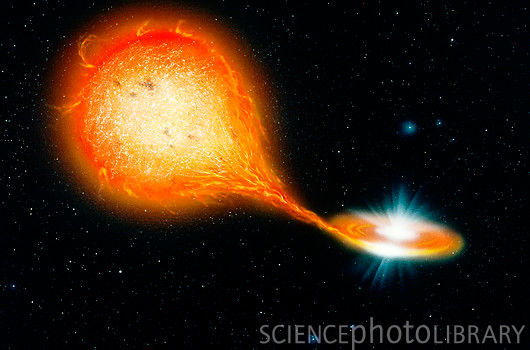
Pre-explosion imaging of supernova SN2011fe sheds light on the question of type Ia supernova progenitors.
by Sukrit Ranjan | Dec 21, 2011 | Current Events, Daily Paper Summaries
• Paper title: EChO: The Exoplanet Characterization Observatory (arXiv: 1112.2728)• Authors: G. Tinetti et al• First Author’s Affiliation: University College London, London, UK.• Journal: Accepted for Experimental AstronomyOverviewThis paper describes a proposed ESA M-class mission , the 1.5-meter Exoplanet Characterization Observatory (EChO).The idea behind EChO is simple: to provide a dedicated platform for exoplanet characterization, i.e. to figure out what’s in the atmospheres of planets around other stars. Missions like Kepler do a great job at finding extrasolar planets and at estimating their sizes. Most of these worlds can be massed as well, using techniques like radial velocities and transit timing variations. These are fantastic measurements that let us build up a broad picture of the exoplanetary population. However, as Figure 1 shows, mass and radius alone tell us almost nothing about what might be in a planet’s atmosphere, and what conditions on the surface (if it even has one) are like. Understanding atmospheric and surface composition is critical to a complete theory of the formation, evolution and dynamics of planets, as well as in determining whether or not they might be habitable. For example, Earth and Venus share similar masses and radii, but life as we know it would be hard-pressed to exist on the lead-melting surface of Venus!Spectroscopy allows us to break this degeneracy and directly characterize exoplanets. By looking for the spectral imprint of different substances, we can figure out the composition of the atmosphere as well as its temperature structure (if a feature is observed in absorption, then that substance is hotter deeper in the atmosphere; if in emission, then the opposite is true).EChO proposes...
