
Title: KiDS-Legacy: Cosmological constraints from cosmic shear with the complete Kilo-Degree Survey
Authors: The KiDS Collaboration, Angus Wright et al
First author institution: Ruhr University Bochum, Faculty of Physics and Astronomy,
Astronomical Institute (AIRUB), German Centre for Cosmological Lensing, Bochum, Germany
Status: Available on ArXiv, submitted to Astronomy & Astrophysics
The KiDS survey (the Kilo-Degree Survey) is a weak lensing survey being conducted on the VST Survey Telescope in Paranal, Chile on a special camera called OmegaCAM that images galaxies. This survey started back in 2011, with data collected until 2019. Today’s bite summarizes the KiDS fifth and final data release, KiDS Legacy – you can also see a nice discussion of the results by cosmology talks on youtube.
This survey specially uses the small distortions in the shapes of galaxies in the sky that are caused by gravity bending and deflecting light on its path to us, which is known as weak lensing. Because these distortions occur due to matter deflecting light on the path to a telescope (illustrated in Figure 1), measuring weak lensing can provide a test of General Relativity (the currently accepted model of gravity) and the amount of normal matter and dark matter in the Universe, allowing us to test cosmological models like the concordance ΛCDM model.
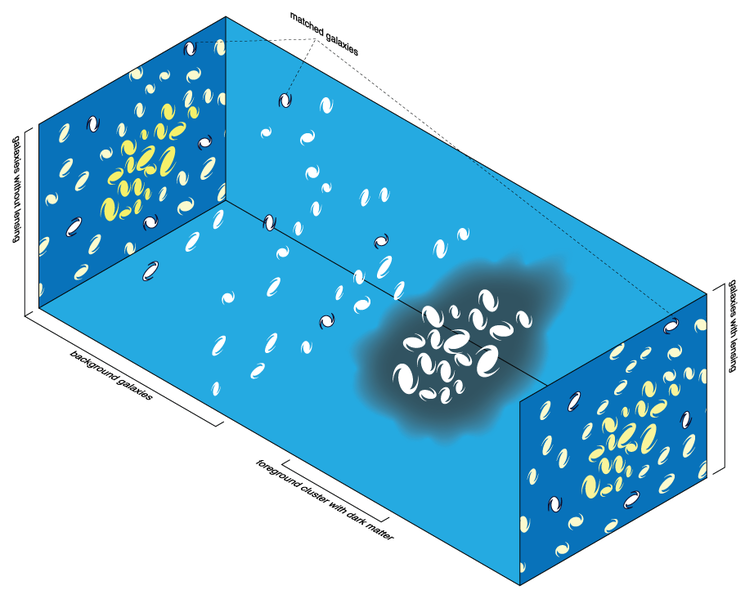
Galaxies have elliptical shapes, but weak lensing, also known as shear, can change these shapes. Shear can change the apparent angular size of an ellipse and also distort and bend it, changing its angular orientation. Since these distortions are small, cosmologists average over galaxy ellipticities to measure shear. However, galaxies also have intrinsic alignments, which are correlations in their orientations and shapes due to tidal gravitational forces. These intrinsic alignments mimic shear and thus contaminate the shear signal, so it must be included in the modelling of the galaxy ellipticities and separated from the shear signal of interest.
Measuring the shear signal
To measure shear, cosmologists measure the correlations in the ellipticities of pairs of galaxies separated by different angles in the sky, or a correlation function. This function contains information about the excess probability of seeing two galaxies aligned in the sky at a particular separation, due to both intrinsic alignment and the shear signal. The intrinsic alignment is modelled and inferred jointly with the shear signal, but they are later separated to use the shear signal for testing cosmology.
Interestingly, cosmologists have to model two separate correlation functions of the ellipticities, because just one doesn’t quite capture all the information in the field; they measure a ‘tangential’ component which is sensitive to a kind of pattern called E-modes and a ‘cross’ component which is more sensitive to a pattern called B-modes (which we shouldn’t really see, but you can see these modes illustrated in Figure 2 of this bite). The tangential component is the part that has the interesting shear signal, as weak lensing creates E-modes.
The correlation function for the shear signal can be related to a cosmological model, allowing us to infer a best fit model. Cosmological models depend on various parameters, including the energy density of matter (both the normal and dark matter) in the Universe, called \(\Omega_{m}\), and also how matter fluctuations are distributed on different scales. The shear signal is especially useful for constraining \(\Omega_{m}\), as well as something called \(\sigma_8\), a parameter that denotes the typical variation in matter fluctuations in a spherical volume with radius of \(\sim 8\) Mpc \(h^{-1}\) (this number of 8 was chosen for historical reasons and has stuck, the \(h\) is just a scaling to remove the dependence on a separate cosmological parameter here) – but you can just think \(\sigma_8\), of as the typical ‘clumpiness’ of the Universe.
The KiDS team use KiDS Legacy, which covers 967.4 square degrees in the sky after applying a mask to correct for systematics in the data, combined with data from a survey called VIKING taken on the VISTA telescope focusing on the same area of the sky but in a different range of wavelengths. The data is divided into 6 bins of different depths (essentially the galaxies’ distance away, which one can tell from a galaxy redshift). Since the redshifts for many galaxies have been measured with a method that can have a lot of uncertainty, they are calibrated with another dataset called KiDZ that has measured redshifts of fewer galaxies but using a very accurate method to measure redshifts. A neural network is used to calibrate the redshifts from KiDS with the accurate redshifts from KiDZ. Furthermore, an approach called blinding is used to improve the analysis by removing human bias. Systematic changes are deliberately added to the data and the analysis has been first performed on this blinded data to check everything looks like its working correctly, before it is applied to the real unblinded data. This prevents bias that may arise due to human expectation for a particular result.
Results
One interesting thing about the results here is that in the past, there has been a mismatch between measurements of \(\sigma_8\), particularly between datasets that probe the Universe at earlier times (such as the Cosmic Microwave Background, CMB) vs later times; this mismatch is known as the ‘\(\sigma_8\) tension’. For some time, cosmologists have been trying to understand if this is due to ‘new physics’ (meaning we need an updated model from ΛCDM) or due to complicated measurement systematics. However the new shear measurements target the late Universe, and seem to agree pretty well with CMB data, as seen in Figure 2.

The authors conducted a thorough analysis of the robustness of the best fits for each parameter by making various changes to steps in the analysis pipeline and reporting the best fit after applying each change. In each case the measurements are still consistent with the main presented result, suggesting a robust pipeline. Compared to a previous release of the KiDS data, the measured value of \(\Sigma_8\) is in less tension with the CMB expectation, and the authors attribute this partly to improvements in the pipeline, and partly to the reduced statistical uncertainty in the measurement with additional data.
It is certainly interesting to see that the data from KiDS seems to suggest the \(\sigma_8\) (or equivalently \(\Sigma_8\)) tension may become less of a concern for cosmologists, especially if a trend showing agreement in measurements from the CMB and late Universe probes like KiDS continues. We can look forward to upcoming data from surveys such as Euclid which will also conduct weak lensing (amongst collecting other data) to test this further.
Edited by: Cesiley King
Featured image credit: ESO’s VLT observatory at Paranal. ESO/Y. Beletsky, CC BY 4.0 <https://creativecommons.org/licenses/by/4.0>, via Wikimedia Commons
