
Authors: Yuzo Ishikawa, Nadia L. Zakamska, Yue Shen, Xin Liu, Yu-Ching Chen, Hsiang-Chih Hwang, Andrey Vayner, Sylvain Veilleux, David S. N. Rupke, Dominika Wylezalek, Arran C. Gross, Swetha Sankar, Nadiia Diachenko
First Author’s Institution: Department of Physics and Astronomy, Johns Hopkins University, Baltimore, MD 21218, USA
Status: Published in The Astrophysical Journal (open access)

Binary supermassive black holes (SMBH) are an interesting phenomenon, with implications for galaxy evolution and gravitational wave observations. It is thought that these SMBH pairs most often arise from galaxy mergers, during which gas accretion can spark Active Galactic Nucleus (AGN) activity. Today’s paper analyzes James Webb Space Telescope observations of one particular pair of quasars (a type of AGN), with the lovely poetic name of J0749+2255. As shown in Figure 1, these quasars (observed at a redshift of 2.17) are quite close together, separated by only 3.8 kiloparsecs. They find the southwest quasar is about 3 times brighter than its partner in the northeast, but the real interesting stuff is found in the spectral analysis.
Seeing Double?

Figure 2 shows the spectra for the SW and NE quasars, and the first thing that is impossible to ignore is just how similar they are. There are some small differences, for example the NE quasar is slightly redder than the SW, and some emission lines have different shapes and are a smidge offset from each other. But the general similarity brings up the possibility that what we’re looking at isn’t two separate quasars, but rather one object that’s being gravitationally lensed! The small differences in the spectra could be consistent with a lensing scenario, as they could be explained by time delays in the lensing or foreground contaminations. A major problem with this idea, however, is that no observations of this system have provided evidence for a lens: we have not seen the massive foreground object that would actually be causing the gravitational lensing. While it’s possible that the lens is just incredibly faint, there’s no smoking gun for lensing happening here.
Disk Gas Enters the Chat
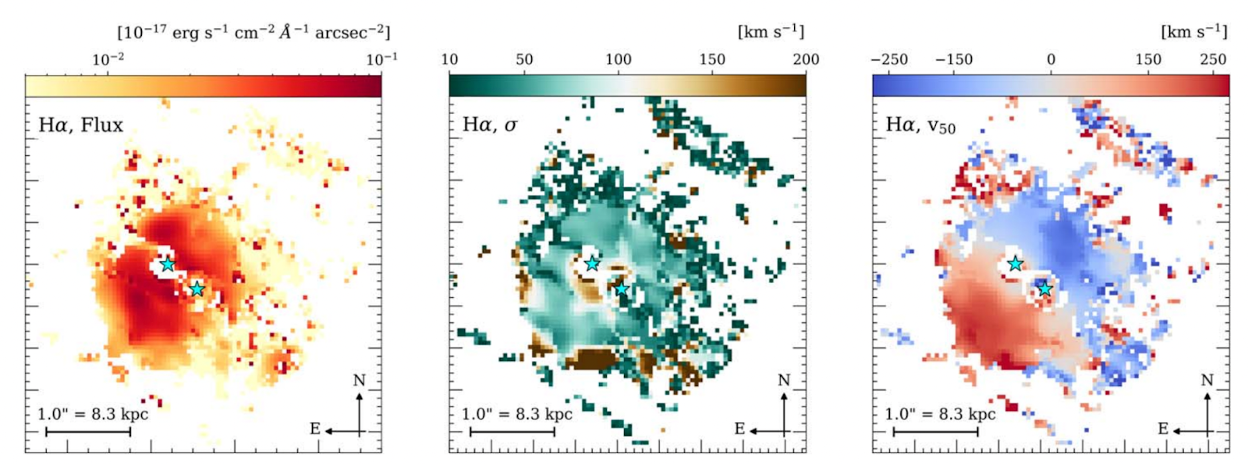
The story becomes even more complicated when you look beyond the quasars, as JWST observations also detected diffuse emission from gas as shown in Figure 3. This gas is at the same redshift as the quasars, and can thus be associated with their host galaxy. And crucially, this gas doesn’t show any signs of lensing, such as the distinct arcs or symmetry you find in other lensed systems. This, coupled with the differences in the quasar spectra, suggests that this is not a lensed system, and that in fact we are looking at two different quasars.
But even within this model there are mysteries afoot! It’s generally thought that dual quasar systems are found in galaxy mergers, and there is some evidence that we’re seeing that here. The region labeled T1 in Figure 1 is one-such piece of evidence, thought to be a tidal tail formed by gravitational disruptions during a merger event. It’s also generally thought that mergers provide a key way to trigger AGN activity, where the two SMBHs of the merging galaxies become fed by the same gas reservoir. This could explain why the two quasars in J0749+2255 are so similar, as they may have undergone very similar accretion histories.
However, this story is complicated by the dynamics within the gas surrounding the quasars. As shown in the rightmost panel of Figure 3, the quasars are embedded in a gas disk that’s rotating, with one half of the gas being redshifted and the other half blue shifted. The quasars aren’t separated into these two regions, but are rather both found at the center of the disk. And the gas is showing none of the kinematic disturbance we would expect during a major merger, as the disk seems to be relatively stable. So maybe we’re not witnessing a merger-in-progress, but rather a disk galaxy that is playing host to two quasars! Based on simulations, one way this could happen is if a major merger takes place at an earlier time, and two black holes form from the resulting instabilities. This is another possible explanation for why the quasars are so similar.
Overall, this work points to the complicated nature of dual quasar systems. Is this one quasar being lensed or two different quasars? If they are distinct objects, are we witnessing a merger of galaxies, or did they both form in one galaxy? Future observations may be the key to answering these questions, but for now it remains a very interesting system.
Astrobite edited by Hillary Andales
Featured image credit: SPSS (note, the image is a different dual AGN system than the one explored in this study.)

Another oddity is that the axis of rotation of the gas disk appears to be coincident with the line between the two AGN’s, as shown in this article’s Fig.3. If the two AGN’s are in fact orbiting each other, it seems highly unlikely that the orbital axis is aligned with the gas disk axis.