
Title: Hypervelocity Stars Trace a Supermassive Black Hole in the Large Magellanic Cloud
Authors: Jiwon Jesse Han, Kareem El-Badry, Scott Lucchini, Lars Hernquist, Warren Brown, Nico Garavito-Camargo, Charlie Conroy, Re’em Sari
First Author’s Institution: Harvard-Smithsonian Center for Astrophysics, Cambridge, MA, USA
Status: Published in the Astrophysical Journal [open access]
In 2005, a team of Smithsonian astronomers discovered something unusual: a star moving so fast that it was no longer bound by the Milky Way’s gravity. Though most stars orbit the Galactic center at speeds of a few hundred km/s, this hypervelocity star (HVS) was traveling over three times faster, on a trajectory that would carry it out into intergalactic space. Intrigued, the team launched the HVS Survey, which led to the discovery of 20 more speedster stars scattered across the northern sky (see Figure 1). Stars aren’t born with such extreme speeds, so this unusual sample raised an obvious question: what gives HVSs such a powerful kick?
Astronomers have identified two prime suspects. The first is the Hills mechanism, where the supermassive black hole (SMBH) at the center of our galaxy disrupts any binary stars that wander too close, swallowing one companion and ejecting the other. Outside of the Galactic center, stars can also be accelerated by a Blaauw kick, where a star is ejected from a binary by the supernova explosion of its companion. But both of these mechanisms fail to explain a key feature of the HVS Survey results: the unexpected clustering of HVSs near the Leo constellation, nicknamed the Leo Overdensity.
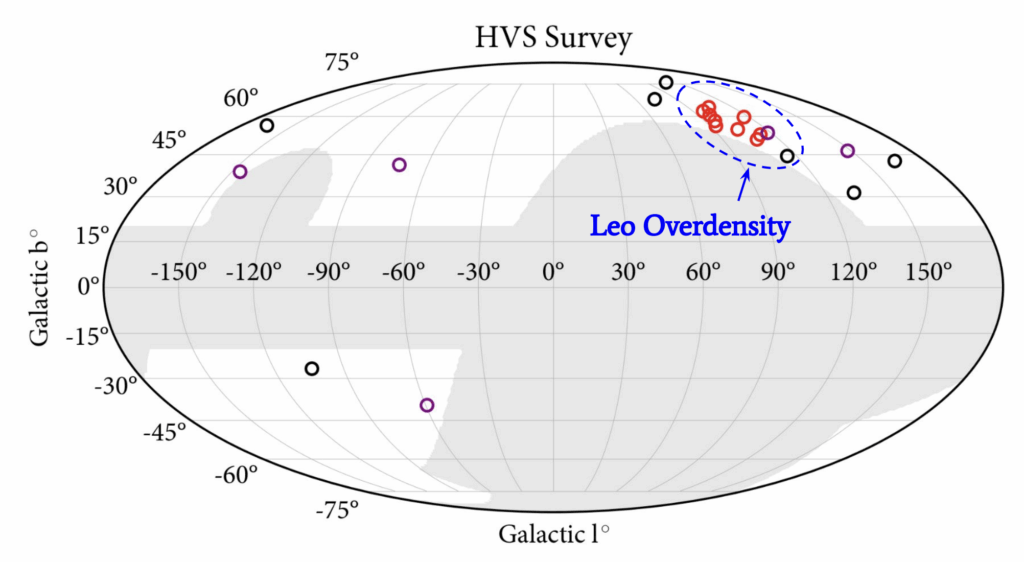
Today’s paper explores a different possibility. What if the stars identified in the HVS Survey were launched not from the Milky Way, but from its largest satellite galaxy, the Large Magellanic Cloud (LMC)? Though past simulations predicted that HVSs from the LMC would appear concentrated on the sky, the idea had never been tested with a large sample of real HVSs. Taking advantage of accurate positions and motions measured by Gaia, the authors of today’s paper rewind the orbits of the HVS Survey sample to investigate this hypothesis.
Looking backwards in time
To trace the origins of their HVSs, the authors used Gala, a Python package that simulates how stars move in different gravitational potentials. They start by adopting a realistic model of the Milky Way + LMC potential, including our best guess for the LMC’s orbit from observations. Then they use Gala to calculate the past orbits of the HVSs by integrating their current positions and velocities backwards in time. For each star, they record the point of closest passage to both the Milky Way and LMC centers, to see which galaxy the star is more likely to be associated with.
To account for measurement uncertainties in the Gaia data, the authors perform 10,000 simulations per star, slightly altering the starting positions and velocities each time. The result is a statistical distribution of closest passages to the Milky Way and LMC for each star (see Figure 2). The authors use these distributions and a metric called the Mahalanobis distance to find the likelihood of the HVSs being associated with each galaxy. They find that out of 21 stars, 16 can be confidently assigned to a galaxy, and 9 of those 16 are more likely to have come from the LMC than the Milky Way. Even more exciting is the fact that all 9 of those LMC HVSs (shown as red circles in Figure 1) are located in the Leo Overdensity!
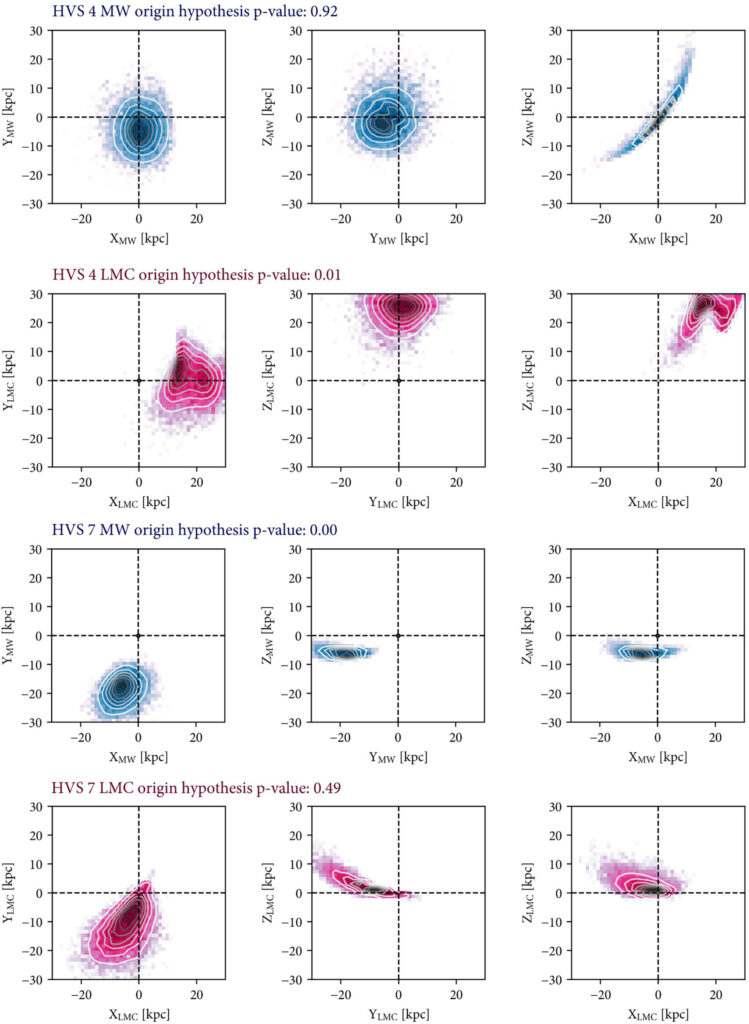
Though the closest-passage distributions are useful for connecting HVSs with their galaxy of origin, they also raise questions about HVS ejection mechanisms. The Milky Way’s disk is about 30 kiloparsecs across – comparable to the spread in the distributions shown in Figure 2. It’s not clear if the HVSs were ejected from the center of each galaxy (which would point to the Hills mechanism) or from random places throughout the disk (which would point to Blaauw kicks).
To investigate further, the authors estimate the ejection velocities of each HVS from their Gala simulations. They find a clear trend: stars from the LMC, which is much less massive than the Milky Way, tend to have lower velocities. This trend is easily explained by the Hills mechanism, since larger galaxies are expected to host larger SMBHs, and larger SMBHs can eject stars at higher speeds. In contrast, Blaauw kick strength depends only on the mass of the exploding star, not the mass of the host galaxy. With this hypothesis in hand, the authors turn to forward modeling to simulate what the HSV population would look like under each mechanism.
Catching the (ejection) culprit
Since both ejection mechanisms involve the disruption of binary systems, the authors start by defining a population of binaries with different masses and orbital separations. Then they run two HVS Survey simulations, each representing a different ejection mechanism. At each step of the simulation, binaries are generated and (occasionally) disrupted, producing a population of HVSs. To compare with the observed sample, the authors generate mock observations of their simulated HVSs and apply brightness and velocity cuts that match the selection biases of the real HVS Survey.
In the first simulation, stars are ejected from the center of the LMC by its SMBH (which they nickname LMC*, in the style of the Milky Way’s Sgr A*) via the Hills mechanism. Excitingly, the simulated HVS population successfully reproduces the Leo Overdensity! The simulation also shows that the overdensity is just the tip of a long tail of stars to the south (top row of Figure 3), which would have been missed in the real survey due to its limited sky coverage. This offers a clear, testable prediction of the existence of LMC*: if the black hole really exists, future follow-up observations in the southern sky should detect these additional stars.
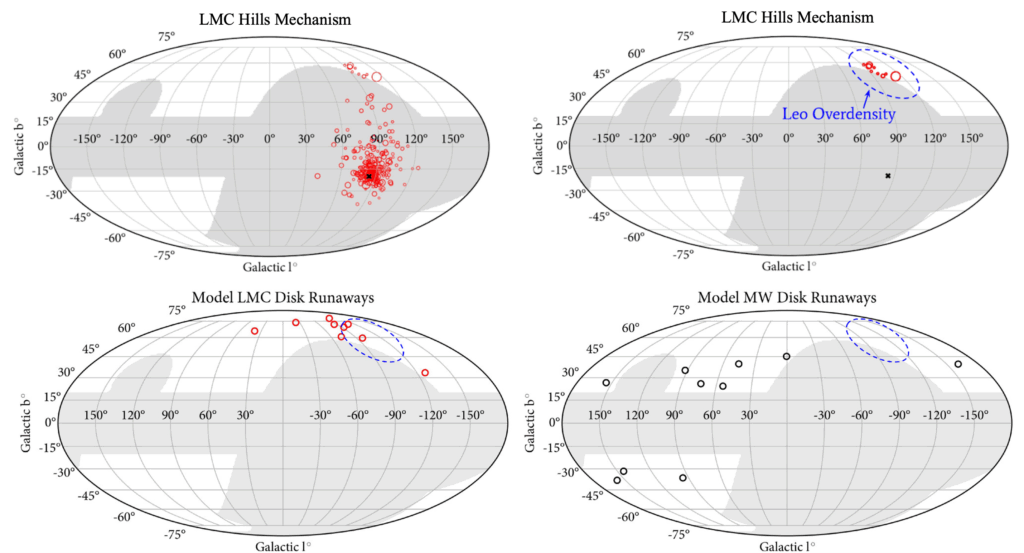
In the second simulation, stars in both galaxies are ejected from locations across the rotating galactic disk, representing the expected randomness of Blaauw kicks. In contrast with the first simulation, the resulting population of HVSs is spread out across the sky, failing to reproduce the Leo Overdensity (bottom row of Figure 3). If the Blaauw kick rate was increased, the LMC HVSs could eventually fill in the overdensity region – but then we’d also expect more HVSs from the Milky Way, which we don’t see in the real data. The authors therefore conclude that the Hills mechanism is more likely than Blaauw kicks to have produced the HVS Survey stars.
Learning about the LMC
With the ejection mechanism established, the authors flip the script and use the observed HVS sample to derive a rough mass constraint for LMC*. First, they run a suite of simulations with Hills-mechanism ejections and different LMC* masses. Then, they compare their simulations with the actual observations to find the one that best reproduces three key values: the Milky Way/LMC HVS count ratio and the mean ejection velocities from each galaxy. (Check out these Astrobites to learn more about the model-fitting method they used!) From this comparison, the authors obtain a best-fit LMC* mass of 6 x 10^5 solar masses. Though this is higher than most theoretical predictions, it fits right in with the observed M-σ relation (Figure 4), which links the mass of a galaxy’s central black hole to the typical velocities of stars orbiting within that galaxy.

Figure 4: Comparison of the derived LMC properties with two different versions of the observed M-σ relation, which changes slightly if you consider all galaxies (blue relation) versus just galaxies with lower-mass black holes (purple relation). Adopting a spread in stellar velocities σ of about 50 km/s from past observational studies, the LMC* mass estimate from today’s paper agrees nicely with both relations. Image credit: Figure 9 in the paper.
The results of today’s paper also have implications for one of the biggest uncertainties in studies of the Magellanic Clouds: the LMC’s orbit. Even though the authors assumed a certain orbit in their simulations, they note that the Hills ejection mechanism should produce an HVS overdensity regardless of which orbit is used. Comparing the observed Leo Overdensity to those produced by different orbit models can therefore refine our understanding of the LMC’s trajectory around the Milky Way. And with upcoming wide-field surveys like LSST poised to discover many more HVSs, we’ll soon have the data needed both to confirm LMC*’s existence and map the orbit of our largest satellite with unprecedented precision.
Astrobite edited by Drew Lapeer.
Featured image credit: Background image, Pablo Carlos Budassi under CC BY-SA 4.0; drawings added by Alexandra Masegian.
