
In this series of posts, we sit down with a few keynote speakers of the 246th AAS meeting to learn more about them and their research. You can see a full schedule of their talks here and read our other interviews here!
Disks are ubiquitous throughout astronomy, from the disks around newborn stars that are the sites for the creation of planets to the Active Galactic Nuclei (AGN) disks in many galaxies which fuel the enormous supermassive black holes at their centers. What sort of hydrodynamical processes occur in disks? And how do various objects behave and interact with the material in a disk? These are just some of the questions that Dr. Saavik Ford has been at the forefront of tackling for the past two decades.
Dr. Ford is a Full Professor at the CUNY Borough of Manhattan Community College, a research associate at the American Museum of Natural History (AMNH) and a visiting scientist at the Flatiron Institute’s Center for Computational Astrophysics. Dr Ford is also well known for being the co-originator of the AGN channel for producing mergers of stellar mass black holes that are now regularly being detected by the LIGO-Virgo-KAGRA detectors for the past ten years.
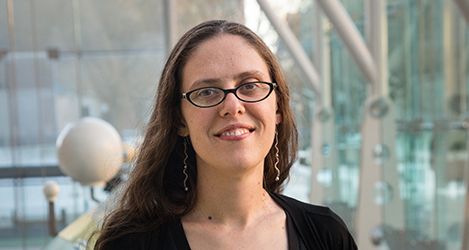
As a child growing up in New York, Dr Ford was drawn to space after frequent visits to the AMNH’s Hayden Planetarium. She also recalls Sally Ride’s flight on the Space Shuttle, which marked the first time an American woman flew to space, as an early inspiration for her interests in space and science. These experiences eventually led her to pursue a Bachelors in Physics at Rensselaer Polytechnic Institute (RPI), where she even convinced a faculty member to offer an undergraduate course on relativity and cosmology, which still runs today! After a few REU’s (Research Experiences for Undergraduates), including one at the now defunct National Solar Observatory in Sunspot, New Mexico, Dr Ford started graduate school at Johns Hopkins. There, she worked on astrochemistry in the circumstellar environments around AGB (Asymptotic Giant Branch) stars, protoplanetary disks and planet formation. She continued to work on these topics during her postdoctoral stint at the Carnegie Institution in Washington. After a brief role as a science curator at a planetarium in rural South Carolina, Dr Ford returned to New York to take up a tenure track position at CUNY with her spouse. Due to the high teaching and service obligations, maintaining two separate research programs became difficult, and this led them to bring together their different research interests in a more effective way. “It turns out that the mechanics of things that happen in protoplanetary disks are actually quite analogous to the things that happen in AGN disks”, said Dr Ford, and for the past two decades, she has worked on understanding what happens when one puts things in AGN disks. Although the physical processes in such disks have similarities to the protoplanetary disks that she worked on previously, switching fields can be daunting, and she emphasizes the importance of having a community of graduate students, postdocs and collaborators to talk to and bounce ideas off.
There are many paths to creating stellar mass black hole binaries that can be detected through their gravitational wave emission. The most popular ones are the isolated, dynamical, and the AGN channels. Dr Ford and her team have developed the last one over the past decade, and are trying to better understand the physical processes that lead to the formation of merging binaries in AGN disks, and also develop simulations to predict their merger rates and the properties of the black holes which can then be compared to gravitational wave observations.
When asked about what she is most excited about in the near future, Dr Ford mentions that a smoking gun evidence for the AGN channel could be detecting mergers that contain black holes with masses confidently in the theorized “upper mass gap”, where modern stellar evolution models predict an absence of black holes formed from the collapse of stars. Thus, these mergers are unlikely to come from the isolated channel, and the remaining two (dynamical and AGN) give different predictions for the resulting spins of such black holes. Even if it turns out that the AGN channel does not have significant contributions to the rates of merging black holes, Dr Ford emphasizes that such an absence would also provide a powerful constraint on how material in AGN disks behave, which itself has several uncertainties. She says, “Everything that we do in astronomy is somehow connected to a bigger problem. And it’s really important to keep half an eye on that at all times, and to sort of try to make sure that whatever your answer is, you can do something interesting with it. Because you can. You just have to figure out how.”
Advice
Dr Ford thinks that it is essential for undergraduates to get an idea of what’s out there, and to take ownership of what excites them. She also emphasizes that even though there will inevitably be hard work and hurdles to overcome, it is important to have an identity and interests outside astrophysics so as to work sustainably throughout one’s career.
Dr Ford is also highly dedicated to mentoring and outreach, and hopes to make astronomy more inclusive, diverse and welcoming for everyone. She notes, “It’s an awesome, and I mean that in a literal sense, like an awe-inspiring field to be able to participate in. And I want everybody to have that opportunity if that’s what they want to do.” She believes that for anyone wanting to pursue astronomy and astrophysics, the community should strive to help them in their goals, as even if they decide not to pursue it later, their skills would be extremely transferable and useful, and would make them a better, more interesting and educated person. She wants to make astronomy as a field, and academia in general, a more welcoming place where people can bring their whole selves, as research does not exist in a vacuum and it is the people that make it what it is.
Dr Ford’s plenary will delve deeper into the the complex physical processes that occur in the swirling disks of matter around supermassive black holes, how objects such as stellar mass black holes and stars behave once they get trapped within them, and the implications these processes have for creating merging binary black holes over cosmic time.
To hear more about things in AGN disks, tune into Saavik Ford’s Plenary Lecture at 4:40pm AKDT on Wednesday, June 11 at #AAS246!
Edited by: Lucas Brown
Featured Image Credit: AAS
