
by Tehreem Hai

Tehreem Hai is a second-year Astronomy graduate student at Rutgers University. She is interested in how star formation is regulated in the low-mass extremes of dwarf galaxies, including ultra-faint dwarf galaxies close to us and extremely low-mass star-forming galaxies further away. She uses both optical and blind neutral hydrogen surveys to find these tiny systems and characterizes their properties using follow-up imaging from the Hubble Space Telescope. In her free time, Tehreem likes to cook, read, and take food-oriented trips on public transit.
Title: DELVE 6: An Ancient, Ultra-faint Star Cluster on the Outskirts of the Magellanic Clouds
Authors: W. Cerny, A. Drlica-Wagner, T.S.Li, A. B. Pace, K. A. G. Olsen, N. E. D. Noël, R. P. van der Marel, J. L. Carlin, Y. Choi, D. Erkal, M. Geha, D. J. James, C. E. Martínez-Vázquez, P. Massana, G. E. Medina, A. E. Miller, B. Mutlu-Pakdil, D. L. Nidever, J. D. Sakowska, G. S. Stringfellow, J. A. Carballo-Bello, P. S. Ferguson, N. Kuropatkin, S. Mau, E. J. Tollerud, and A. K. Vivas (DELVE Collaboration)
First Author’s Institution: Department of Astronomy, Yale University, New Haven, CT, USA
Status: Published to The Astrophysical Journal Letters [open access]
Scientists have found a new population of stars in our galactic neighborhood! The origin of this (tentatively-classified) star cluster is unknown, however, and figuring out where it came from could shed light on the history of our own Milky Way (MW) galaxy and its interaction with two nearby galaxies, the Large and Small Magellanic Clouds (LMC and SMC). The MCs consist of two irregular dwarf galaxies, which interact gravitationally both with each other and with our own MW. We can probe the properties of the MCs and the interaction history of this three-galaxy system through the star clusters and smaller galaxies which are ‘hosted’ by the MCs and the MW. These ‘satellite’ systems orbit the MCs and MW, so their kinematics trace the total mass (including the hidden dark matter) of their host galaxies.
The ages and metallicities of satellite star clusters like the one in today’s paper also offer unique insights into the star formation history of their host galaxies. A star cluster contains stars which formed at roughly the same time, and so they have about the same age and metal content. Having a large number of stars with the same age and metal content gets us a much more precise measurement of these properties compared to individual stars, and measuring this for a sample of star clusters can give us robust snapshots into a host galaxy’s history while constraining the mechanisms (e.g., interactions with other galaxies) which drive that history. Finding star clusters on the outskirts of galaxies is especially important, because they provide reliable measurements to constrain the age-metallicity relation of the host at large radii, where individual host stars are difficult to find.
Recent digital large-sky surveys have revolutionized our census of these satellites, finding fainter systems further away from their hosts and putting important constraints on the environment surrounding the MCs and the MW. The DECam Local Volume Exploration survey (DELVE) is one such survey. DELVE had previously found both star clusters and galaxies orbiting around the MW as a result of a comprehensive search of data from the Dark Energy Camera (DECam). This recent letter reports DELVE’s discovery of another ultra-faint stellar system, the star cluster DELVE 6, found at the outskirts of the MCs. The authors find DELVE 6 to be old, low-metallicity, and at an unusually large separation from its likely hosts. So the question is, what are the origins of this peculiar star cluster?
The properties of DELVE 6
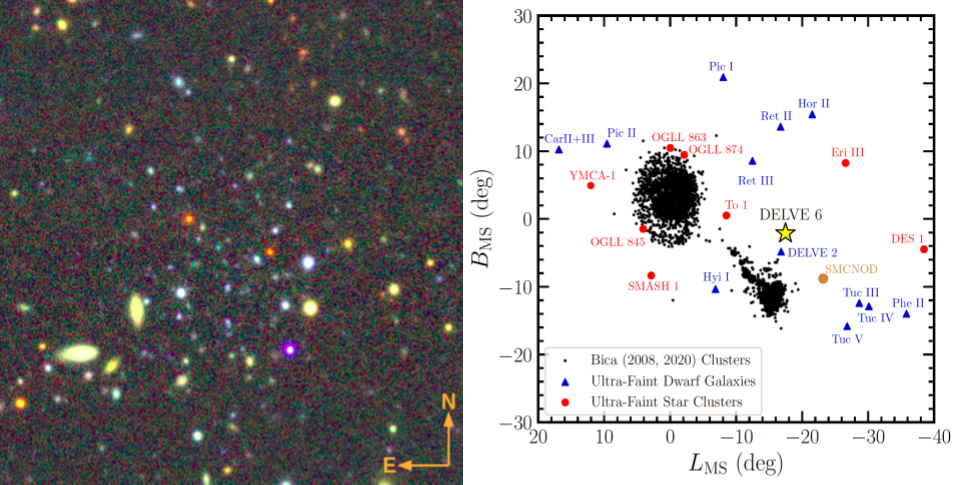
DELVE 6 shows a clear overdensity of stars in its color image (left plot in Figure 1). The authors used the spatial distribution and magnitudes (brightness in different filters) of the stars in DELVE 6 to fit the star cluster’s structural and stellar population properties. They found DELVE 6 to be ancient (older than 9.8 billion years) and metal-poor (with a metallicity of less than -1.17 dex, or <6% of the Sun’s metallicity). They also found the separation of the system from the SMC/LMC system; you can see this in the right plot in Figure 1, which maps out the ultra-faint star clusters and galaxies near the MCs. DELVE 6, marked with a star, lies relatively close to the two possible hosts. However, its separation from the LMC (35 kpc) is larger than the tidal radius of the LMC due to the MW, and its distance to the SMC (20 kpc) is larger than the tidal radius of the SMC due to the LMC. The tidal radius is a measure of the extent of gravitational pull of the hosts, and thus the MCs appear to have only a weak influence on the system. So who is hosting DELVE 6?
Where did DELVE 6 come from?
The authors posit three different scenarios for the origin of DELVE 6.
DELVE 6 is a distant satellite of the MW which happens to be near the MCs.
This theory is supported by the fact that DELVE 6 is consistent in age and metallicity with other star clusters orbiting the MW, and explains why it is so far from the MCs. This theory was further tested with the proper motion measurement of DELVE 6. Proper motion tells us how stars move across the sky, in a 2D projection of their real 3D velocity. If we have proper motions for multiple stars in a system (as is the case with DELVE 6), we can find the proper motion of the whole system, which can give us clues into whether they are associated with different host galaxies. Tentative proper motion measurements for DELVE 6 are actually consistent with the MC system and inconsistent with the MW hosting the cluster, implying that the MW satellite scenario may not be likely. However, the authors caution that this conclusion is limited by the large uncertainties in the proper motion measurements.
DELVE 6 is a (weakly bound or unbound) satellite of the LMC.
This is supported by the age of the cluster, which is comparable to ~15 other clusters orbiting the LMC. While the large separation between DELVE 6 and the LMC makes this less likely, there are at least two ultra-faint dwarf galaxies (Horologium I and Phoenix II) which lie further than DELVE 6 but are still likely (weakly bound or unbound) satellites of the LMC. This suggests that DELVE 6 may also have such an association with the LMC.
DELVE 6 formed within the SMC but was stripped from its host and now is part of the MW+LMC potential.
This might be the coolest scenario (in my biased opinion), but arguably the only evidence for it is DELVE 6’s large separation from the SMC and its location on the sky, which happens to be where simulations predict a lot of SMC satellites end up due to interactions with the LMC and the MW.
The authors note that disentangling these scenarios will require spectroscopic follow-up observations. Proper motion measurements give us the 2D velocity; if we also have the third component of the velocity, the radial velocity (which is usually calculated from stellar spectra), we have the full 3D movement of the stars in DELVE 6. Using this, we can ‘rewind’ DELVE 6’s orbit and investigate its origins.
Whatever the scenario, the authors remind us that DELVE 6’s discovery implies our census of ultra-faint stellar systems around the MCs is far from complete. Many such systems lay hidden in our galactic neighborhood, waiting to be found.
Astrobite edited by Katherine Lee
Featured image credit: from Figure 1 in today’s paper.
