
Title: Cool Gas in the Circumgalactic Medium of Massive Post Starburst Galaxies
Authors: Zoe Harvey, Sahyadri Krishna, Vivienne Wild, Rita Tojeiro, Paul Hewett
First Author’s Institution: School of Physics and Astronomy, University of St Andrews, St Andrews, Fife KY16 8AZ, UK
Status: Submitted to The Open Journal of Astrophysics [open access]
Gas in galaxies is the fuel for star formation. Gas-rich spiral galaxies can form hundreds or thousands of stars per year, while gas-poor elliptical galaxies might only form a star once every thousand years. Gas enters galaxies from the intergalactic medium—the warm, low-density plasma that flows between galaxies at large scales. It then falls into the circumgalactic medium (CGM), or the gas just outside the galaxy’s gravitational influence, and finally into the galaxy itself, where it forms stars. Gas then “drains” out of the galaxy through outflows and back into the CGM, where it can either fall back onto the galaxy and form more stars or be ejected back out into the intergalactic medium. So the galaxy acts like a bathtub, filled by gas from the CGM instead of water.
But what happens when you shut off the tap, or when the water drains faster than the tub can fill? Well, just like a bathtub running out of water, the galaxy runs out of gas, leaving no fuel for star formation. This might lead to “quenching,” or the process which turns galaxies from star-forming spirals into “quiescent” (non-star-forming) ellipticals. A variety of processes could cause this transformation, some of them quick and some of them slow. A massive dark matter halo could hold gas far enough away from the galaxy that it never falls back into the disk to form stars (“shutting off the tap”) or supermassive black hole accretion could launch massive jets that blow gas out of the galaxy (“draining” the gas). These processes disrupt the galactic gas cycle and therefore star formation. Today’s authors study gas in the CGM of massive galaxies which have recently stopped forming stars to study the processes that turn off the tap or drain gas from galaxies.
Lighting up the circumgalactic medium
Studying gas in the CGM is challenging. Unlike the gas inside the galaxy, there are no stars lighting up the CGM. Gas in the CGM is mostly made of atomic hydrogen, which emits very faintly at a wavelength of 21 cm. This wavelength is covered by a few radio telescopes, but not enough to observe large populations of gas halos at high resolution, meaning astronomers need a clever way to observe gas in the CGM.
This is where quasar absorption line spectroscopy comes in. Recall that absorption lines occur when a cool gas is backlit by a hot source. The gas absorbs light at the wavelengths corresponding to different elements and molecules in the gas. Quasar absorption line spectroscopy uses quasars—bright supermassive black hole accretion systems—as a backlight for the CGM, where absorption lines in the QSO spectrum indicate absorption by CGM gas (see diagram in Figure 1).
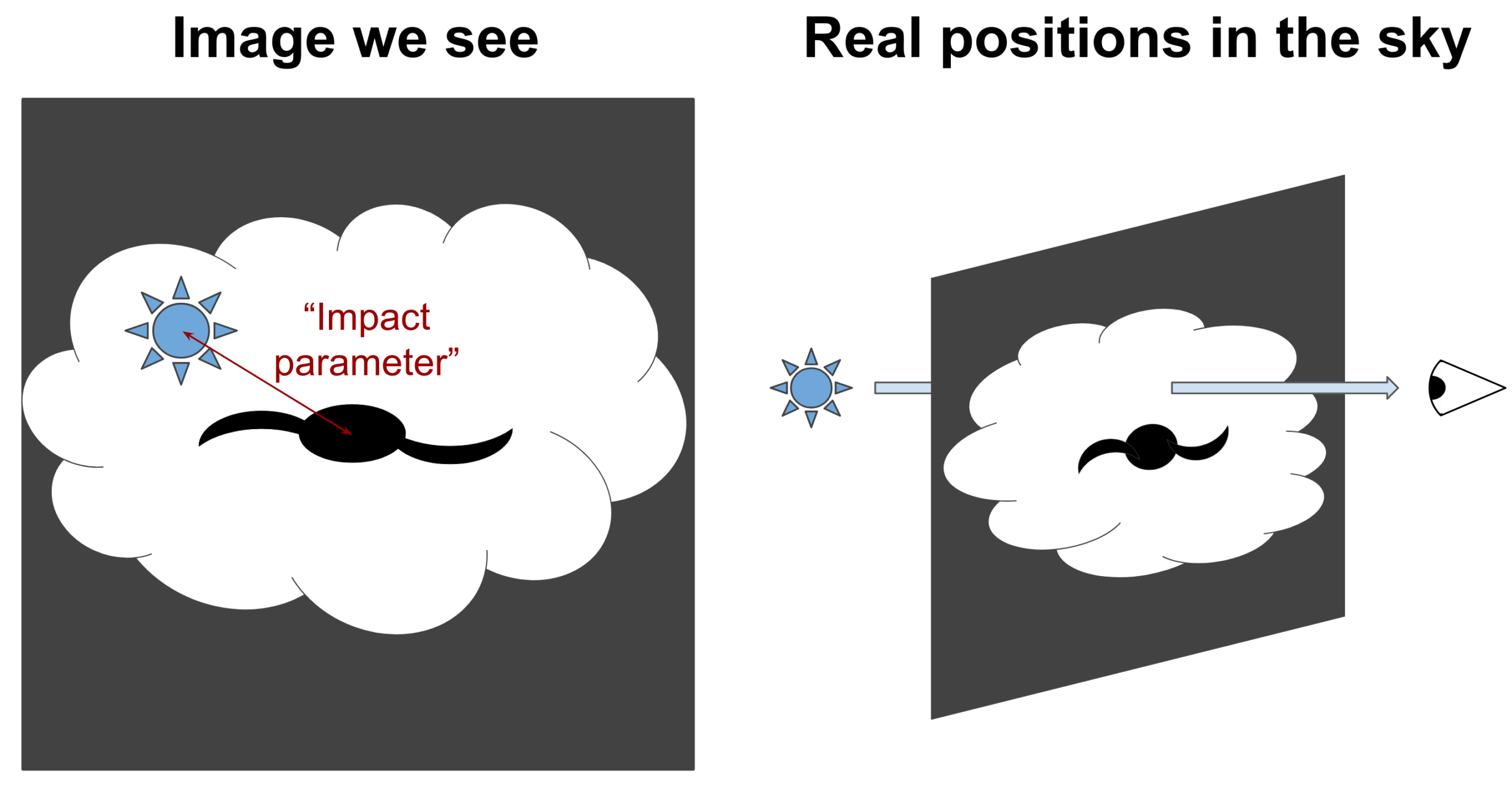
The authors of today’s paper begin by finding galaxies with quasars which are 1) nearby enough in imaging to act as a backlight but 2) behind the galaxy, so they can light up the gas in front of them. In practical terms, this means they look for galaxies which have quasars at a variety of “impact parameters,” or projected distances from the center of the galaxy, but at a higher redshift (distance) than the galaxy. Since this is a pretty strict set of requirements, it’s not possible to do this kind of analysis for galaxies one at a time (since to do this for one galaxy, you’d need several quasars at different impact parameters)—instead, the authors take the average absorption over quasars for multiple galaxies to get the average radial profile of gas in the CGM.
How does CGM gas relate to star formation?
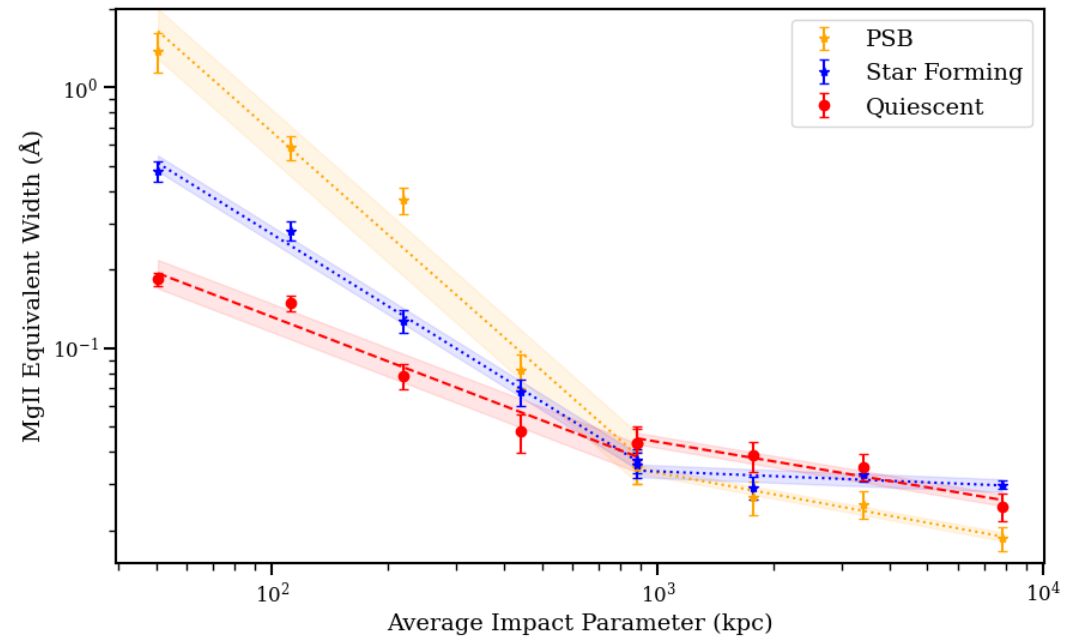
The authors first measure absorption from CGM gas as a function of radius around all galaxies in their sample. They find that the absorption drops with radius, meaning the amount of gas in the CGM decreases as you move farther from the galaxy, in line with what is expected from simulations.
They then repeat their analysis, this time dividing their sample into star-forming, quiescent, and post-starburst galaxies. Post-starburst galaxies are galaxies which experienced a burst of star formation in the past billion years, then rapidly shut off their star formation. These galaxies can give us a hint into the processes that “shut off the tap” or “drain” the gas from galaxies, since they’ve only recently shut off star formation. By looking for differences between star-forming, post-starburst, and quiescent galaxies, the authors want to figure out what happens to the gas in the CGM when star formation shuts off.
One might expect that post-starbursts, which have low current star formation rates, might have gas profiles that look like quiescent galaxies. One might also expect that, since they only just shut off star formation (and since post-starbursts sometimes host a fair amount of gas even after quenching), they would have an intermediate amount of gas—lower than star-forming galaxies, but higher than quiescent galaxies. Surprisingly, it turns out that post-starbursts actually have the most CGM gas of all three samples (Figure 2). The authors take this as a clue that the process of moving gas from the galaxy to the CGM is part of the process of shutting off star formation. But how?
How did post-starbursts “drain” their gas?
The authors discuss four possible reasons why post-starbursts would have the most gas in their CGMs. They have enough evidence to make statements about the first three; the fourth will require further work in cosmological simulations to confirm or rule out.
1. Whatever process triggered the starburst also ejected gas into the CGM.
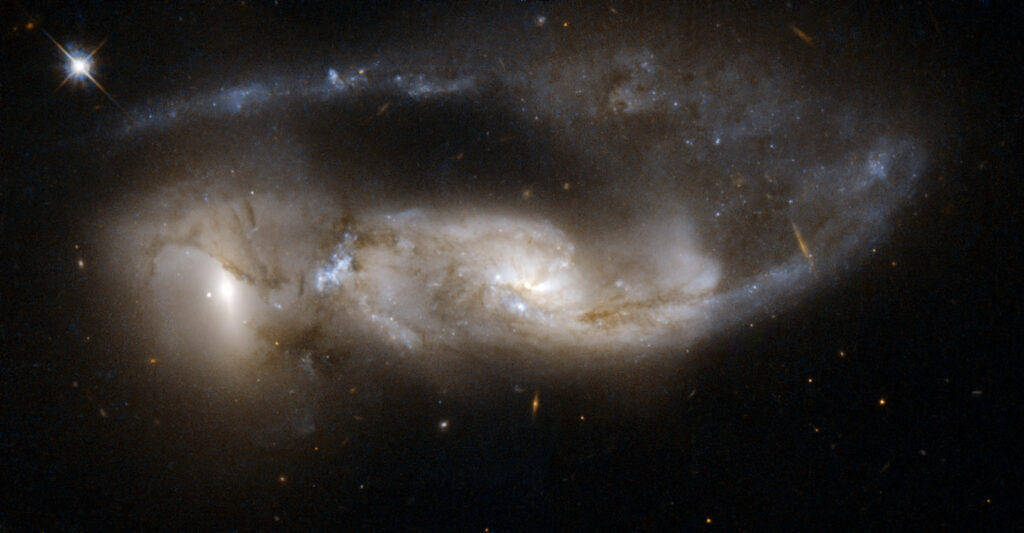
Galaxy mergers are a popular explanation for post-starburst galaxies and rapid galaxy quenching. When two galaxies collide, they drive gas inward—stimulating star formation in the centers of galaxies—and expel gas outward—forming “tidal tails” of star formation (see Figure 3) and helping to drain the galactic bathtub of its gas. If the quasar backlight happened to be behind one of these tidal tails, it might lead to a higher measurement of the gas content at large radii.
The authors quickly rule this out by saying that 1) tidal tails are usually less than 100 kiloparsecs across, about a tenth the size of the absorption measured here, and 2) if this were the case, then the trend would be driven by a few quasars with lots of absorption where the tidal tail happened to line up with the quasar’s line of sight. Instead, the authors saw significant absorption in most of the sample, implying a more homogeneous distribution of gas in the CGM around post-starbursts.
2. There are more satellite and dwarf galaxies around post-starbursts contributing to the gas content of the CGM.
Environment can play a huge role in galaxy evolution (see so-called “jellyfish galaxies,” a result of gas being stripped from a galaxy as it moves through a cluster). If post-starbursts are being quenched because they live in a dense environment, they might seem like they have more gas in their CGM which is actually gas hosted by a satellite galaxy.
The authors point to a study looking at the environment of post-starbursts which finds that most live “in the field,” a fancy way of saying they don’t live in high-density galaxy clusters. However, existing studies mostly focus on massive galaxies, while galaxies are often surrounded by smaller satellite galaxies that may be missed in imaging.
3. Outflows, which either drive quenching or are driven by the quenching mechanism, launch gas into the CGM around post-starbursts.
This is the authors’ preferred explanation for their findings. Outflows around post-starbursts are common and have been measured at sufficient speeds to launch gas out to ~1,000 kpc in the billion years after a starburst. It’s still not clear what process drives these outflows and whether the outflows cause or are caused by quenching; one popular theory is that outflows are launched by quasars, which are very short-lived relative to even the short post-starburst phase.
4. Gas within the dark matter halos of post-starbursts is more conducive to forming cool gas than for other types of galaxy.
This is the hardest theory for the authors to comment on, as we can’t directly observe the dark matter halos around galaxies. Here, the authors point to simulations as the best tool to try to understand how dark matter influences gas in the CGM. Simulations show decreasing CGM gas as you move farther from the center of a galaxy, and they also show that star-forming galaxies have more gas in their halos than quiescent galaxies. This is partly because star formation drives outflows into the CGM and partly because jetted quasars in quiescent galaxies can heat up gas in the CGM until it ionizes, which would render it undetectable by quasar absorption line spectroscopy. However, simulations find that galaxies which are undergoing quenching have similar CGM properties to quiescent galaxies, the opposite of what the authors find in this study. This may be because most galaxies undergoing quenching in simulations are quenching slowly, while post-starbursts make up a minority of quenching galaxies. The authors point to future studies on post-starbursts in cosmological simulations as the best way to support or rule out this explanation.
Conclusion
The high gas content in the CGMs of post-starbursts may offer a clue to the physical mechanisms which shut off star formation so rapidly in massive galaxies. Today’s paper is part of a growing body of evidence that just “shutting off the tap” or “draining the tub” is not sufficient to explain why post-starburst galaxies have shut off star formation. Instead, models that can explain why post-starbursts can still have gas, the processes which heat or move that gas, and explanations for why that gas never falls back into the galaxy are needed to understand how rapid quenching has led to the quiescent galaxy population we see today.
Astrobite edited by Tori Bonidie
Featured image credit: NASA, ESA, the Hubble Heritage (STScI/AURA)-ESA/Hubble Collaboration, and W. Keel (University of Alabama, Tuscaloosa)
