
Title: Deep in the Fields of the Andromeda Halo: Discovery of the Pegasus VII dwarf galaxy in UNIONS
Authors: Simon E.T. Smith, Alan W. McConnachie, Stephen Gwyn, Christian R. Hayes, Massimiliano Gatto, Ken Chambers, Jean-Charles Cuillandre, Michael J. Hudson, Eugene Magnier, Nicolas Martin, and Julio Navarro
First Author’s Institution: Department of Physics and Astronomy, University of Victoria, Victoria, BC, Canada
Status: Published in The Astrophysical Journal [open access]
Picture a galaxy. It’s big right? Unfathomably big, huge even! But galaxies aren’t all extremely massive; they come in a variety of sizes and luminosities, some of which are so small and so dim that astronomers may not even know they’re there, even when they’re basically in our backyard. The hunt for the smallest galaxies is an important one, as these systems give us extreme environments where we can test theories of dark matter and galaxy evolution. The authors of this paper present a newly discovered ultra-faint dwarf galaxy (UFD) dubbed Pegasus VII (Peg VII), found next to our nearest major galactic neighbour: Andromeda.
How Do You Find a Dwarf Galaxy?
Finding UFDs requires deep, long-exposure imaging across wide swaths of the night sky, something that is only possible through observational surveys. Some telescopes, like the James Webb Space Telescope, require astronomers to submit an application to point the telescope at a specific, known target and, if approved, will have some amount of “telescope time” to do their imaging. Others, like the Euclid Space Telescope, are part of large surveys where an area of the sky is selected and systematically imaged over several years, regardless of if there are known objects there or not. Because of this, surveys are our best bet to discover faint systems like UFDs.
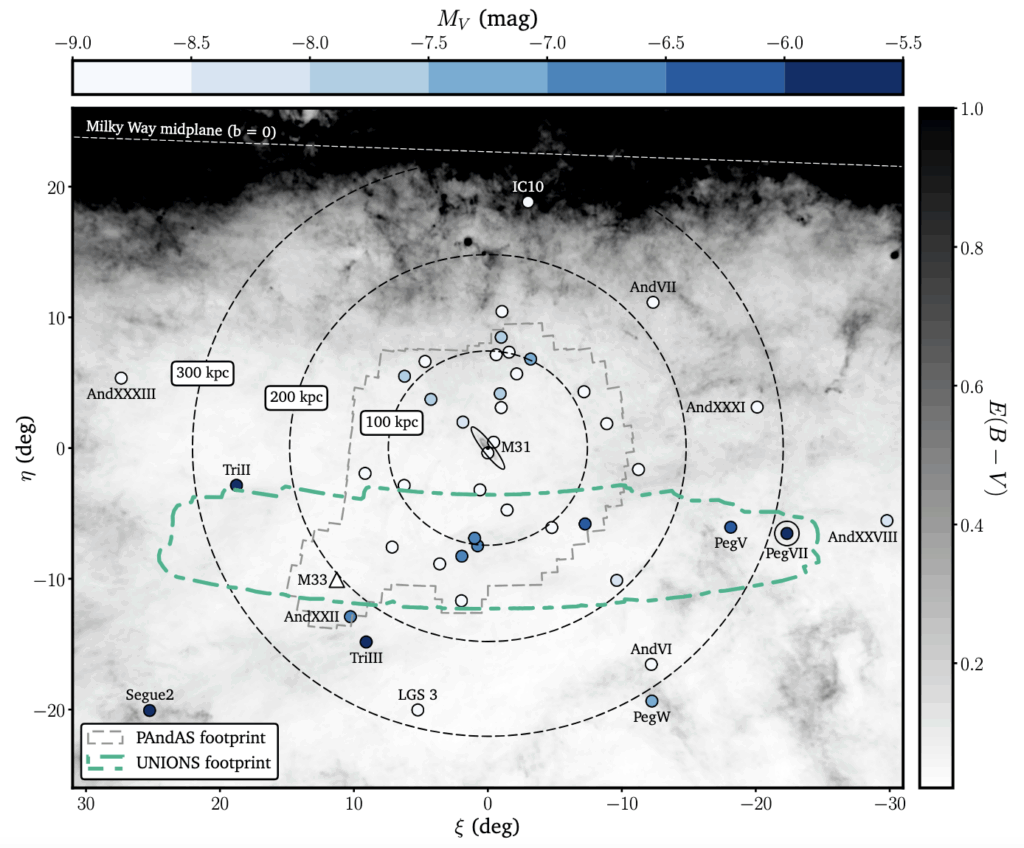
The survey these authors used is UNIONS (Ultraviolet Near Infrared Optical Northern Survey), which covers the same area of the sky as the Euclid Space Telescope, but is done with three ground-based telescopes, the Canada-France-Hawaii Telescope (CFHT), Pan-STARRS, and Subaru, all located on Mauna Kea in Hawai’i. The authors were originally focused on finding satellite galaxies in the outskirts of Andromeda’s gravitational influence and during their search were able to identify an overdensity of bright stars. They then applied for and were awarded telescope time with both CFHT and the Gemini Observatory to perform deeper follow-up imaging of the system to figure out what exactly it was.
Optical Illusion or Optical Observation?
With this deeper follow-up imaging they could confirm if these stars were really one coherent system or if they just appeared to be clumped together on the sky. When they plotted the stars on a colour-magnitude diagram (CMD) they were able to identify a main sequence, horizontal branch, and red giant branch, as would be expected if these stars all formed at roughly the same time and were allowed to evolve over billions of years. Congratulations, it’s a dwarf galaxy!
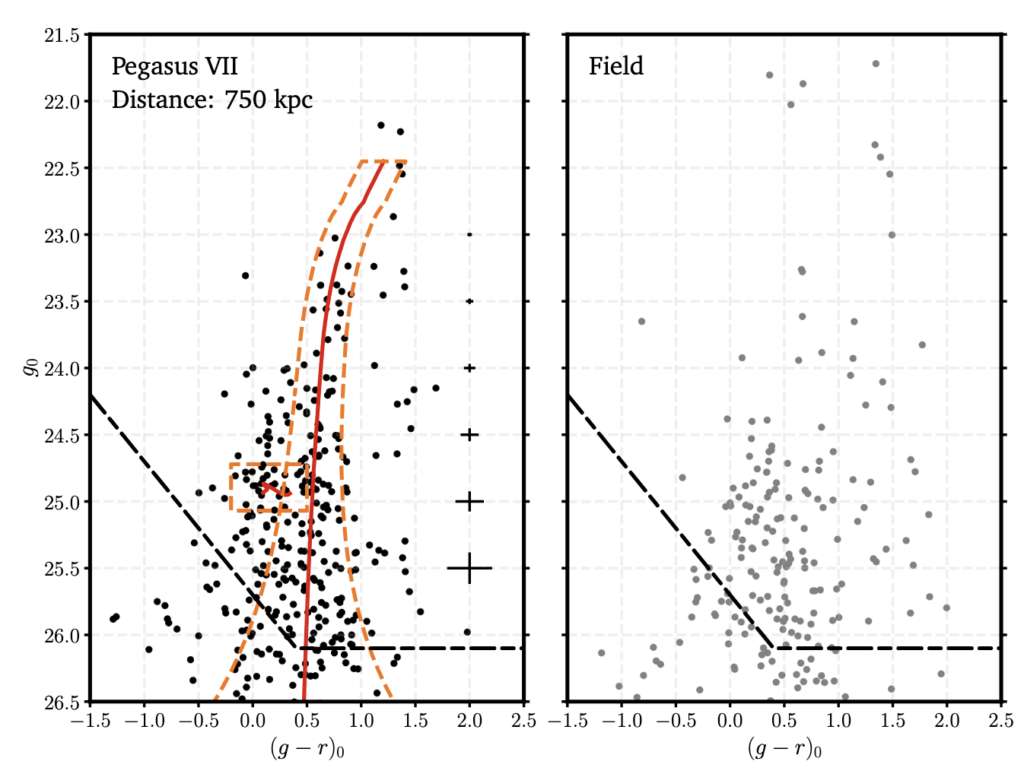
All together, Peg VII only hosts around 82 stars with a physical size 129 times smaller than Andromeda’s. This results in a brightness of only -5.7 magnitudes (in astronomy, the more negative the magnitude number, the brighter it is). For context, Andromeda hosts over 1 trillion stars resulting in a brightness of -21.5 magnitudes, making Peg VII two million times dimmer than its massive neighbour. This definitively makes Peg VII the dimmest known Andromeda satellite galaxy.
With their CMD, the authors could also fit isochrone models to determine estimates of other properties of the system. Essentially, they took simulations of systems with a variety of ages and metallicities and determined what their CMDs would look like and compared it to Peg VII’s. They estimate Peg VII to be very metal-poor, which is expected for a small galaxy like this, and around 10 billion years old.
How Are Baby Dwarf Galaxies Made?
The big question surrounding Peg VII is, how exactly did it get like this? Did it originally form with so few stars, or was it originally bigger and has since had stars stripped away due to tidal forces exerted on it by Andromeda? It’s difficult to answer this right now because the imaging the authors obtained doesn’t allow them to determine Peg VII’s orbital path and speed around Andromeda. But, they can look for indicators of tidal disruption, like spatial elongation of the stars’ distribution, or how “stretched out” the galaxy is.
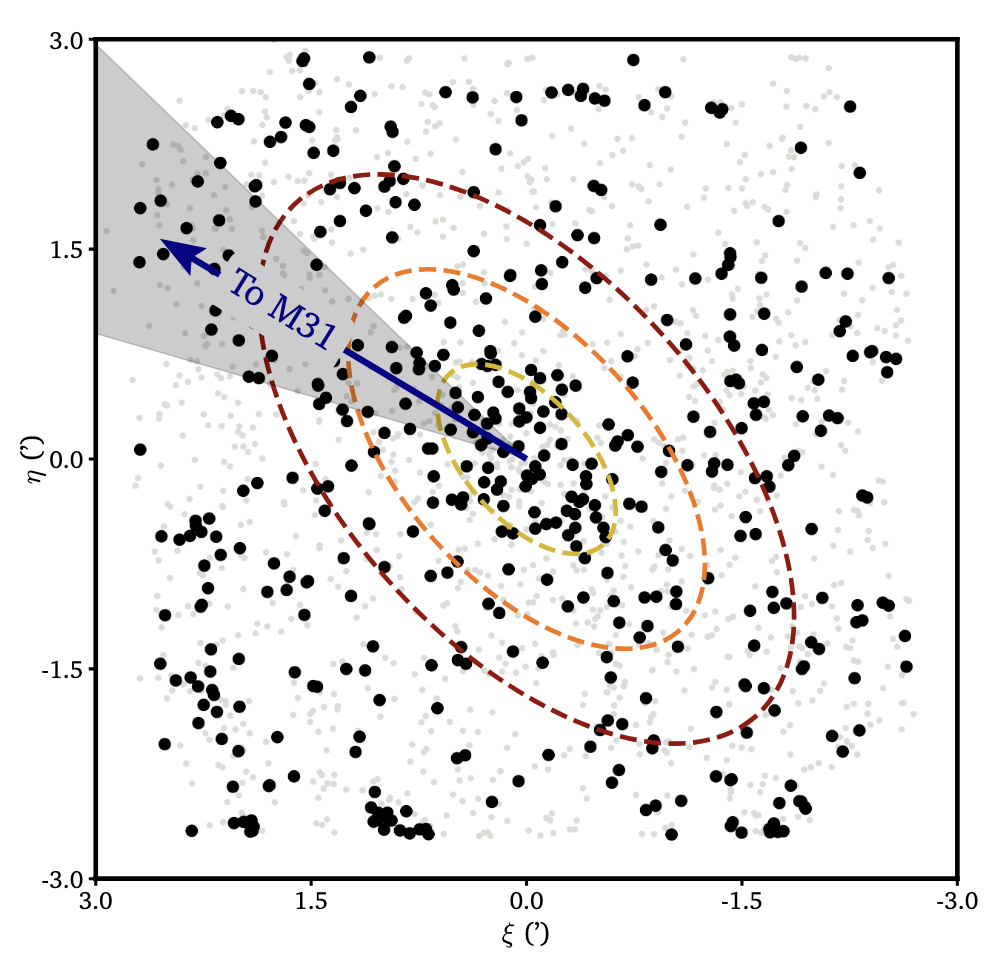
They found that Peg VII is quite elliptical (oval-like) and its major axis is roughly pointed at Andromeda. This could indicate that Peg VII has interacted with Andromeda in the past and this could have affected its mass and size. However, there are lots of other possibilities for Peg VII’s shape that wouldn’t involve Andromeda at all. Peg VII could have naturally formed like this in isolation and has only just recently been brought into Andromeda’s orbit. It’s also possible Peg VII is the byproduct of a merger between two even smaller dwarf galaxies, which has been shown to result in elliptical distributions.
To answer all of these questions more follow-up observations are needed. By combining different wavelengths of light it will be possible to determine Peg VII’s velocities, its star formation history, and its hydrogen gas content and distribution. Even without an answer about Peg VII’s evolution, its discovery alone is noteworthy for the Andromeda system. Our theories of galaxy formation predict that Andromeda should have way more small satellite galaxies like Peg VII that we haven’t observed yet, as many as 60! This study of Peg VII highlights the need for large, deep surveys to extend this search for satellites to further distances from Andromeda and perhaps down to dimmer magnitudes.
In the meantime, keep your eye on the sky for more news about Peg VII and its other ultra-faint dwarf galaxy buddies. As big surveys designed for finding faint systems like these start to ramp up, like the Euclid Space Telescope and Rubin Observatory, we may be hearing more big things about these little galaxies.
Astrobite edited by Caroline Von Raesfeld
Featured image credit: Wikimedia Commons
