
Authors: Yutaka Fujita, Kotaro Fukushima, Kosuke Sato, Yasushi Fukazawa, Marie Kondo
First Author’s Institution: Department of Physics, Tokyo Metropolitan University, Japan
Status: Submitted to arXiv (preprint) and Publications of the Astronomical Society of Japan
The Mystery of Cooling Gas
Galaxy clusters provide a fascinating laboratory for much modern astrophysics research. Consisting of hundreds to thousands of galaxies gravitationally bound together, clusters are massive objects. However, most of the baryonic mass in clusters is found not in the galaxies themselves, but in the gas in between them, called the intracluster medium (ICM). The conditions in the ICM are governed by complex heating and cooling processes, driven by the cluster’s gravity, radiative cooling, and feedback from supernova and active galactic nuclei (AGN). In many cluster environments, the temperatures and densities of the ICM suggest that it should be rapidly cooling, generating an inflow of material towards the central region of the cluster. X-ray observations should show lots of emission from this cooling gas, but this is not actually observed. This discrepancy is often called the cooling flow problem, and suggests that there must be something else happening in clusters that balances the cooling!
AGN Feedback Enters the Chat
AGN feedback is a promising source of heating in cluster environments. Material around the supermassive black holes in galaxy centers can deposit energy on large scales, oftentimes beyond the galaxy itself. It is thought that this feedback can drive turbulence and shocks in the ICM which counteract the cooling. However, these processes are still not well understood, as the precise impacts of AGN feedback on the ICM is difficult to study. Today’s paper looks at X-ray spectroscopic data in one specific galaxy cluster, Ophiuchus, to try and understand the cluster’s ICM.
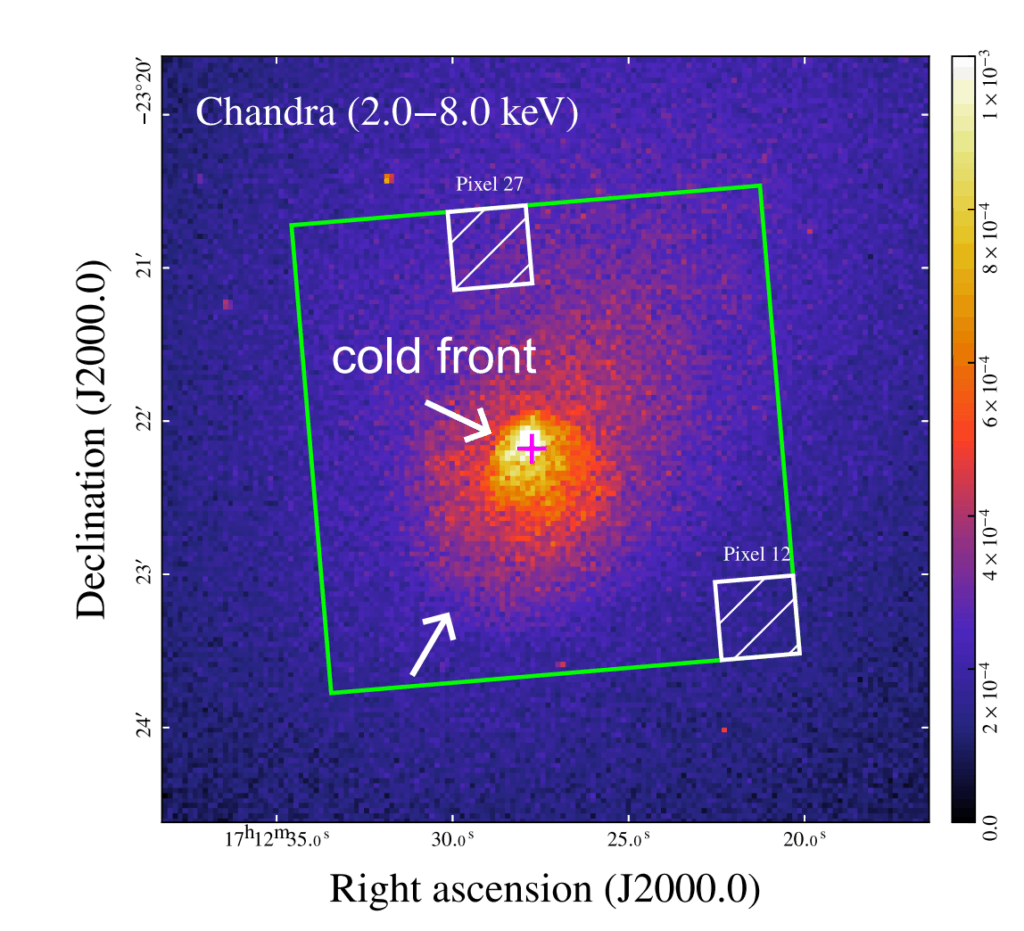
Ophiuchus is an interesting case study, as previous observations showed evidence of extremely powerful AGN activity. Images from the Chandra X-ray observatory (see Figure 1) suggested that the gas in the cluster center is moving, driving cold fronts and shocks. But to better understand the velocity structure, spectroscopic data is necessary.
So in this work, they looked at Ophiuchus with XRISM, an X-ray telescope jointly led by JAXA (Japanese Space Agency), NASA (US Space Agency), and the ESA (European Space Agency). XRISM has the highest spectral resolution of any X-ray telescope to-date, which allows researchers to measure the velocities of the ICM with unprecedented precision. Figure 2 shows the XRISM spectrum, taken from observations at the cluster center and in a region 25-50 kiloparsecs away from the center. The spectrum is dominated by emission from iron lines, and the width of those lines provides information about how fast the gas is moving.

Uh oh, the gas is slow!
They found that gas in the cluster’s core has a velocity dispersion of about 115 km/s, which while very fast by human standards, is actually too low to counteract the cooling we would expect to see in this cluster. At these velocities, they estimate the heating rate from turbulent motions is only about 40% the cooling rate, meaning that it could not alone explain why the gas is not cooling extremely rapidly.
It’s possible that we may be witnessing a transition point in this cluster, where the AGN feedback has been weakening and more cooling may be able to happen. This could suggest that clusters go through cycles of activity where sometimes heating and cooling are not balanced. Or it could mean that there is something else heating the gas that we aren’t capturing with the X-ray observations shown here. There is still a lot more left to understand about the ICM!
Astrobite edited by Kylee Carden
Featured image credit: NASA’s Chandra X-ray Observatory, ESA’s XMM-Newton, the Murchison Widefield Array, and the Giant Metrewave Telescope.
