
Title: Geodynamics of Super-Earth GJ 486b
Authors: Tobias G. Meier, Dan J. Bower, Tim Lichtenberg, Mark Hammond, Paul J. Tackley, Raymond T. Pierrehumbert, José A. Caballero, Shang-Min Tsai, Megan Weiner Mansfield, Nicola Tosi, Philipp Baumeister
First Author’s Institution: Atmospheric, Oceanic and Planetary Physics, Department of Physics, University of Oxford, Oxford, UK
Access: Published in JGR Planets on October 27 2024; preprint posted on arxiv on August 20 2024
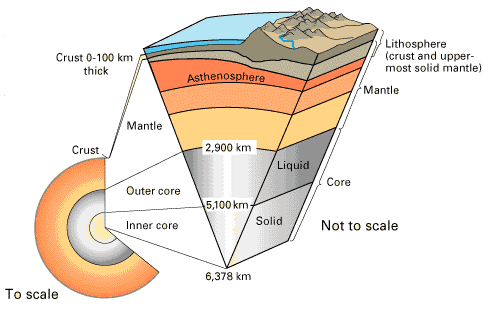
Out of every planet we’ve detected in the Universe so far, we only know of one with active (ongoing) plate tectonics, and it’s our home, Earth. While Mars, Mercury, the Moon, and Venus are thought to have experienced some form of tectonics, it is not like our plate tectonics. Our lithosphere, the outermost rocky layers of our planet including the crust (seen in Figure 1), is brittle yet elastic. It floats on top of the aesthenosphere, the partially molten rock slowly flowing in the upper mantle, which tugs and pushes at the lithosphere. Cooling over Earth’s formation history, coupled with these forces from the interior, has broken our lithosphere up into multiple plates whose motion is largely driven by convection in the mantle. Gravity cycles regions of these plates in and out of the mantle in a process known as subduction, leading to a dynamic Earth surface and plate tectonics as we know it.
Every terrestrial planet in our Solar System started off as a molten heap of rock – why don’t they have plate tectonics too? What gives?
In short, it’s due to an intricate combination of factors that includes composition, mass, light received from the Sun, temperature, and countless other aspects that planetary scientists are hard at work understanding. We have a pretty good idea why Mercury and the Moon don’t have plate tectonics–they are so small compared to Earth, Venus, and Mars, that, after formation, they lost much more heat in much less time. Thus, their lithospheres comprise only one “plate,” the mostly intact shell that wraps around their respective aesthenospheres, which has been slowly contracting as it cools further. Geologists call this kind of tectonic behavior a “stagnant-lid” regime, named so for the shell, which is like a lid. Mars is a bit more complicated. Despite having a mostly inactive core and its lithosphere contracting like that of the Moon and Mercury, its surface features suggest a tectonic history rife with volcanism. Venus is mainly a huge unknown due to its near-impenetrably opaque atmosphere, but radar data and modeling leads us to suspect signs of volcanism and perhaps periods of tectonic activity in what is called an “episodic-lid” regime. What distinguishes Earth from its brethren is its not-so-secret weapon: liquid water, which lowers the melting temperature of rock in the lithosphere and the aesthenosphere, “lubricating” the lithospheric plates and making it easier for them to slide around.
Given the uncertainty around geodynamics on other planets in our Solar System, this begs the question: what about exoplanets? What kind of tectonics would they have?
As of this Astrobite, there have been over six thousand exoplanets detected, representing a mindboggling diversity of worlds. One particularly common type is the Super-Earth, an exoplanet whose mass is higher than Earth’s, but lower than Uranus or Neptune. Despite their name, their actual composition and structure could be very different from Earth–some are giant lava worlds, others are tidally locked to their star, and some may be water worlds. This makes Super-Earths compelling laboratories to test planet formation theories in the most extreme conditions. While we can’t observe their interiors directly, astronomers, planetary scientists, and geologists are working together to make inferences from observations and models.
One such Super-Earth is GJ 486b, which lies 26 lightyears away from Earth, and the subject of today’s paper for a variety of reasons. It has been estimated to have an Earth-like density and composition and JWST discovered potential traces of water vapor in its atmosphere (although it might be from starspots). This might make it a hopeful candidate for an Earth-like planet, if it weren’t for the fact that it is too close to its host star to be in the habitable zone and thus sustain liquid water on its surface. Additionally, it is likely tidally locked to its star, meaning one side permanently faces its star, while the other experiences endless night.
An earlier Astrobite covered a later study by different authors who modeled possible interior structures that would line up with JWST atmospheric data. Today’s paper is somewhat older than that article, but focuses on the effects of tidal locking on tectonics development on GJ 486b. They hypothesize that if GJ 486b does have an atmosphere, heat would travel between the night and day sides more efficiently, meaning less of a difference between night side and day side temperatures. If it does not have an atmosphere, there would be a dramatic difference, as there wouldn’t be air to smear out heat across the planet. They also surmise that in the case it did not have an atmosphere, the direction of mantle convection would differ on either side (hemisphere), which they dub anchored hemispheric tectonics.
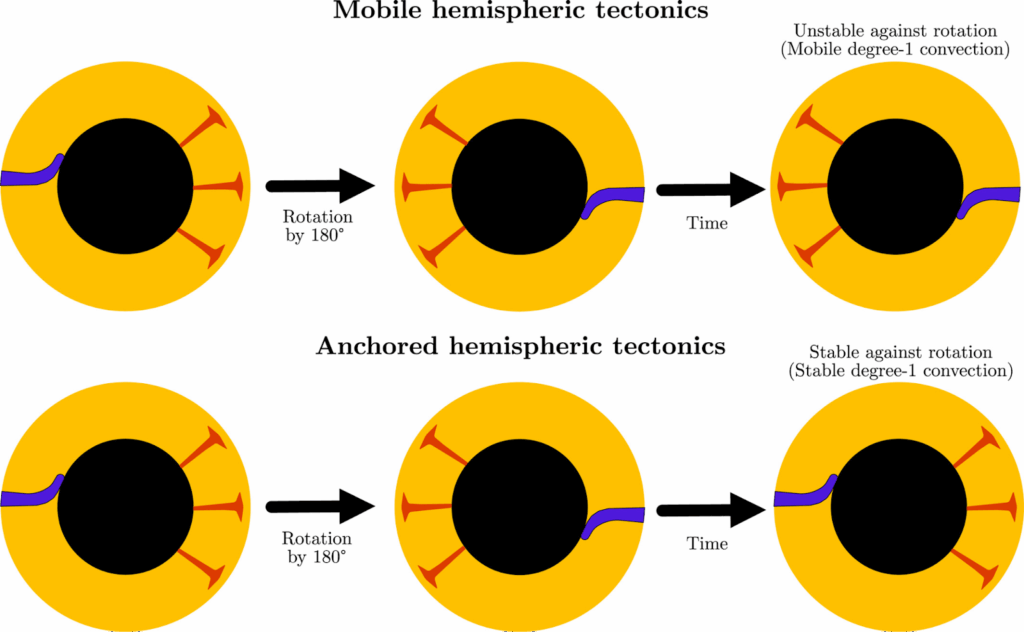
Anchored hemispheric tectonics has no analog in the Solar System, but its cousin, mobile hemispheric tectonics, has been thought to have potentially occurred in the early history of the mantles of Mars and the Moon. There, violent impacts and volcanic activity would have forced giant pillars of magma to rise up from the core and into one side of the mantle, which would eventually migrate into the other side–hence the term mobile. In geophysics, mantle convection is described in terms of “degrees.” A “degree-1” pattern, which corresponds to hemispheric tectonics, is essentially one big loop where hot rock rises on one side (an upwelling) and cold rock sinks on the other (downwelling). This can occur in both mobile and anchored hemispheric tectonics.
The authors use mantle convection code StagYY to model the mantle convection within GJ 486b. They also model the lithosphere strength, which is how much stress the lithosphere can take before it breaks. They create four different surface temperature distribution cases:
- Tidally locked, no atmosphere: surface temperature on day side is much higher than on night side
- Heat-efficient atmosphere: surface temperature is the same throughout the planet
- Average of the no-atmosphere and heat-efficient atmosphere models: surface temperature on day side is approximately twice as high as on night side
- Earth-like, heat-efficient atmosphere: surface temperature is the average Earth surface temperature (300 K) throughout the planet
For each of these cases, they assign low and high lithospheric strength models, and run StagYY for 50 million years. Throughout the simulation, they track the direction and location of upwellings and downwellings, determined by temperature differences in the mantle.
The authors find that lithosphere strength and the surface temperature contrast seem to strongly influence the direction of mantle convection throughout time, and tectonic behavior. Upwellings and downwellings tend to have no preferred hemisphere in models with weak lithosphere strength. But in models with high lithosphere strength, upwellings tend to favor one hemisphere while downwellings favor the other, indicating degree-1 convection. This occurs for these models even when day side and night side temperature differences are lowered or minimal, suggesting that lithosphere strength has more of an influence than temperature contrast.
While the high lithosphere strength models show degree-1 convection, making them hemispheric tectonics, the authors must test whether they are in the mobile or anchored regime. They do this by rotating the models so that the upwellings and downwellings occur on opposite sides, then watching for whether they return to their original locations. Those that do are considered stable, and thus display anchored hemisphere tectonics. Models where upwellings and downwellings do not return to their original hemispheres display mobile hemisphere tectonics. Rotation’s impact on these regimes is displayed in Figure 2.
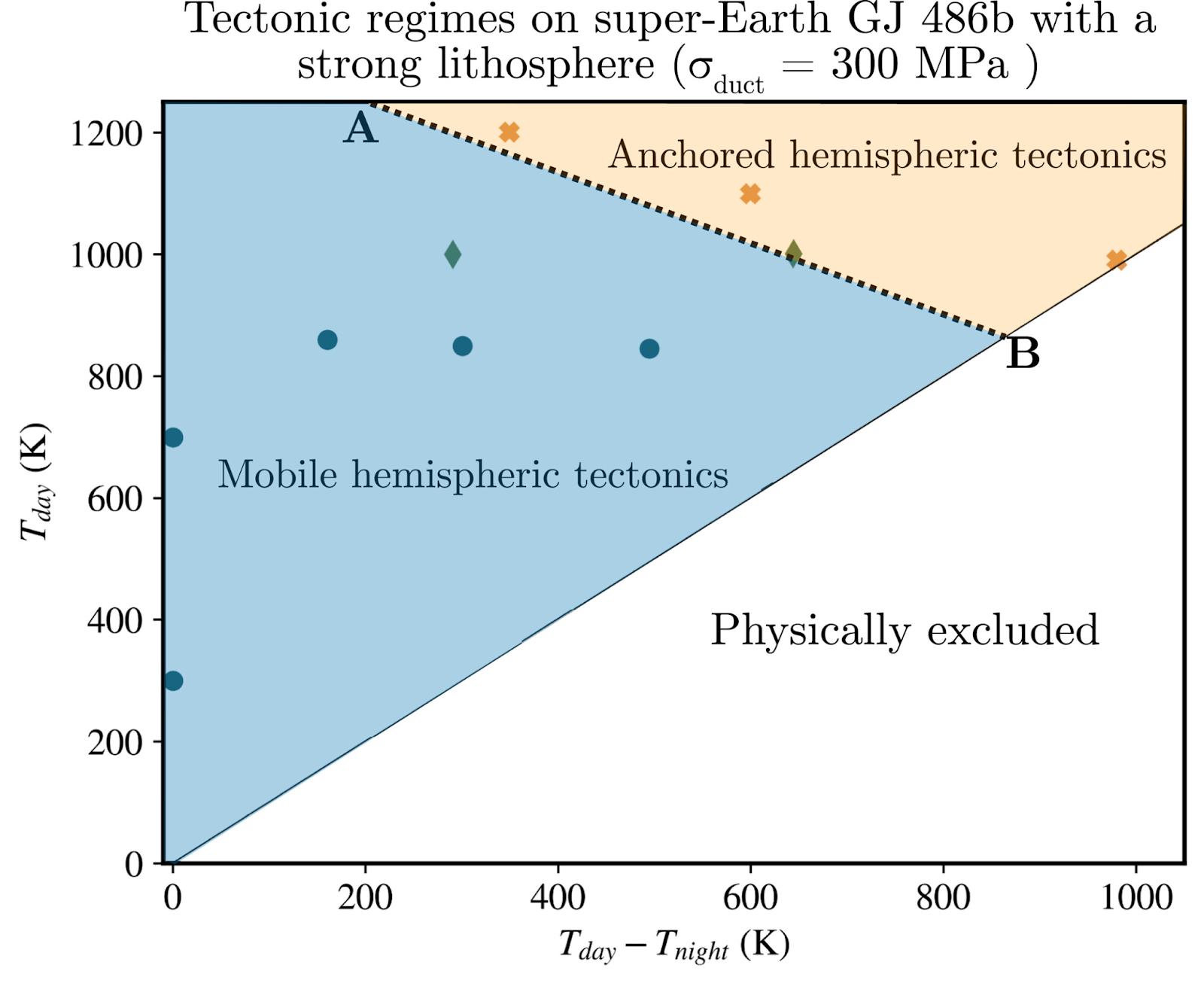
Tidally locked models with strong temperature contrasts favor anchored hemispheric tectonics, as long as the day side temperature is above 845 K. Weaker contrasts, and lower day side temperatures, result in mobile hemispheric tectonics, as seen in Figure 3. Figure 3 displays how temperature contrasts land strong lithosphere models into the two hemispheric tectonic regimes.
Overall, from these models it seems that rocky Super-Earth may fall into different tectonic regimes based on their lithosphere strengths and atmosphere contrasts. Weak lithospheres might tend to produce uniform mantle convection, while stronger ones favor degree-1 convection. This will influence how heat and volatiles flow through a planet’s interior and atmosphere, ultimately affecting habitability. While temperature contrasts may be discernable from exoplanet observations, lithosphere strength will be much trickier to confirm observationally if at all. The key will be to look for clues, such as potential signs of volcanism in exoplanet spectra. Exo-tectonics is truly out of this world!
Astrobite edited by Abbe Whiteford
Featured image credit: Ana H. Lobo

