
Title: Gravitational scattering of ejecta in the Didymos system cannot explain the evolution of the binary’s orbital period
Authors: Harrison Agrusa, Camille Chatenet
First author’s institution: Université Côte d’Azur, Observatoire de la Côte d’Azur, CNRS, Laboratoire Lagrange, Nice, France
Status: Accepted to Astronomy & Astrophysics [open access]
Asteroids are small rocky or metallic bodies – leftover remnants from planet formation and relics of the early Solar System that encode its history and evolution. Our Solar System hosts a delightful asteroid belt between the orbits of Mars and Jupiter, that we can admire and study from a distance. We’ve learned about planet formation, orbital resonances, and much more from the asteroid belt. However, some large asteroids unfortunately make the trip into the inner Solar System and towards Earth.
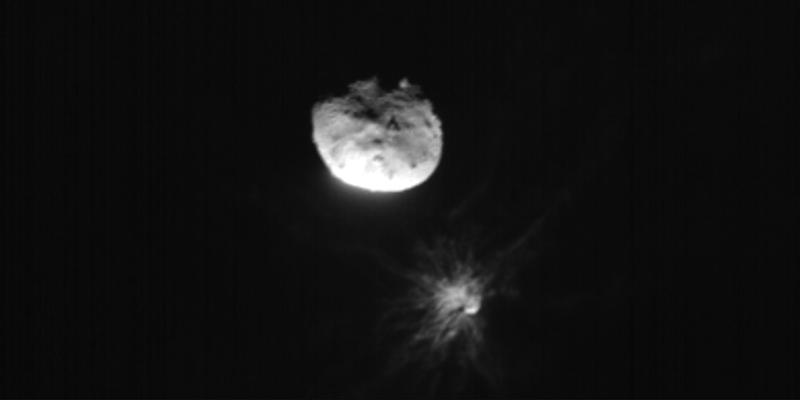
A massive asteroid impact some 66 million years ago caused a mass extinction event that eliminated 80% of all animal species on Earth. An encore sounds undesirable, so NASA and other space agencies have begun taking planetary defense seriously. In 2022, NASA launched the Double Asteroid Redirection Test (DART) spacecraft to intentionally collide with the asteroid Dimorphos, the smaller of two asteroids in the Didymos-Dimorphos system. On September 26, 2022, the 570-kg DART spacecraft collided with 177-meter-diameter Dimorphos at a speed of 22,530 km/hr, as shown in Figure 1.
Several ground- and space-based telescopes observed Dimorphos during and after the collision, finding an immediate ~30 minute drop in the orbital period of the system. In the months following the collision, an additional ~30 second period decrease was observed, and the authors of today’s paper are interested in the cause of this subsequent period decrease.
The authors of today’s paper simulate the evolution of the Didymos-Dimorphos system with a cloud of particles, ejecta, kicked up by the collision. In a closed system, angular momentum is conserved. So, if the orbital period is decreasing, which implies orbital angular momentum is being lost, there must be a mechanism at hand. Previous studies proposed binary hardening, the loss of angular momentum as ejecta are scattered out of the system, as the most likely solution. The authors of today’s paper run an N-body simulation to investigate whether Didymos-Dimorphos can scatter particles out of the system faster than those particles re-accrete back onto a body.
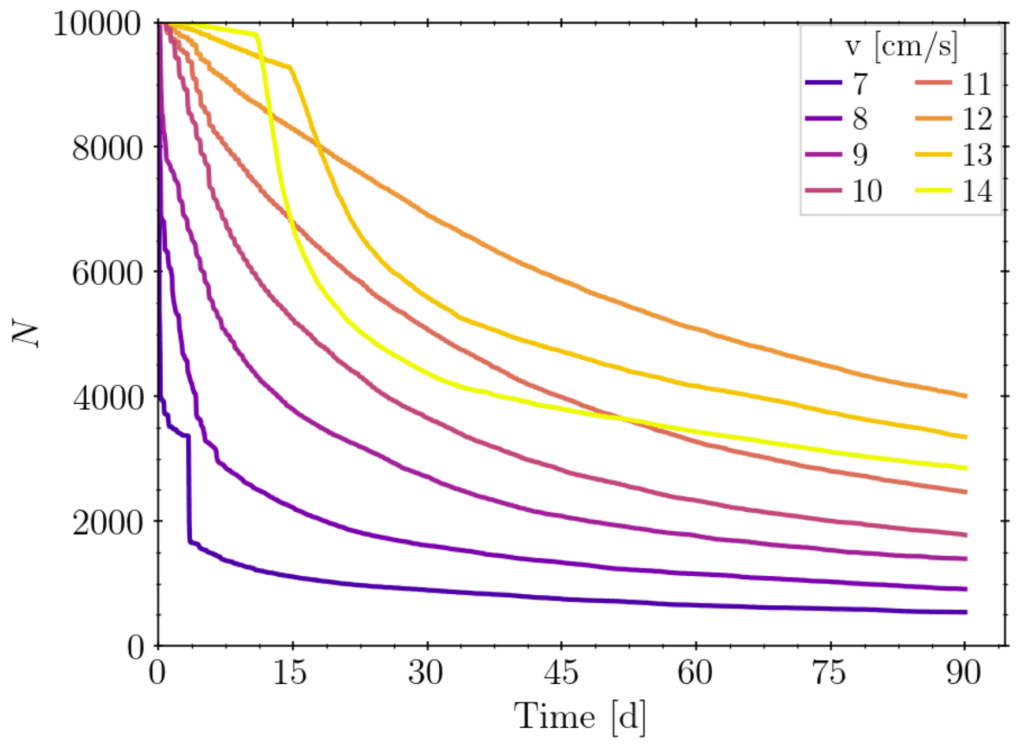
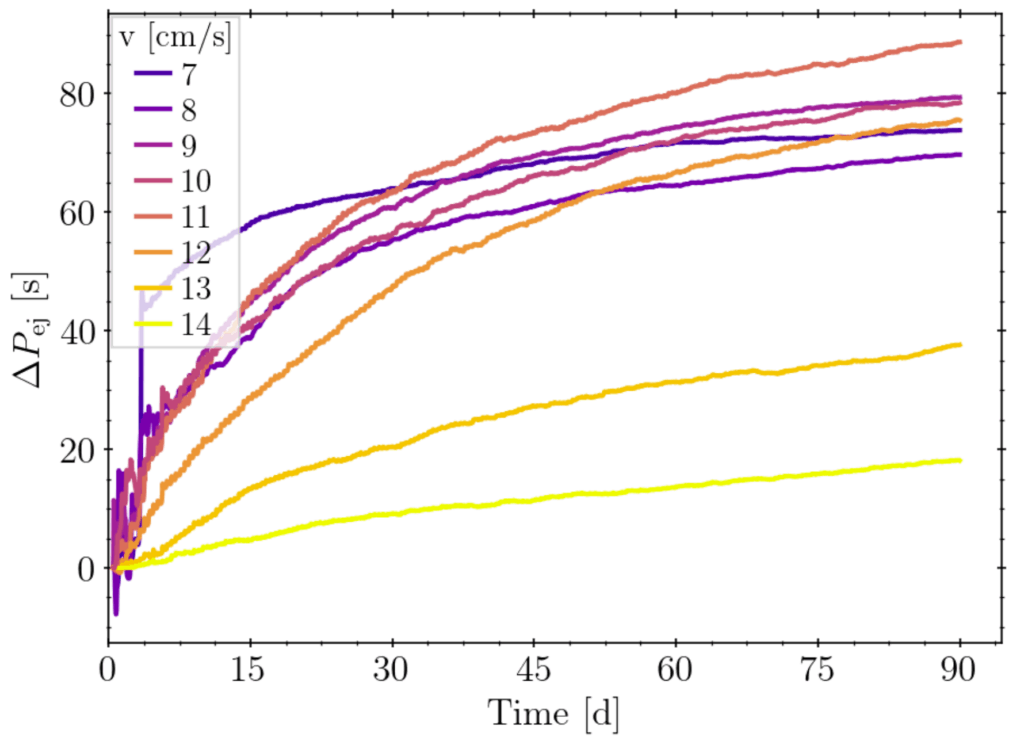
The simulation is run with the REBOUND code, a popular choice for simulating gravitational interactions, and the initial conditions of the ejecta cone were adopted from observations right after the collision. The authors run eight simulations, each with a different ejecta speed from 7 – 14 cm/s. The bounds are chosen because ejecta with speeds < 7 cm/s are rapidly re-accreted, and ejecta with speeds > 14 cm/s are rapidly ejected so only intermediate-speed ejecta contribute to gradual evolution after the collision. Figure 2 shows the population of ejecta particles, showing a rapid decrease over time for each possible speed.
Figure 3 shows the main result of the paper, that for any ejecta speed, the binary period is expected to increase over time. This is because Didymos-Dimorphos is a weak scatterer, and particles are much more likely to re-accrete and add angular momentum back to Didymos-Dimorphos. This result challenges the plausibility of binary hardening.
So, could higher-order effects (like radiation pressure, solar tides, asteroid spin, gravitational attraction among ejecta) matter? Maybe, but it seems unlikely, especially since the authors ran some preliminary tests and found no difference. A bigger caveat is that the ~30 s subsequent period decrease is only a marginal detection and might not be real. If it is real, the authors speculate it is more likely due to additional reshaping of Dimorphos from DART-induced chaotic rotation. The reshaping could continue gradually after the impact, changing the mutual potential of the system and, consequently, the orbital period.
It is strange for a binary system to evolve differently than we expect, and this paper shows the richness of the physics involved. Spacecraft collisions to redirect asteroids might be the future of planetary defense. If so, we should be able to robustly predict the outcome of such collisions, you know, in case that ever becomes important.
Astrobite edited by Ryan White
Featured Image Credit: NASA, ESA, STScI, Jian-Yang Li (PSI); Image Processing: Joseph DePasquale
