
Title: Cosmological feedback from a halo assembly perspective
Authors: Luisa Lucie-Smith, Hiranya V. Peiris, Andrew Pontzen, Anik Halder, Joop Schaye, Matthieu Schaller, John Helly, Robert J. McGibbon, Willem Elbers
First Author’s Institution: Hamburger Sternwarte, Universität Hamburg, Gojenbergsweg 112, D-21029 Hamburg, Germany
Status: Published in Physical Review D [open access]
Understanding the formation history and evolution of galaxy clusters – massive regions of hundreds or thousands of galaxies – tells us about the history and makeup of our Universe. We can estimate different cosmological parameters from clusters, like ΩM (the matter density in the Universe) and σ8 (the clumpiness of matter in a given volume), which tell us about the distribution of matter over time. However, depending on which measurements (“cosmological probes”) are used, these parameter estimates aren’t always in agreement with one another.
The measurements of cosmological probes depend on the internal mass and energy flow, or feedback, of the cluster. This feedback is often due to activate galactic nuclei (AGN), which can push baryonic (normal) matter far out from the center of the dark matter halo the galaxy sits in. The baryonic cycle within halos are important, as it can define the mass evolution and star formation history of the galaxy within.
In today’s paper, the authors use the FLAMINGO simulations of galaxies and clusters to study if the cosmological probes themselves are sensitive to different galaxy populations. They studied a set of galaxy clusters across different masses and redshifts, and the mass evolution of those clusters. If the galaxy halo mass evolutions are strongly affected by baryonic feedback rates, then cosmological probes might be biased for different samples. If this is the case, then the tension between estimates of cosmological parameters might be due to population bias and not something intrinsically wrong with λCDM cosmology.
The FLAMINGO simulations (see this astrobite for more) are cosmological simulations of galaxies and clusters. The authors did three sets of runs, one with the standard AGN feedback model, and two with increased rates of feedback. They were then able to select out individual galaxies in halos to study their sensitivity to different probes.
The cosmological probes used in this study are the thermal Sunyaev-Zeldovich (tSZ) effect, the kinetic Sunyaev-Zeldovich (kSZ) effect, mass estimates from the eROSITA X-ray catalogs, and weak lensing sensitivity estimates. The tSZ and kSZ effects trace the location of hot gas in the Universe by considering how electrons interact with the photons of the CMB. Measurements of the tSZ effect are lower than what is predicted by λCDM, and measurements of the kSZ effect suggest the need for strong baryonic feedback in clusters. eROSITA predicts the masses of clusters based on how much X-ray emission is present. The weak lensing sensitivity estimates consider the spatial correlation of galaxies, which can tell us about the large scale structure of the Universe. Overall, the data prefers a stronger impact of baryonic feedback than is predicted in simulations that are calibrated to reproduce the hot gas fraction in low-redshift X-ray bright groups and clusters.
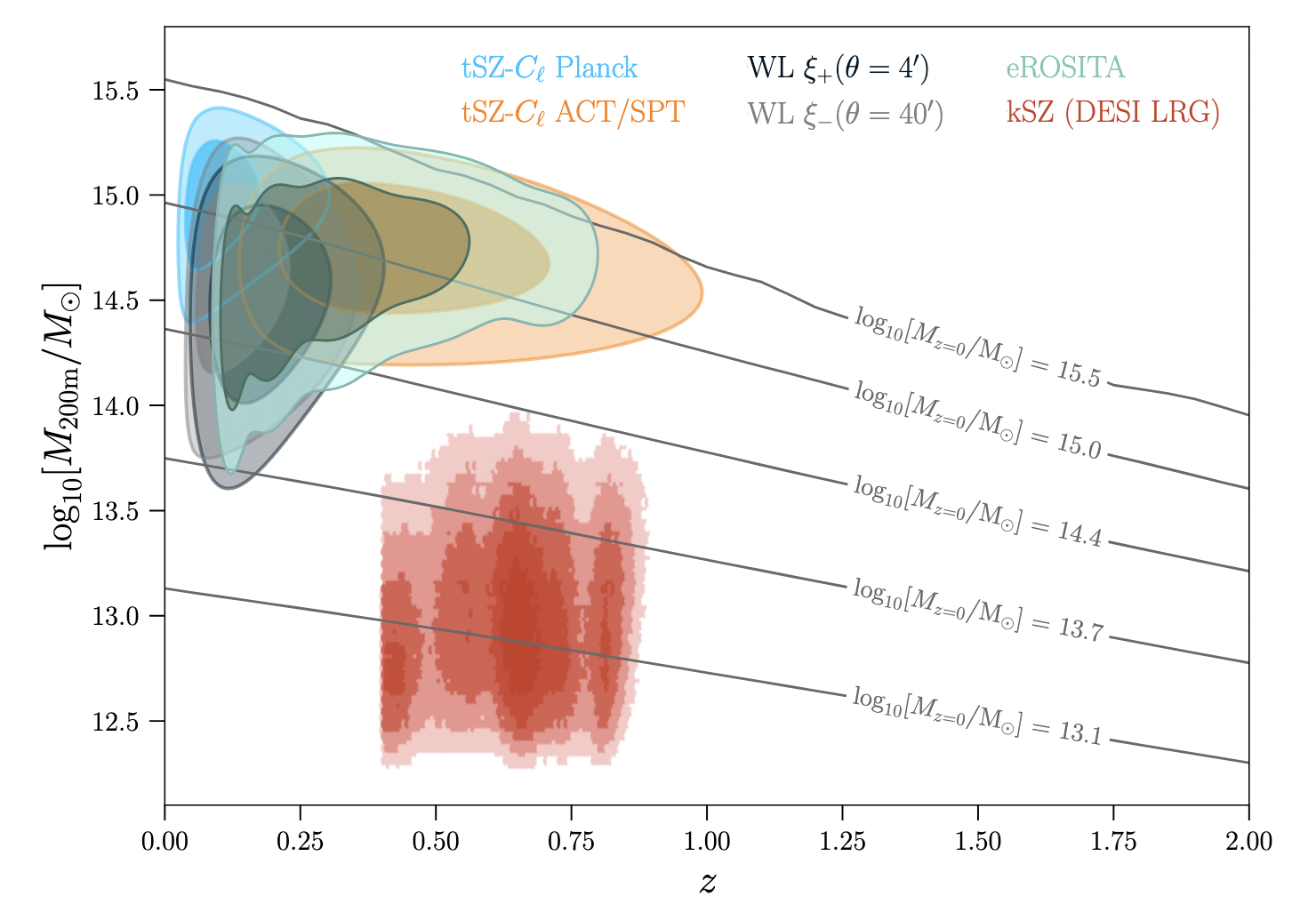
The study found two distinct halo populations: 1) a high mass cluster population that is well probed by tSZ, weak lensing, and eROSITA measurements, and 2) a lower mass, low redshift (0.4<z<1) group well probed by kSZ (Figure 1). This suggests that the feedback constraints and cosmological parameter estimates within each of those two groups of probes should be consistent, as they reflect the same halo population. However, the two populations’ probes might not be consistent with each other, and this could be causing at least some of the tension in the estimates of different parameters from different measurements. The catalogs used in the study are representative of other catalogs of the same measurements, suggesting that this might be broadly applicable in the field.
The authors mapped the baryonic mass fraction in the halos over time, and found that baryonic feedback does not manifest in the same way for the two populations. In the massive halo population, feedback was more efficient at early times (z~2-4), but dropped off in more recent times. Baryons ejected in that earlier era were not fully kicked out of the gravity well, and were re-accreted at later times. The lower mass population saw more efficient feedback at more recent times (z~2). This can explain some of the apparent tension in gas mass fraction estimates, as the two sets of probes are measuring halos at different feedback efficiencies.
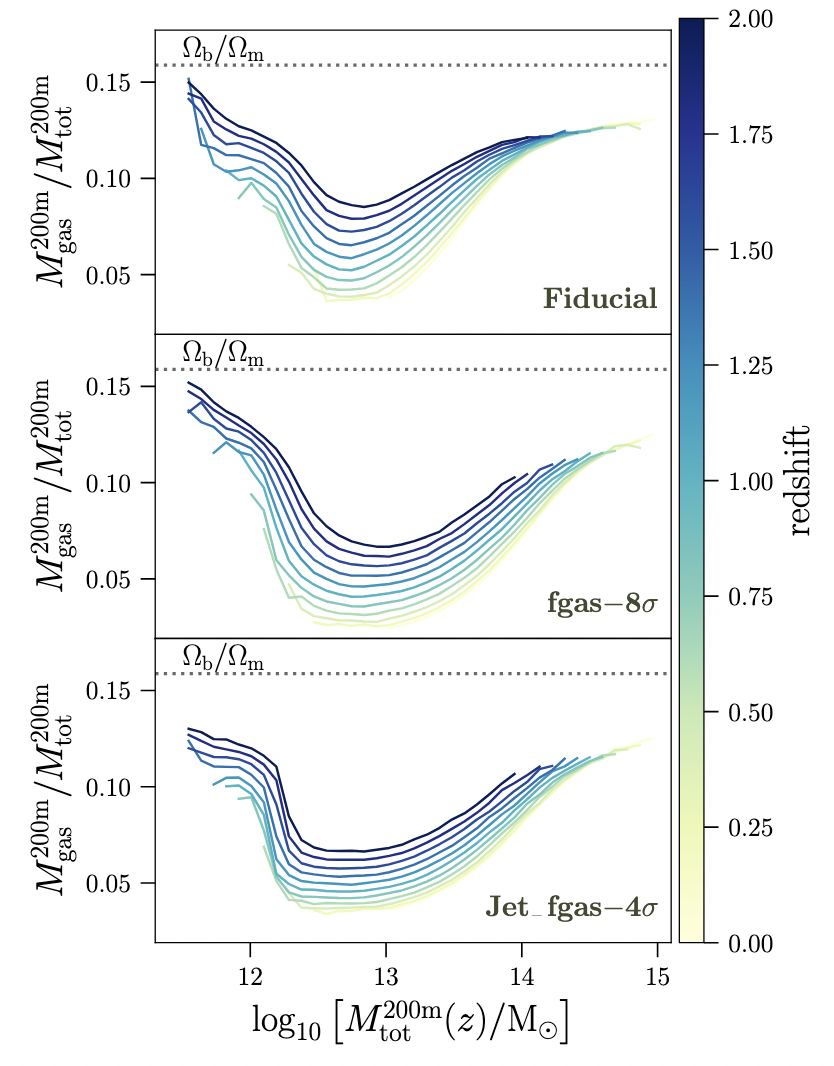
They also considered the baryonic feedback at fixed halo masses across time. The feedback was more efficient at expelling gas when halos were at a gas mass of 1012.8 Msun, regardless of redshift, which would place them mostly in the low-mass population.
The radial dependence of AGN feedback is also important, as kSZ is easier to measure on the outskirts of halos. In FLAMINGO the high mass clusters were less radially sensitive to feedback, and the lower mass halos were more sensitive, which explains why kSZ is a better probe for the low mass clusters.
These results show a bias in galaxy halo populations towards different cosmological probes at different stages of their assembly and evolution. This can help explain the tension between estimates of cosmological parameters, but is only part of the picture when it comes to untangling the large-scale universe.
Edited by Anavi Uppal
Thanks to Derek Perera for the weak lensing discussion
Featured Image Credit: Braspenning+24 Figure 1, WikiMedia Common

.jpg)