
Title: Caught in the Act of Quenching? — A Population of Post-Starburst Ultra-Diffuse Galaxies
Authors: Loraine Sandoval Ascencio, M. C. Cooper, Dennis Zaritsky, Richard Donnerstein, Donghyeon J. Khim, Devontae C. Baxter
First Author’s Institution: Department of Physics & Astronomy, University of California, Irvine, 4129 Reines Hall, Irvine, CA 92697, USA
Status: Published in the Open Journal of Astrophysics [open access]
Most Astrobites, talks, and classes about galaxies start with the idea that there are two main types of galaxies: star-forming spiral galaxies like the Milky Way, and quiescent (or non-star-forming) elliptical galaxies. This is true, but it’s also a simplification—galaxies come in many shapes and forms, some of which have only been discovered recently. Today’s authors search for rare “post-starburst” galaxies among a sample of some of the strangest galaxies in the Universe: Ultra-Diffuse Galaxies.
What are Ultra-Diffuse Galaxies?
Ultra-diffuse galaxies (UDGs) are galaxies with masses similar to other dwarf galaxies (107 to 108.5 solar masses) but radii of several thousand light-years, not much smaller than the Milky Way. We don’t know exactly why some galaxies are so diffuse. One theory is that UDGs are “failed” Milky-Way-like galaxies, with dark matter halos similar to the Milky Way’s, but which stopped forming stars early in their evolution. Another theory is that dwarf galaxies in groups get stretched out by gravitational interactions with more massive galaxies in a process called “tidal heating.” Most UDGs we’ve found so far are in groups of galaxies, lending support to this idea; however, there exists a population of UDGs out on their own in the Universe, and we don’t know how they formed.
Today’s authors start with a sample of candidate UDGs from a survey called SMUDGes (Systematically Measuring Ultra-Diffuse Galaxies). They choose galaxies that are bright enough to show up in imaging from the Dark Energy Spectroscopic Instrument (DESI), but extended enough to be low-density galaxy candidates. The authors search for quiescent galaxies from their sample that still have some contribution from A-type stars, which live for about a billion years. These stars indicate that a galaxy is “post-starburst,” or a galaxy where star formation shut down recently. Since their star formation shut down in the recent past, post-starburst galaxies offer astronomers a chance to search for the physical mechanisms that cause the end of star formation in galaxies.
Confirming post-starburst UDGs
UDGs are defined by having very low surface brightness. When observing an object at a distance, its observed brightness will decrease as the distance increases. In astronomy, we call the observed brightness “apparent magnitude” and the real brightness “absolute magnitude.” To convert between the two, we use the formula
M = m – 2.5 log[(d/10)^2]
Where M is the absolute magnitude, m is the apparent magnitude, and d is the distance.
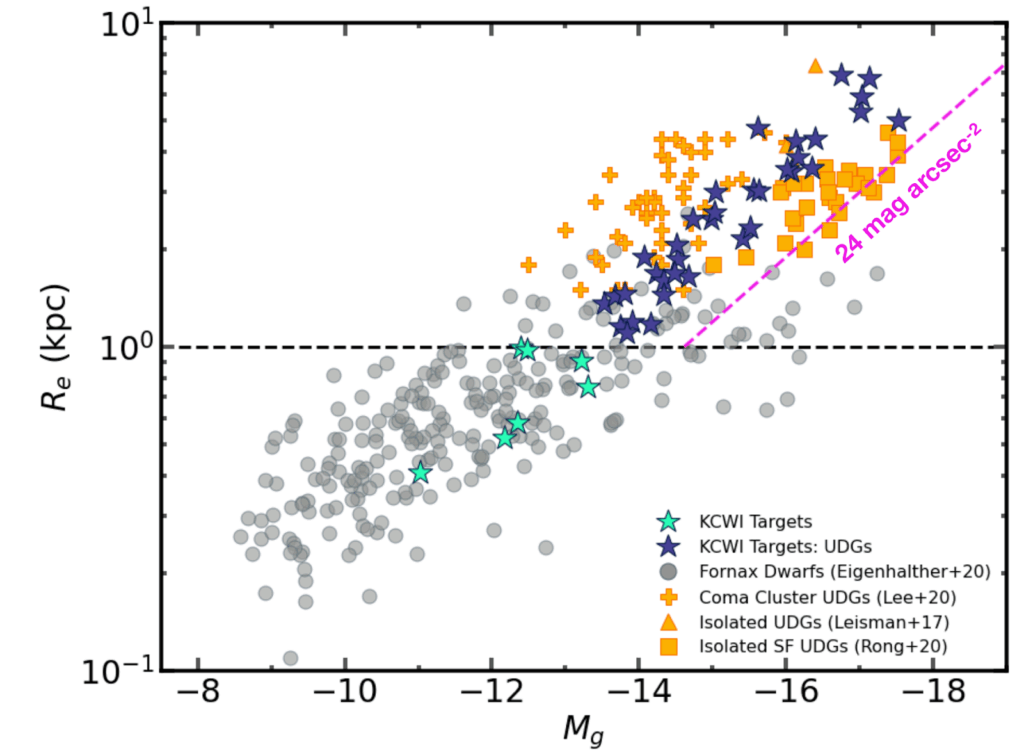
For the UDG candidates in SMUDGes, previous estimates of distance were based only on imaging, which is less certain than the distance we can measure spectroscopically. By taking a spectrum, the authors confirmed the distances of the UDGs to find their absolute magnitudes. Then, they checked whether the UDG candidates met their threshold surface brightness and found that 35 of 42 were truly UDGs (Figure 1).
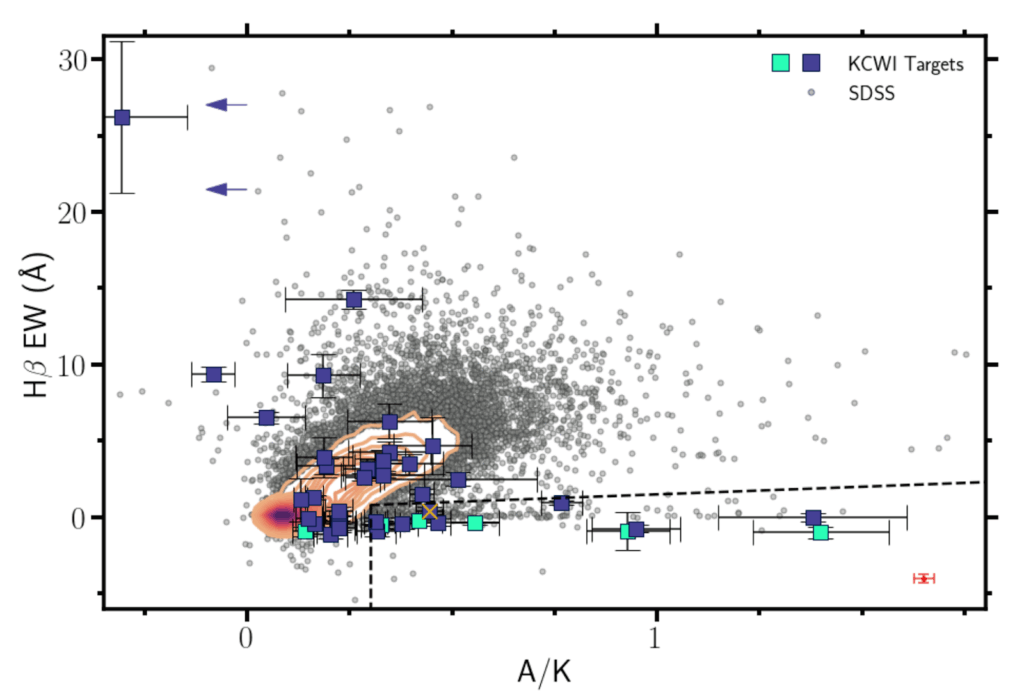
Then, the authors search for post-starburst UDGs by comparing the light from A stars to the light from an older stellar population. If the UDGs have lots of light from A stars, it indicates they experienced a starburst within the last billion years. The authors find 7 post-starbursts in their confirmed UDG sample, meaning 20% of UDGs are post-starburst. This is a much higher fraction than for normal galaxies (~1% of all galaxies are post-starbursts).
Why so many post-starburst UDGs?
The authors spend the rest of the paper discussing why there’s such a high post-starburst fraction among UDGs. Post-starburst galaxies are more common among less massive galaxies, but only by a few percent. It would take something special to explain why UDGs have such a high post-starburst fraction.
One hint may lie in the environments of these PSB UDGs. Four of the seven post-starburst UDGs are likely satellites of nearby groups or clusters of galaxies. UDGs in dense galactic environments could have their gas stripped by gravitational interactions with more massive galaxies, removing the fuel for star formation. This is supported by the fact that all the other quiescent UDGs in their sample are in groups, meaning interactions with other galaxies are likely required to shut down star formation in UDGs. These same gravitational interactions may also serve to stretch out a normal galaxy, turning it into a UDG.
But what about the other three post-starburst UDGs in this sample that don’t live in galaxy groups? The authors suggest these galaxies are experiencing bursty star formation, with brief periods of quiescence before stellar material is recycled for a new period of star formation. Since these UDGs still have stars that formed in the past billion years, the authors claim these quiescent periods must last less than a billion years. These periods would perhaps be driven by stellar feedback, or the heating/removal of gas by supernovae and stellar winds.
No matter how they quenched or how long they’ll stay quiescent, these three isolated post-starburst UDGs pose a real challenge to our understanding of galaxy evolution. Future work with larger samples of UDGs will be needed to understand how these strange objects form and evolve.
Astrobite edited by Viviana Cáceres
Featured image credit: NASA, ESA, and P. van Dokkum (Yale University)
