
Authors: Peng Peng, Alessia Franchini, Matteo Bonetti, Alberto Sesana, Xian Chen
First Author’s Institution: Astronomy Department, School of Physics, Peking University
Status: Published in the Astrophysical Journal [Open Access]
Active galactic nuclei (AGN) are the extremely luminous central regions of some galaxies, powered by gas accreting onto their supermassive black holes and often outshining the entire galaxy in which they reside. One reason they are so studied in astronomy is that they connect many pieces of physics and astronomy in one cosmic place. This is especially true for AGN as potential gravitational wave sources. Gravitational waves are observed when two compact objects, usually black holes, orbit each other. Black holes span a massive range of masses, but they are typically categorized into one of three categories: stellar mass black holes, or sBHs (tens to hundreds of times the mass of the sun), intermediate mass black holes or IMBHs (hundreds to thousands of times the mass of the sun), and supermassive black holes or SMBHs (millions to billions of times the mass of the sun). AGNs are special because they are among the very few places where black holes across this entire mass spectrum might be found in the same place at the same time. Not only do they host an SMBH at their centers, but their gas disks are ideal nurseries for capturing and growing sBHs and IMBHs.
Current-generation gravitational wave detectors like the LIGO–Virgo–KAGRA (LVK) network can observe stellar-mass to lite-IMBH black hole mergers. Future detectors like LISA will be able to observe black holes in the intermediate-mass to supermassive mass range. In addition to the mass range a detector can detect, it is also valuable to know the mass ratio (usually denoted by q) that a detector might detect, as unequal mass ratio mergers can tell us a lot about General Relativity that more equal mass mergers cannot because the smaller object orbits the more massive one many times right before merger, essentially providing a gravitational wave measurement of spacetime around the larger black hole (see this video for an example of black hole orbits with a large mass ratio, and imagine the spacetime observations around the larger black hole that could be possible with orbits like that). One of the most promising advances in gravitational wave detection with LISA will come with the observation of EMRIs, extreme mass ratio inspirals, usually defined as a smaller black hole that is at least ten thousand times less massive than the massive black hole it orbits (though the exact mass ratio defining an EMRI is a matter of convention and may vary somewhat). In addition, LISA will be able to observe IMRI’s or intermediate mass ratio inspirals, usually defined when the smaller black hole is one hundred to ten thousand times less massive than the larger one.
This paper uses multiple techniques to address the question of what happens when an AGN disk hosts both an IMBH and an sBH at the same time. They began with a hydrodynamic simulation of an AGN gas disk around a 106 solar mass SMBH. They add a 103 solar mass IMBH into the gas disk. Because the IMBH orbits within a gas disk, the gas exerts a force on it, causing its orbit to shrink toward the SMBH (a process called migration). Additionally, the IMBH carves out a path through the gas. Once the IMBH carves out enough of a path in the gas, the authors add an sBH of 20 solar masses into the simulation near the IMBH.
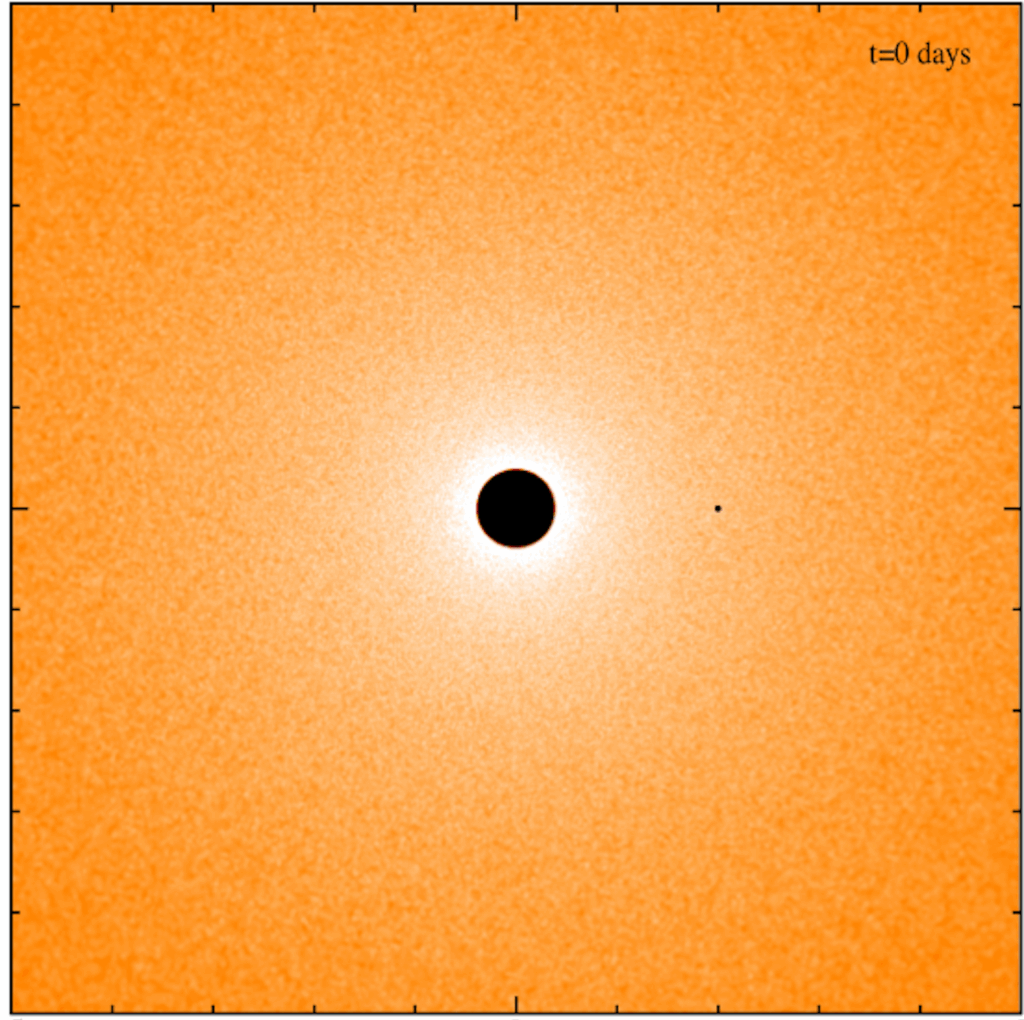
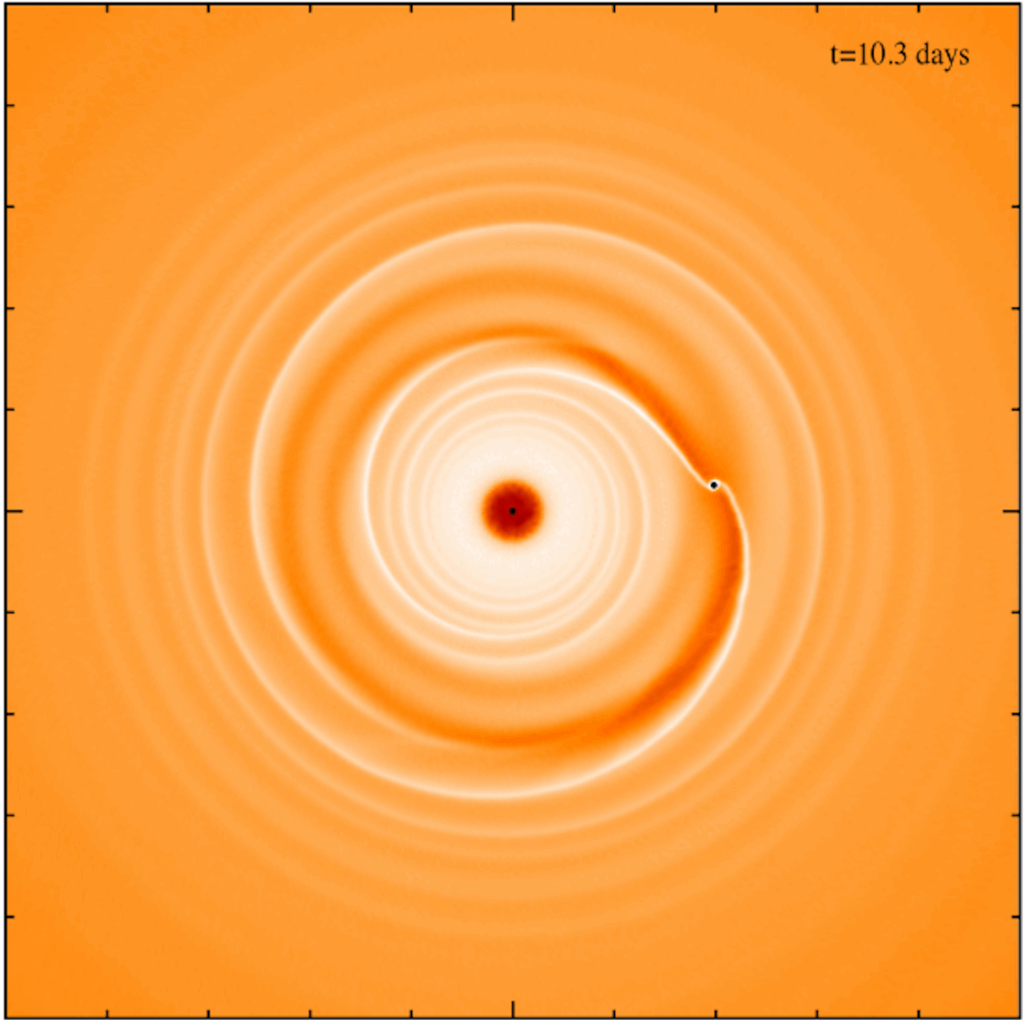
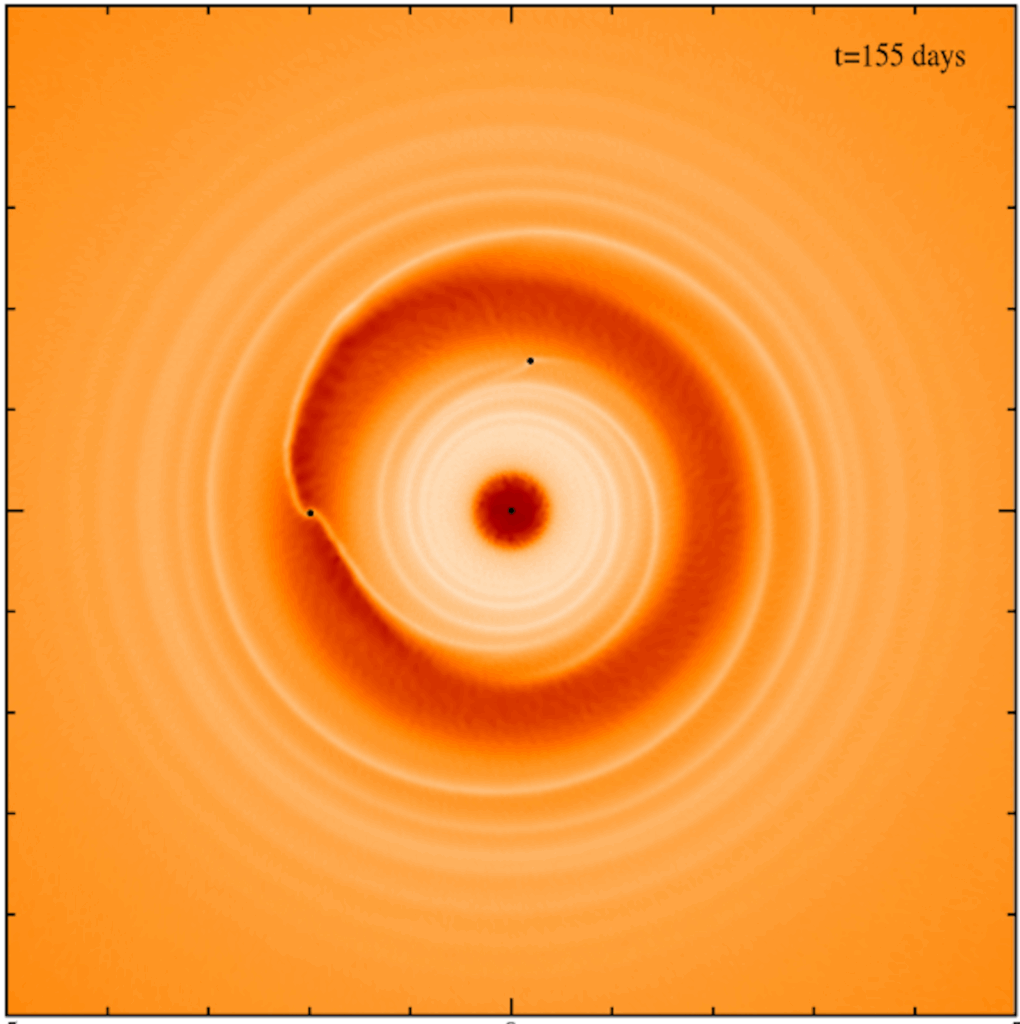
Figure 1 – Simulated gas disk around an SMBH with an implanted IMBH at 0 days (top), 10.3 days (middle), and 155 days (bottom). Brighter orange indicates higher gas density, and darker orange/red indicates lower gas density. An sBH was added at 100 days and is seen in the right panel. These three panels represent the “InnerDisk” scenario. Top row of Figure 1 in the paper.
The authors test the sBH outcome for two initial conditions of the gas disk. The first, which I will refer to as “InnerDisk,” is when gas already exists inside the IMBH’s orbit (see Figure 1). The other, which I will refer to as “NoInnerDisk,” is when the simulation begins with gas only outside the IMBHs orbit, with no gas initially between the IMBH and SMBH. In this case, gas crosses the IMBH’s gap after the simulation starts. In the InnerDisk case, the sBH initially gets pushed inward from the presence of the inner gas, but that gas steadily drains into the SMBH and is only partly refilled, so the gas’s push on the sBH weakens over time. In the NoInnerDisk case, the IMBH’s direct pull on the sBH becomes more important. The amount of gas that leaks across the IMBH orbit into the inner disk gradually settles into a steady state that is less dense than the InnerDisk case. With a weaker gas push, the sBH stays closely tied to the IMBH and migrates inward at nearly the same rate. In both setups, the IMBH carves a gap in the gas and keeps moving inward, but the presence and evolution of inner gas chiefly determine how closely the sBH can keep up.
Once the sBH and IMBH migrate close enough to the SMBH, gravitational waves are responsible for more and more of the energy loss and orbital decay of the system compared to the gas. To account for that, once the sBH and IMBH migrate close enough to the SMBH, instead of using a hydrodynamic simulation of a gas disk, they switch over to a “three-body problem” solver. Because these are black holes emitting gravitational waves, regular old Newtonian mechanics is insufficient, so they add post-Newtonian (or PN) terms to correct for this. Additionally, though they no longer model the gas hydrodynamically, they do include terms for a gas “force” acting on the black holes to mimic the gas disk.
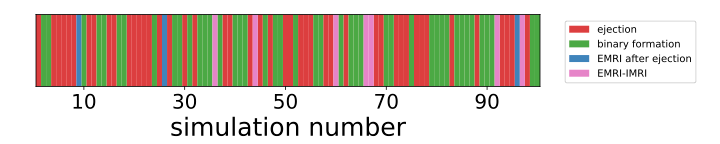
Figure 2 – Post Newtonian simulation outcomes for different values of sBH initial phase angle from 0 to 2π in increments of 0.02π, while all other initial conditions were kept fixed. Green (binary formation) represents a merger of the IMBH and sBH before reaching the SMBH, blue (EMRI after ejection) represents the sBH being ejected from the system, but not before some of its orbits can be observed as an EMRI event, EMRI-IMRI (pink) represents the sBH merging with the SMBH, followed by the merger of the IMBH with the SMBH, and red (ejection) represents the sBH being ejected from the system entirely before entering a gravitational wave EMRI regime. Figure 13 in the paper.
Once the IMBH and sBH were in the gravitational regime, their outcomes became much more chaotic. As seen in Figure 2, a slight change in the initial phase angle of the sBH can lead to drastically different consequences for the system. In some cases, the sBH is ejected entirely. In other instances, it merges with the IMBH soon after the simulation begins. Yet in others, it first merges with the SMBH. This leads to one overall message of this paper: the orbits of the IMBH and sBH tend to be regular with some gentle variation when they are further out in the gas disk, but they become highly chaotic once they shrink into the gravitational wave regime closer to the central SMBH.
AGN disks may provide a natural setting for interactions among stellar, intermediate, and supermassive black holes. The authors of this paper demonstrated that gas can keep an IMBH and an inner sBH migrating together until gravitational waves dominate, after which slight differences in their orbital phases can lead to a wide range of outcomes. While uncertainties remain, this study provides more evidence that LISA could identify. Until LISA flies, continued simulations like this one will help refine the spectrum of EMRIs and IMRIs we can expect to see.
Edited by: Maggie Verrico
Image credit: N. Franchini through AAAS Eureka Alert!
