
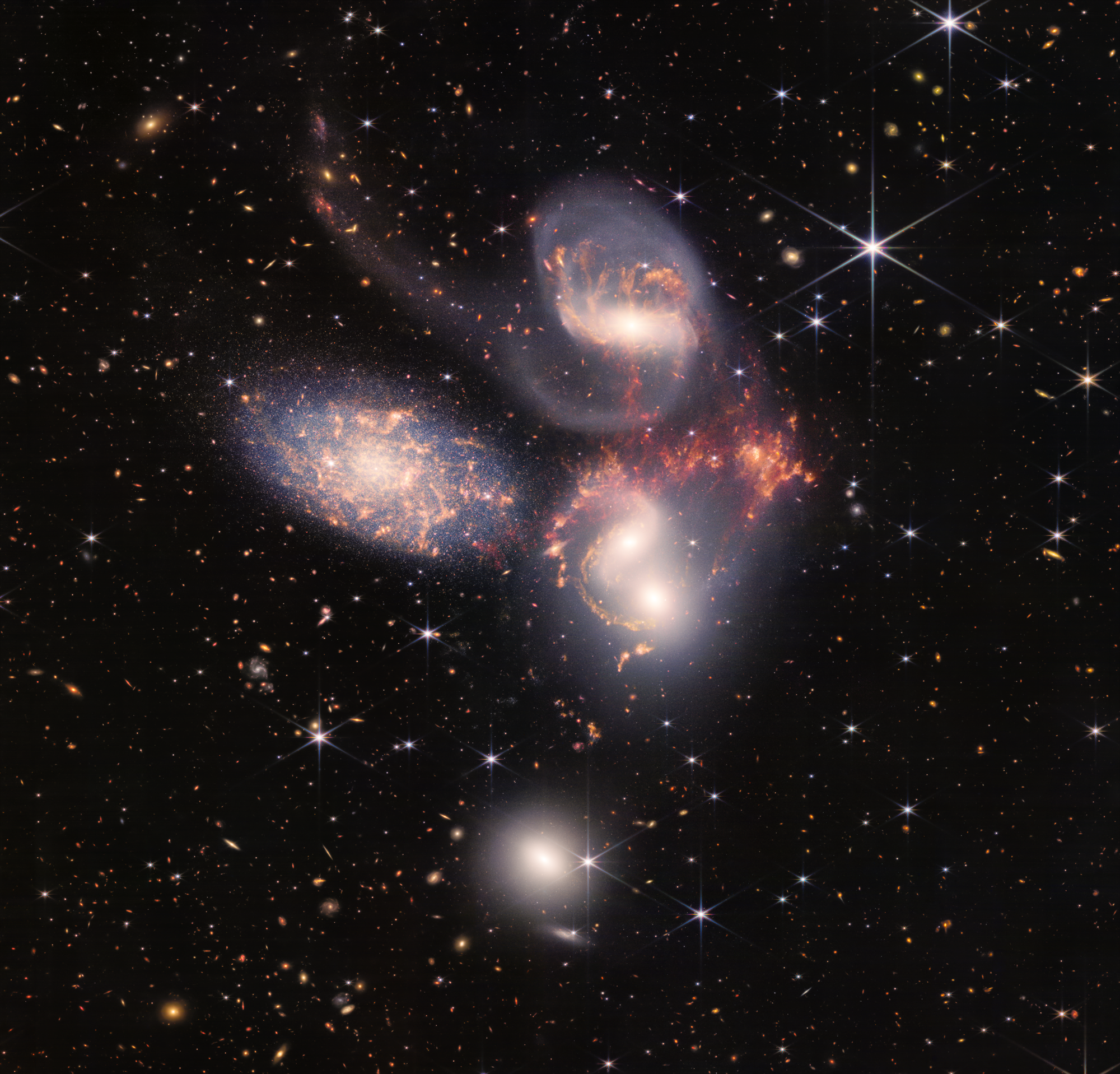
Galaxies come in a diverse plethora of shapes, colors, and sizes. Scanning across the night sky is like walking through a cosmic menagerie. You’ll find breathtaking “grand design spiral” galaxies that look much like our own Milky Way, but you’ll also come across sources that could have been plucked out of the most creative works of science fiction. It won’t be hard to notice gargantuan elliptical galaxies, whose stars mill about like swarming bees. Squinting closer, you’ll also start to notice faint dwarf galaxies, which may have a thousand stars or fewer but are nonetheless tightly held together by mystifying knots of dark matter. You’d almost certainly be enchanted by mergers, sets of galaxies whose limbs are twisting into each other, casting out streaming tails of gas, dust, and stars.
It’s easy to marvel at objects like these, but many astronomers fixate on a set of sources which might appear boring at first glance. In early images, active galactic nuclei (AGN) looked like stars – just boring points of light. But as our telescopes got bigger and better, and as we collected more and higher-quality data, they turned out to be quite mystifying. Unlike stars, AGN are strikingly bright across the entire electromagnetic spectrum, from X-rays to radio waves. Their total luminosity can exceed the power of an entire galaxy!

Many AGN rapidly fluctuate in brightness, sometimes on the scale of a few hours. This means that their emission must be confined to a relatively small space. To understand why, imagine if the light was coming from a huge object, say one thousand light-years across. If such a large source was pulsating, its various parts would have to be synchronized with each other. But even the fastest stuff in the universe can only travel at the speed of light, meaning that it would take a thousand years for different parts of this object to “communicate”. The result would be that its components couldn’t actually sync up, and we wouldn’t see rapid variations in brightness. This exercise suggests that the objects powering AGN are, at most, only a few “light-hours” across. For reference, the Earth is eight light-minutes from the Sun. Despite being comparable in size to the Solar System, AGN can outshine hundreds of billions of stars put together!
Astronomers eventually realized that the only way to power such an energetic, compact system is a black hole. We know that almost all galaxies have a staggeringly large black hole at their center. An AGN forms when one of these central black holes starts rapidly accreting gas and dust from its surroundings. As material falls onto these black holes, its gravitational potential energy is eventually released as radiation. It turns out that this conversion is significantly more efficient than nuclear fusion, which explains how it can power such intense sources. But how exactly do AGN emit such copious amounts of energy across the entire electromagnetic spectrum? Let’s dissect one, and examine how each part of an AGN gives rise to the dizzying array of features that makes them so fascinating.
Supermassive Black Hole

The central engine that powers an AGN is a supermassive black hole (SMBH). These black holes range in mass from hundreds of thousands to billions of times the mass of the Sun. SMBHs lie at the center of nearly all large galaxies, but not all of them are active. AGN are actually quite rare in the nearby universe, but evidence suggests that they were more common in the past. This hints that SMBHs may have exhausted their supply of fuel over time or pushed it away via radiative feedback.
Understanding how SMBHs formed is an extremely active area of study. The leading theory is that they started off as stellar-mass black holes, which were produced when the stars in the early universe went supernova. These seeds then grew rapidly by accreting matter around them and possibly by merging with other black holes. Over billions of years of cosmic time, they ballooned to their staggering sizes. However, our conventional understanding of this scenario is being challenged by observations from JWST, providing a tantalizing hint at something more exotic.
Accretion Disk
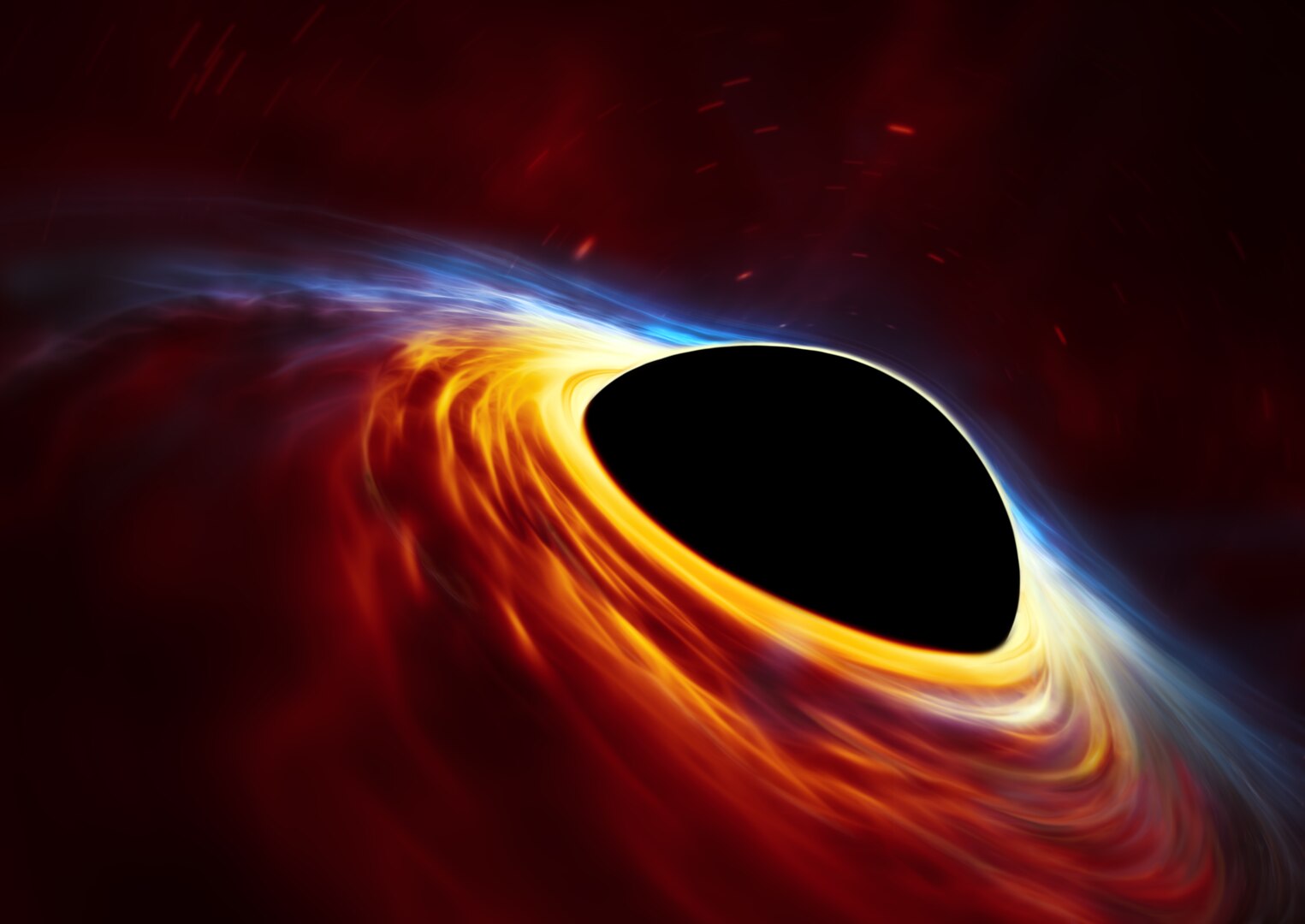
As material falls towards a SMBH, it forms an accretion disk. Friction between particles heats up this disk, causing it to glow extremely bright. The accretion disk is responsible for most of the ultraviolet and optical emission from an AGN. As you might expect, the inner edge of the disk is thought to be the hottest, while it cools off towards the edges. Unlike stars, which (roughly) produce a blackbody spectrum, the combined thermal emission from regions of the disk with varying temperatures produces a characteristic power-law continuum.
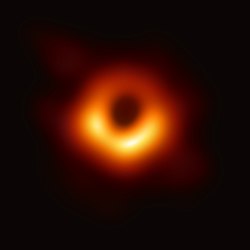
As you might expect, it’s extremely challenging to model accretion disks around black holes. Theoretical work often combines general relativity with complicated gas physics, as in the case of general relativistic magnetohydrodynamics (GRMHD). Their small scale also makes them extremely difficult to probe observationally. This is true even for the Event Horizon Telescope, which combines data from radio telescopes around the planet to form an effectively Earth-sized interferometer.
Dusty Torus

Far away from the accretion disk, there’s a dense, donut-shaped structure called the dusty torus. While the accretion disk is generally quite flat, the dusty torus is thick. This means that if you observe an AGN edge-on, or even at a modest angle, it can actually completely block out the accretion disk. You won’t be able to see much of the UV-optical continuum if this happens! This orientation effect is thought to be responsible for the observed differences between type-1 and type-2 AGN, an idea called the unified model.
While dust blocks out UV and visible radiation, it glows brightly in the infrared. The dusty torus of an AGN can thus block out light while being a blazing beacon of its own. Searching for galaxies with bright emission in the mid-infrared is a common way to identify AGN. However, some low-luminosity AGN in the nearby universe seem to lack dusty torii, raising potential challenges for the unified model. Recently, JWST has also uncovered a set of objects called little red dots, which share many properties with AGN but are nonetheless infrared-faint.
Broad and Narrow-line Regions
There are patchier clouds of gas sprinkled around an AGN. Some are tucked in near the accretion disk, while others are further away than the dusty torus. These clouds are being continually blasted with radiation. While they aren’t the dominant source of the UV-optical continuum, they produce strong emission lines which can be seen using spectroscopy. Famously, they are the source of the Balmer series of hydrogen emission lines seen brightly in AGN spectra.

The clouds closest to the SMBH are whipping around at staggering speeds – up to thousands of kilometers per second, or a few percent the speed of light! These clouds comprise the broad line region (BLR). While the emission lines they produce start off narrow (most of the light is at a single wavelength), the high velocity of the clouds produces a Doppler effect, causing their emission lines to appear broadened (spread out over many wavelengths). Some of the clouds appear to be moving towards us, shifting their light to be bluer; at the same time, other clouds are pulled away from us, shifting their lines to the red end of the spectrum. The net effect is that we observe a broadened emission line.
Importantly, astronomers can use the width of a broad line in the spectrum of an AGN to estimate its mass. This is a crucial tool which allows us to get a handle on even the most distant AGN in the universe.
Clouds far away from the SMBH are moving slowly, so their emission lines stay narrow (the Doppler effect is weak at low speeds). The area bounded by these clouds is called the narrow line region (NLR). While the BLR can be obscured by the dusty torus, the NLR lies outside of it. This is another key difference between type-1 and type-2 AGN; the former has broad lines, while the latter appears to lack them. Strikingly, some objects known as changing-look quasars appear to move between these two types, further challenging the unified model.
Relativistic Jets

The churning accretion disk generates extremely strong magnetic fields, causing some nearby matter to be shot up and down at the poles. These streams of particles form jets, which are often observed in pairs, and travel at velocities approaching the speed of light. Jets can travel for staggering distances. In some observations, they extend for hundreds of thousands of light-years or more. The extreme properties of relativistic jets cause them to emit synchrotron radiation, making them the dominant source of radio waves from AGN. In a famous illusion, jets can sometimes appear to be moving faster than the speed of light. When an AGN’s jets are pointed directly at us, we observe unique signatures including high-energy gamma rays and extreme brightness fluctuations. Astronomers refer to such objects as blazars.
Hot Corona
Nearly all AGN are extremely bright in X-rays. While the source of this emission isn’t fully understood, the leading candidate is an extremely hot cloud of material called the corona. Located just above the accretion disk, the corona is being continually blasted by high-energy radiation. Its electrons move so fast that they crash into UV or optical photons, giving them a kick of energy and bumping them up to X-ray frequencies. While these X-rays are nearly ubiquitous among AGN, they are sometimes missing in Compton-thick AGN, which are obscured by a thick blanket of gas and dust. Puzzlingly, they also appear to be absent in the little red dots seen by JWST.
Churning Cosmic Furnaces
Thus far, I’ve made it sound like all of these parts are cleanly separated, with each being responsible for its own slice of the radiation pie. In reality, these components interact with each other in complicated ways. Each may be present to varying degrees in a given object, or sometimes not at all. Connecting observational characteristics with physical features has proven challenging. The picture presented here represents the culmination of decades of dedicated study.
I mentioned a few ongoing puzzles throughout this piece. The compact nature of AGN, the very thing that makes them so remarkable, also makes them profoundly difficult to study. Ongoing observations by facilities like JWST, the GRAVITY instrument on the Very Large Telescope, and the Event Horizon Telescope are probing them at varying scales in exquisite detail. However, as often happens in science, these cutting-edge observations seem to raise as many questions as they answer. Hopefully, future telescopes will be able to provide explanations for the spectacular fireworks of AGN.
Astrobite edited by Sparrow Roch
Featured image credit: ESO/WFI (Optical); MPIfR/ESO/APEX/A.Weiss et al. (Submillimetre); NASA/CXC/CfA/R.Kraft et al. (X-ray)

This is one of the best articles on active galactic nuclei (AGN) and the explanation of some of the mysteries of our universe. Looking forward to more such articles from Ansh.