
Title: A far-ultraviolet-driven photoevaporation flow observed in a protoplanetary disk
Authors: Olivier Berné, Emilie Habart, Els Peeters, Ilane Schroetter, Amélie Canin, et al.
First Author’s Institution: Institut de Recherche en Astrophysique et Planétologie, Université de Toulouse, France
Status: Submitted to Nature [open access]
by Matheus Bernini Peron

This guest post was written Matheus Bernini Peron, a final-year PhD student at Heidelberg University in Germany. Since completing his bachelor’s degree in astronomy in Rio de Janeiro, Brazil, his research has focused on massive stars. During his master’s (also in Rio), he began studying their winds, and has been doing so ever since. Outside of astrophysics, he enjoys swimming, dancing and drawing.
A stellar system, like our own Solar System, forms when the gas-and-dust disk that orbits the central star (also called a protoplanetary disk) collapses into planets, moons, comets, and asteroids. However, in star-forming regions, low-mass stars also coexist with big, hot, freshly formed massive stars, which emit a lot of radiation and wind. For the poor, low-mass stars trying to sculpt their own planetary system, this is not good news…
In today’s article, the authors discuss how massive stars in the Trapezium Cluster affect planet formation around a young low-mass star (d203-506, yep, ugly name…) in the Orion Bar – part of the Orion Nebula. They show that the incoming radiation from the massive stars is sabotaging the formation of giant planets!
Crazy, right? Then let’s now dive into how the authors found this out!
Molecules are the Clues
Essentially, the aim of the authors was to analyse how the “dust cocoon” or protoplanetary disk around d203- 506 is interacting with the ultraviolet (UV) radiation of nearby, hot, massive stars. In the zoomed-in region of the right panel of Figure 1, you can see the dust cocoon as a dark-red blob, which is the ionized gas of the western edge (right side) of the Orion Bar.
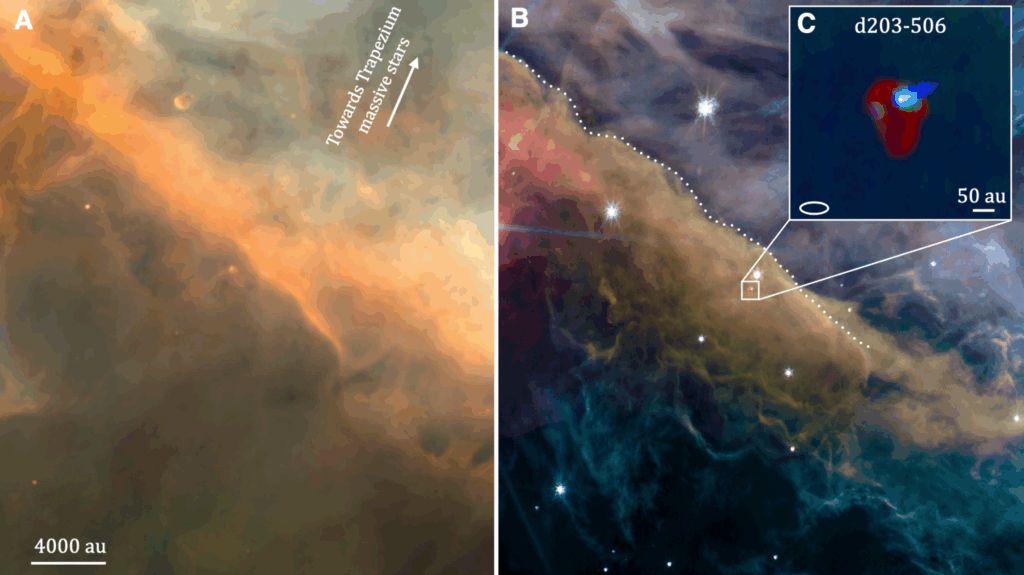
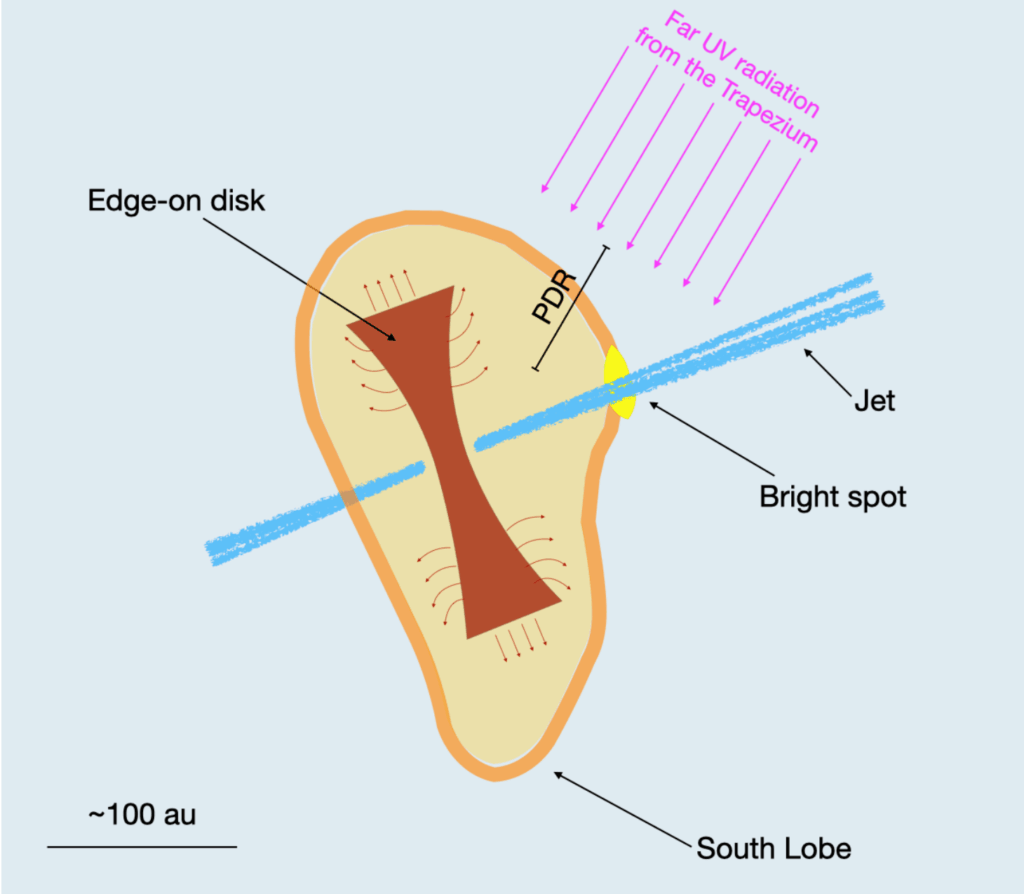
The UV radiation from nearby stars has the ability to break molecules, dissociating their atoms. Therefore, by looking closely at the regions where molecular gas is destroyed by such UV photons – called Photodissociation Regions (or PDRs) –, it is possible to quantify how the planet-forming process is impacted by those nearby hot stars.
The PDRs can be identified and mapped by looking at spectral signatures (in the infrared regime) of molecules such as hydrogen gas (H2), oxygen gas (O2), organic molecules, and other molecules. In Figure 2, we can see images of the d203-506 system at different wavelengths and the observed infrared spectrum crowded with molecular and atomic signatures.
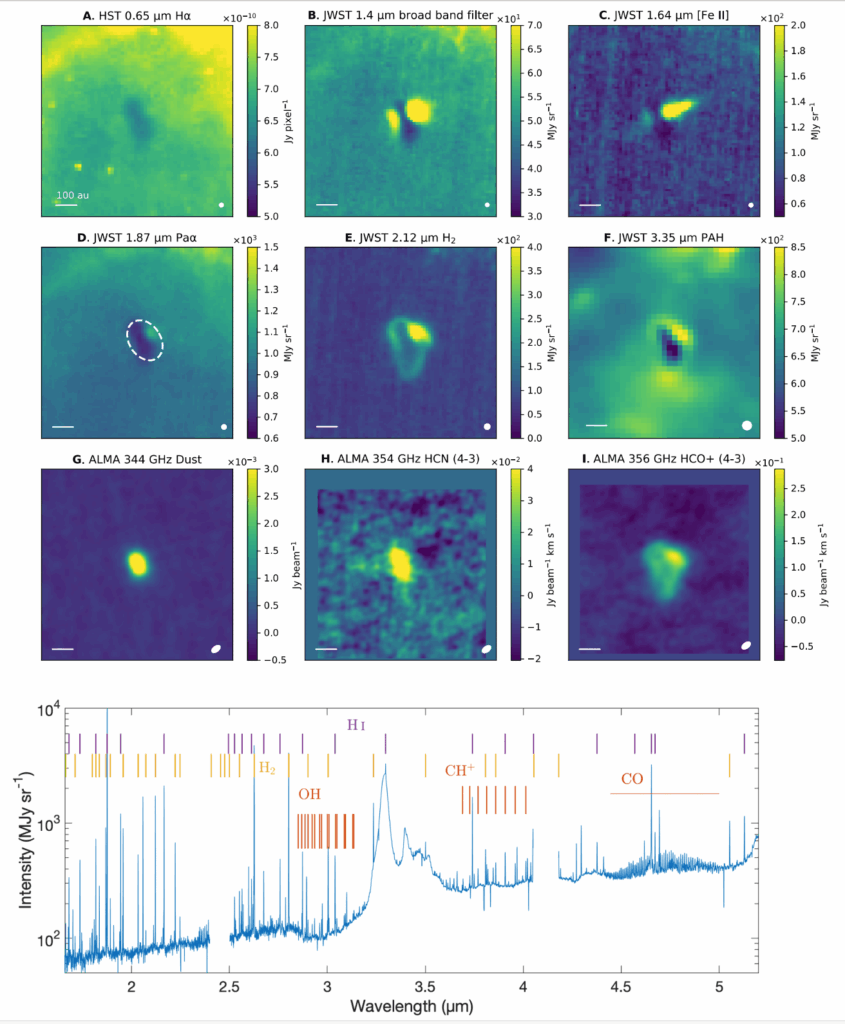
Each wavelength reveals different features, which are produced by different molecules and physical processes, allowing us to understand the structure of the system and the different phenomena that are happening in it. Namely, a bright emission spot can be seen in multiple frequency bands, which indicates excitation by UV radiation. This brighter region seemingly coincides with the interaction region with the Trapezium Cluster radiation. From the physical interpretation of these images, the authors developed the schematic representation of the system that is shown in Figure 3.
Catching the Sabotage
The authors used sophisticated radiative transfer and molecular physics models to produce synthetic (or artificial) spectra. By comparing these with the observed spectrum of d203-506 and photometry in multiple wavelength bands, the authors inferred the density and temperature of the blob’s gas, which is about 1000ºC.
If one knows the density and temperature, it is possible to infer the speed of sound (i.e., the speed with which a sound/vibration propagates through a substance). By comparing this with the orbital speed (i.e., the velocity at which a particle should follow a stable orbit around the central star at a certain radius), the authors could derive the maximum radius at which a particle would still be considered gravitationally bound to the central star. This is called the gravitational radius.
The authors determined a gravitational radius of about 26 AU, which is much smaller than the size of the region that emits H2-transition (about 130 AU). This indicates that this gas is largely unbound to the star and therefore is flowing away from it. From the speed of sound, it is also possible to calculate the mass outflow from the system and the total mass-loss rate (i.e., how much mass is lost per unit of time), which is about 0.1 to 4.6 solar masses per million years. These values of mass-loss rates are consistent with those obtained by means of a more detailed radiative transfer and hydrodynamical model, which the authors computed as a “sanity check” via an independent method.
Implications for Planet Formation
Gas in protoplanetary disks is a basic ingredient for forming gas-giant planets (such as Jupiter and Saturn). Therefore, if a disk loses its mass due to the incoming UV radiation destroying the molecules and pushing the gaseous material away, the formation and growth of these big planets can be suppressed.
How much a stellar system in formation can resist the UV radiation from hot massive stars in its vicinity will depend, of course, on the strength of this incoming UV radiation and on the mass of the central star of the system. The authors discuss that if the UV radiation hitting the disk is 500 times higher than the radiation in the Solar Neighborhood, the formation of giant planets around stars 50% lighter than our Sun – which is the case for the majority of stars – is suppressed.
In d203-506’s misfortune, its mass is one-third of the Sun’s mass, and the incoming UV radiation is a hundred thousand times the radiation of the solar neighborhood! This implies that the disk should dissipate faster than giant planets could start forming.
This might be the reason behind the correlation between the host stellar mass and the presence/absence of more massive exoplanets. Namely, in a stellar cluster, while the young stars are making (or trying to make…) giant gas planets, the UV radiation from the neighboring hot massive stars severely suppresses planet formation. Essentially, if you are a star, but not massive enough to protect your disk, you may need to give up the idea of having a Jupiter-like planet entirely!
In fact, according to the authors, our Sun’s apparent lack of bigger planets might be the result of massive stars sabotaging its disk with their UV radiation!
Astrobite edited by: Sonja Panjkov
Featured image credit: Matheus Bernini Peron
