
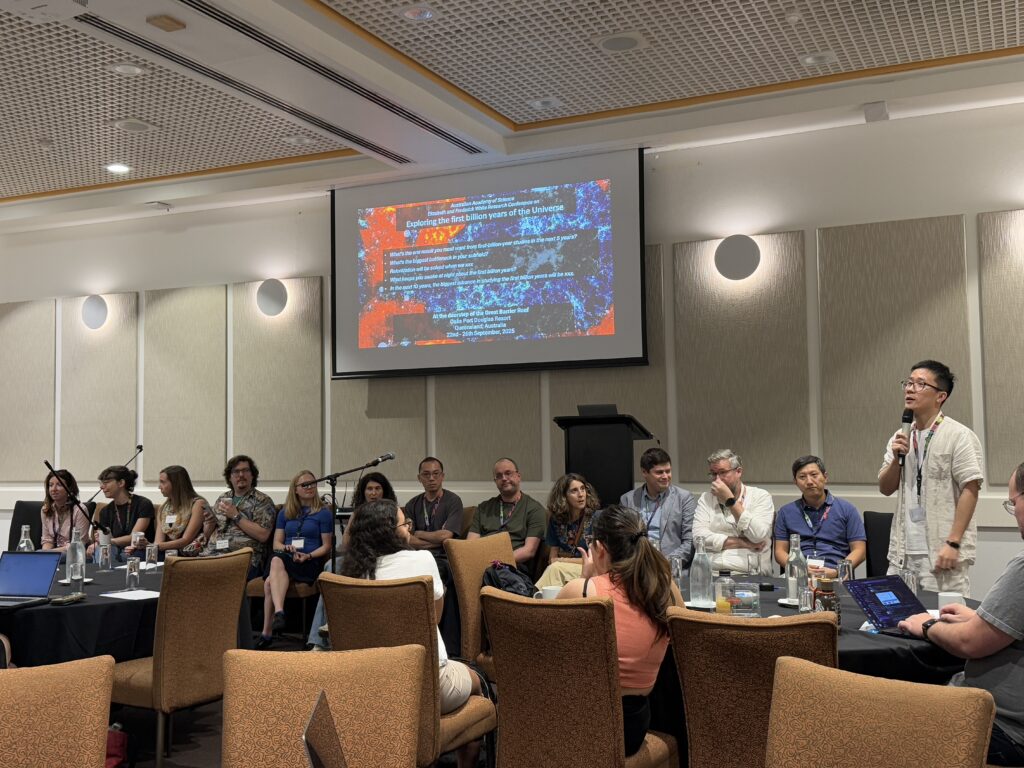
Between September 22–26, 2025, nearly 80 astronomers from around the world gathered in Port Douglas/Manjal Jalunbuy, Australia, near the Great Barrier Reef for the “Exploring the first billion years of the Universe” conference. Despite the long journey for many attendees, the welcoming Aussie spirit and beautiful setting quickly reminded everyone why it’s one of the most beautiful places on Earth to meet. Over several days of talks and seaside conversations, researchers shared the latest findings on high-redshift galaxies, quasars, the 21-cm line, reionization, and the cosmic microwave background (CMB). This meeting was a cosmic antipode to one held just months earlier by the CHOIR Collaboration in Maine, USA (“A Week Downeast, Challenging Assumptions about Galaxy Evolution”), featured in this astrobite.
Both conferences were held on unceded land. In Port Douglas/Manjal Jalunbuy, Linc Walker, a traditional owner of the local Kuku Yalanji nation, gave the Welcome to Country and Smoking Ceremony and shared stories about the region, its challenges for Indigenous communities, and even a few tips on avoiding saltwater crocodiles. A couple of weeks later, a saltwater crocodile was found in the pool at the resort next door – no one was injured.
This astrobite is a student-led initiative written by the guest authors and conference attendees noted in the byline of each section and Sabrina Berger (conference organizer). The full program with abstracts can be found here.
Galaxies – Day 1
By Alice Ferreira and Sophia Geris
The first two days of the conference explored how the first galaxies formed, evolved, and enriched their surroundings, and how the James Webb Space Telescope (JWST), the Atacama Large Millimeter Array (ALMA), and simulations together are reshaping our view of the early Universe. Speakers explored how the first black holes grew, how the earliest cosmic dust formed, and painted a dynamic picture of the Universe’s infancy.
Observations I – Seeing is Believing
The conference opened with several speakers providing exciting updates on recent observational results relating to high-redshift galaxies. For example, Dr. Yuichi Harikane (invited speaker; University of Tokyo) showed the distinct yet complementary perspectives that JWST and ALMA observations provide on early galaxy properties. This is likely to have important implications for the nearly 300 candidate JWST galaxies at z > 9.5 that were presented by Hollis Akins (UT Austin). Weiyang Liu (University of Chinese Academy of Sciences) presented an early dark energy model as an alternative to the standard Lambda-CDM cosmology, which could help explain the observed abundance.
Reionization I – Lyman Alpha Emission
Reionization marks the era when radiation from the first stars and galaxies ionized the neutral hydrogen that made up the early Universe. Lyman-alpha is an ultraviolet (UV) spectral line from hydrogen that is absorbed by neutral hydrogen but not by ionized hydrogen. Therefore, its detection is a telltale sign of ionized regions, which are transparent to this UV emission and allow it to reach our telescopes, while neutral regions absorb or block the signal. Dr. Joris Witstok (Cosmic DAWN Center) reported Lyman-alpha emission at z ~ 13, indicative of a very early start to reionization, and Dr. Laura Pentericci (invited speaker; INAF) discussed how JWST has helped us determine which galaxies supplied most of the ionizing photons. Using a survey of low-z Lyman continuum, Amanda Stoffers (Cambridge) developed a new modeling framework that efficiently estimates the number of ionizing photons that escape galaxies and is consistent with JWST results. Interestingly, Dr. Cody Carr (Zhejiang University) found that galaxies with stronger radiative feedback allow more of these photons to escape, whereas faster outflows tend to trap them. Complementing these insights, Dr. Hiroya Umeda (Tokyo) stacked 581 JWST spectra from z ≈ 4.5–13 to study reionization and identified UV-bright galaxies as potential significant drivers in reionization.
Observations II – Stars, Gas, and Early Galaxies
The focus then shifted to the complex interplay between star formation and early galaxy evolution. Dr. Karl Glazebrook (invited speaker; Swinburne) described how the early appearance of quiescent galaxies in the Universe’s first 2 billion years challenges Lambda-CDM cosmology, and Dr. Themiya Nanayakkara (Swinburne) described how active galactic nuclei (AGN) might have played a role in this cosmological conundrum.
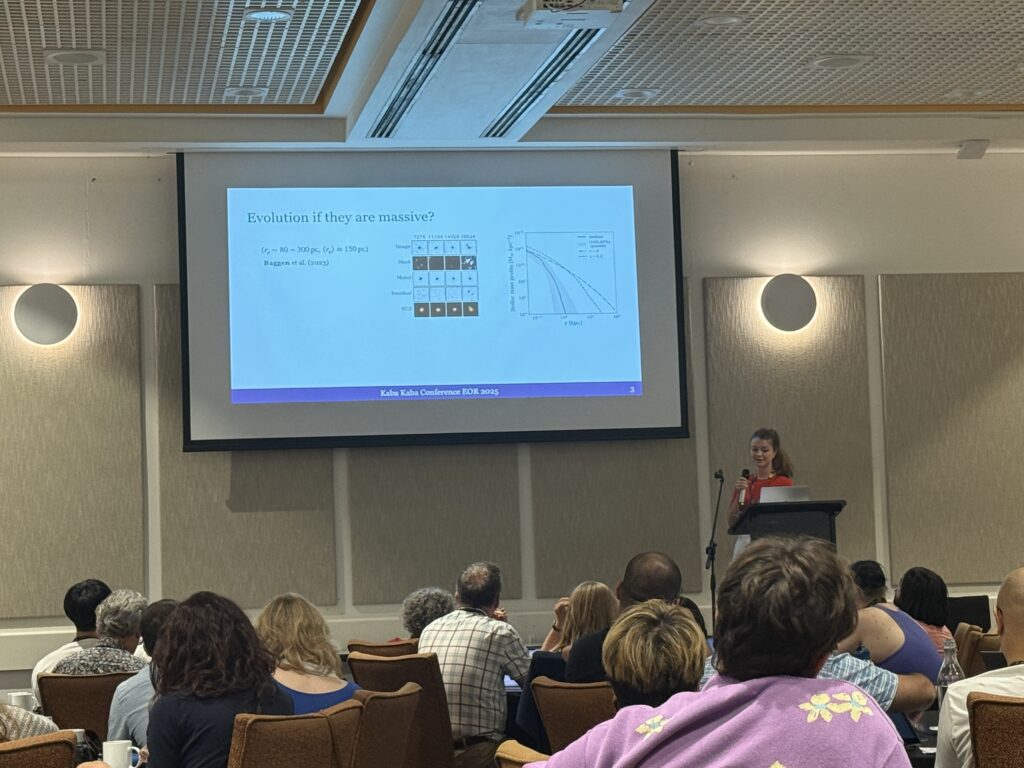
Josephine Baggen (Yale) discussed ‘little red dots’ (LRDs) – the compact, red, distant sources recently detected by James Webb Space Telescope – and suggested that some of these may arise from extremely dense galaxies whose light is dominated by an older stellar population (rather than primarily by an AGN). Dr. Melanie Kaasinen (invited speaker; ANU) showed that highly star-forming galaxies during the Epoch of Reionization contain centrally concentrated, dense, and turbulent cold gas that challenges existing models of how quickly gas cools and becomes enriched with metals. Dr. Benedetta Casavecchia (MPA) used simulations to demonstrate that [CII] and [OIII] emissions trace neutral and ionized gas, respectively, and are strongly affected by metallicity, the star-formation rate, and feedback.
Dust? Never Forget About Dust!
The first day concluded with discussions on dust in the early Universe. Dr. Laura Sommovigo (invited speaker; Flatiron Institute) highlighted the challenge of explaining overly dusty galaxies seen just 800 million years after the Big Bang. Dr. Nicholas Martis (University of Ljubljana) and Alice Ferreira (University of Hertfordshire) showed that dust enrichment likely began as early as 300 million years after the Big Bang, though reproducing observed dust masses in simulations still requires unrealistically efficient dust production, pointing to missing physics.
Together, these sessions painted a dynamic picture of early galaxy formation, with many galaxies and black holes defying their pre-JWST expectations. JWST continues to challenge our models, simulations race to keep up, and new multi-wavelength surveys promise to bridge the gap between observation and theory. The emerging story is clear. The first billion years were far busier, brighter, and more complex than anyone imagined.
Galaxies – Day 2
By Alice Ferreira and Sophia Geris
Observations III – Zooming In and Out of Galaxies in Early Universe
Tuesday kicked off with another round of observations! Dr. Caitlin Casey (invited speaker; UC Santa Barbara) presented results from the COSMOS-Web JWST survey, highlighting UV-bright galaxies and suggesting that LRDs are likely AGN with minimal dust. Dr. Chiara Mazzucchelli (UDP-IEA) and Dr. Anniek Gloudemans (Gemini North) explored high-redshift (z > 5) quasars in the radio for the first time, probing their environments and emission properties to help us understand how they grew so massive so early in the Universe’s evolution. Dr. Rebecca Davies (Swinburne) showed that stellar-driven outflows may quench early star formation, and Maria Pudoka (University of Arizona) found that the earliest quasars likely formed in the Universe’s overdense regions.
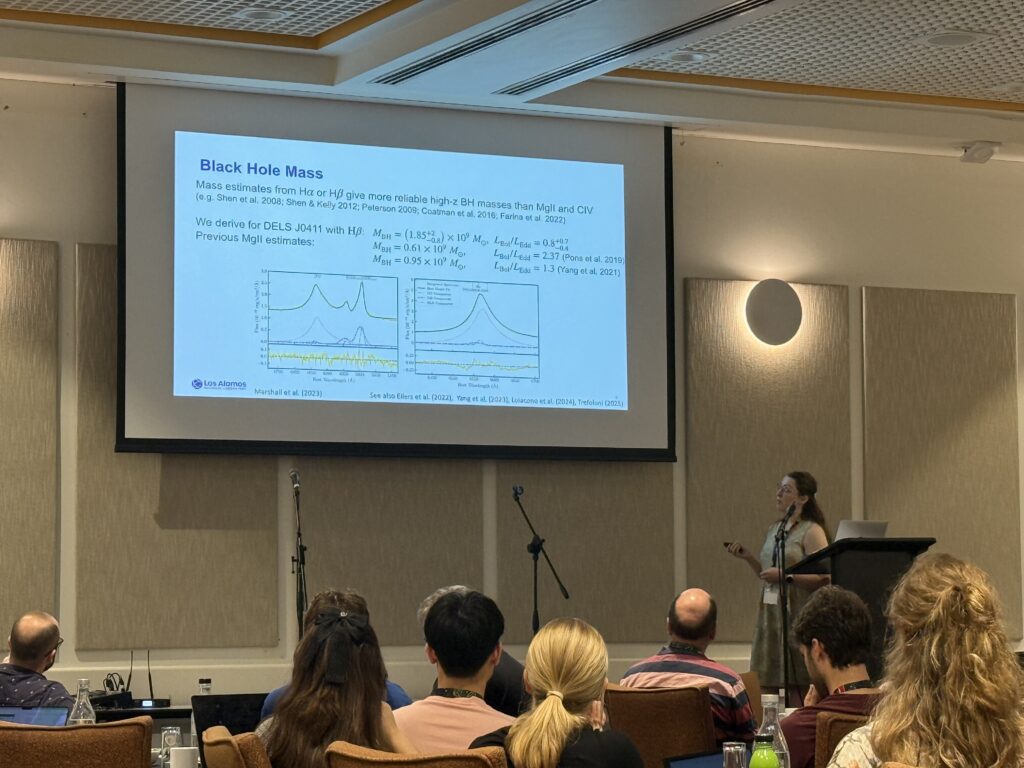
Sophia Geris (Cambridge) stacked JWST spectra to uncover faint AGN hosting ~106 solar mass black holes that help to constrain early supermassive black hole growth scenarios. Dr. Madeline Marshall (LANL) presented JWST results showing extreme black-hole-to-galaxy mass ratios, reconfirming that high-redshift quasars are overmassive compared to their local counterparts.
High-Redshift Simulations
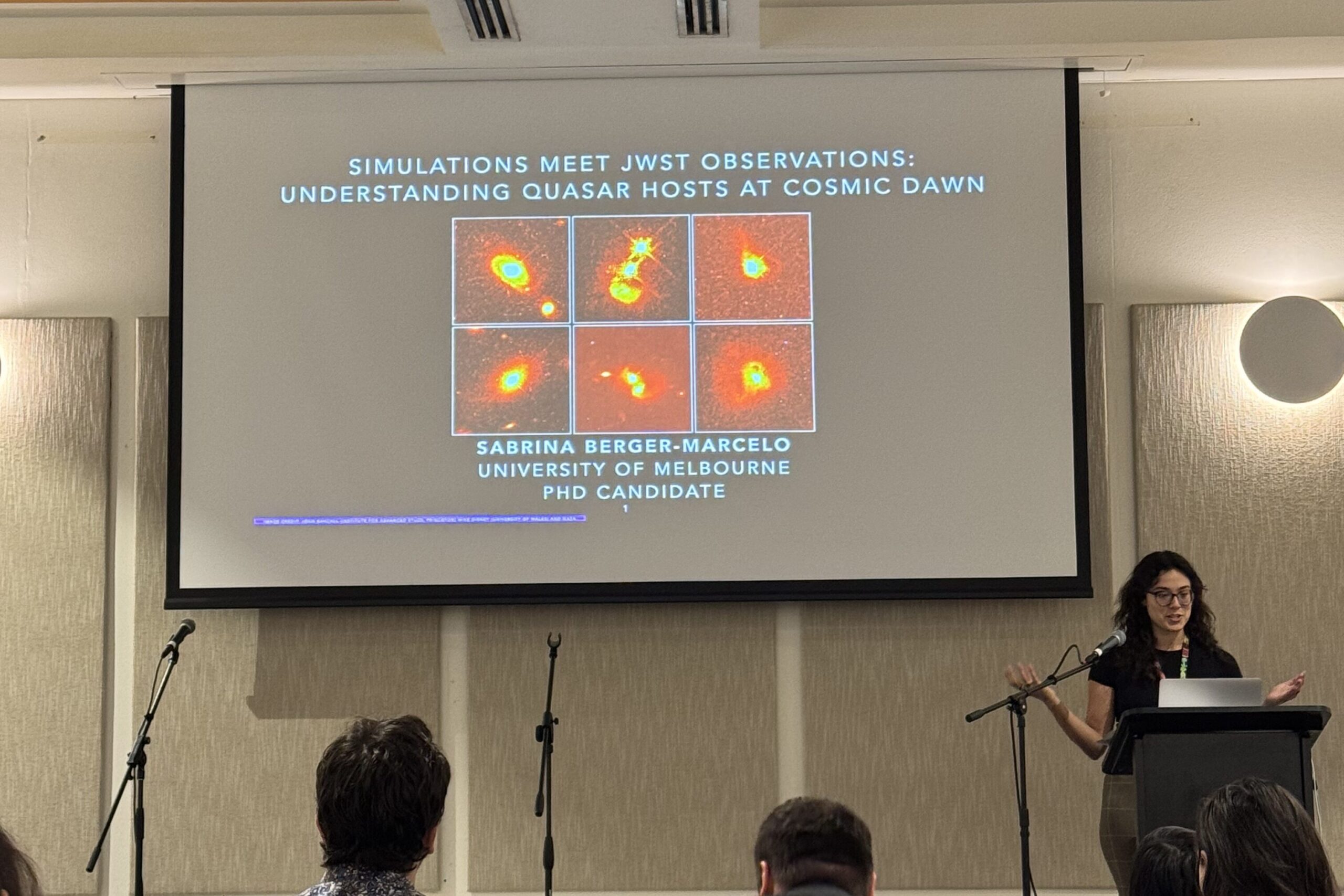
In the afternoon, Sabrina Berger (Melbourne) brought the focus back to simulations, testing black hole and galaxy co-evolution. She showed that removing the contribution of bright black holes can lead to overestimated stellar masses in some systems, while others remain consistent. Talks from Lucas Kimmig (University Observatory Munich) and Dr. Harry Chittenden (Swinburne University) explored how massive galaxies quench via starbursts and AGN feedback in simulations, while Dr. Rhea-Silvia Remus (University Observatory Munich) emphasized the need for larger simulations to match JWST observations. Anirban Chakraborty (National Centre for Radio Astrophysics in India) modeled coupled galaxy and reionization evolution, finding that enhanced star-formation efficiency is required to reproduce early JWST data. Simulations from Dr. Sunmyon Chon (Max Planck Institute for Astrophysics) indicate that metallicity likely drives the stellar mass distribution evolution that we see from the early Universe to the present day, explaining UV luminosities at z ≈ 10.
Reionization II: Quasar Observations – Day 2.5
By Sabrina Berger, Alma Maria Sebastian, and Daniela Breitman
Tuesday afternoon’s session explored how metals, feedback, and reionization shaped the early Universe, with a focus on what quasar absorption can tell us. Quasar spectra act like backlights shining through the gas in the early Universe, which can reveal how neutral or ionized it was at different times. This helps trace when the first galaxies lit up their surroundings. One key probe of this process is the Lyman-alpha forest, or patterns of hydrogen absorption in quasar light that map where neutral gas still remains.
Dr. Valentina D’Odorico (invited speaker; INAF–Trieste) used quasar absorption spectroscopy to show that heavy elements were already widespread by z~6, indicating that metal enrichment happened rapidly in the young Universe. These chemical signatures help track how the early Universe became ionized, and metal-poor gas at higher redshifts hints at the influence of the first stars, known as Population III stars. Dr. Emma Ryan-Weber (Swinburne) continued the theme, searching for signatures of Population III stars and reionization of the circumgalactic medium.

Alma Maria Sebastian (Swinburne) looked at high-redshift quasars and found that the farther the host galaxy was from the line of sight, the narrower the Mg II absorption lines from quasar sightlines appeared.She found that this correlation looks much weaker than what’s seen at lower redshifts.
The Lyman-alpha forest shows that by redshift 5.6, a few percent of the Universe’s gas was still neutral, potentially indicating reionization ended later than we thought. Dr. Benedetta Spina (Heidelberg) found an unexpected 90 Mpc-scale pattern in intergalactic gas that simulations can’t yet explain, hinting there’s still much to learn about how reionization unfolded.
Reionization III: Simulations – Day 3
By Alma Maria Sebastian
On Wednesday, we were back to thinking about reionization through the lens of simulations. Dr. James Bolton (invited speaker; University of Nottingham) discussed how to study the intergalactic medium in the reionization era using Lyman alpha absorption. Dr. Barun Maity (NCRA, India) presented models of how the Universe absorbed Lyman alpha during the Epoch of Reionization, showing that Lyman alpha fluctuations can reveal how strongly the early Universe was ionized and how far light could travel through it.
Dr. Christopher Cain (Arizona State University) used cosmic microwave background measurements to show that reionization likely happened over a short period. Dr. Luke Conaboy (Nottingham) demonstrated that the apparent mismatch between simulated and observed light transmission in the early Universe could be resolved by adjusting the assumed mass of galaxies in models. Dr. Frederick Davies (invited speaker; Heidelberg) highlighted tensions between the cool temperatures of intergalactic gas at z ~ 5 and the Lyman-alpha emission seen from distant galaxies, suggesting these differences may stem from limits in simulation resolution or the influence of magnetic fields. Samuel Gagnon-Hartman (SNS Pisa) introduced a new analytic model that links galaxy properties to their Lyman alpha emission output during reionization. Meredith Neyer (MIT) used the THESAN simulation to show that the Lyman alpha emission of early galaxies can trace the size of surrounding ionized bubbles. Dr. Enrico Garaldi (Kavli IPMU, Tokyo) presented THESAN-zoom, a new suite of high-resolution radiation magnetohydrodynamical simulations and how simultaneous modeling of reionization and galaxies provides the best constraints. The session concluded with a talk from Hurum Maksora Tohfa (University of Washington), who presented improved models of how gas in the intergalactic medium absorbed light during reionization, enabling more accurate estimates of the Universe’s transparency to radiation from early galaxies.
Together, these talks highlighted how studying metals, transparency to Lyman alpha emission, and large scale gas patterns provides complementary clues to one of astronomy’s biggest questions: how and when did the first stars and galaxies ionize the Universe?
Day 4 – 21 cm Cosmology
By Daniela Montes Doria and Maria Valentina Garcia Alvarado
The fourth day of the conference was dedicated to one of the most promising probes of the early Universe: the 21 cm line of neutral hydrogen. This cosmic signal carries information from the Universe’s first billion years, a time when the first stars and galaxies were forming. The day’s talks spanned experimental updates, theoretical insights, and new machine-learning tools, all united by the challenge of detecting and interpreting the faint 21 cm signal buried beneath bright foregrounds.
Reionization IV: 21 cm observations
The morning began with a status of current instruments chasing the elusive 21 cm signal. Dr. Leon Koopmans (invited speaker; University of Groningen) summarized the progress of LOFAR and NenuFAR, highlighting the painstaking efforts to separate the 21 cm cosmological signal from foregrounds and systematics. Dr. Ridhima Nunhokee (Curtin) and Dr. Nichole Barry (UNSW Sydney) followed with complementary work from the Murchison Widefield Array (MWA) in Australia, which is developing new techniques to suppress foreground contamination and push power spectrum limits. Dr. Steven Murray (Stellenbosch University) then shared first results from the radio telescope HERA Phase II, highlighting exciting upper limits on the 21 cm power spectrum. Looking further ahead in the future, Dr. Jane Kaczmarek (SKAO) presented the SKA pathway outlining what the next generation of interferometers will achieve.
Reionization V: Simulator perspectives on 21 cm observations
Observations are only half of the story, the other half is how they are interpreted and what the 21 cm signal tells us about the Universe’s first billion years. Dr. Andrei Mesinger (invited speaker; SNS Pisa) emphasized the power of multi-tracer analyses, combining 21 cm observations with JWST and other probes to uncover the physics of reionization and validate early 21 cm power spectrum detections. Dr. Ivelin Georgiev (Stockholm) followed by exploring how intergalactic medium parameters shape features in the 21 cm power spectrum, proposing a new way to learn about intergalactic medium conditions. Dr. Daniela Breitman (SNS Pisa) then presented 21cmEMU, a new emulator designed to forecast SKA observations and efficiently explore astrophysical parameter space, while Dr. Balu Sreedhar (Seville) demonstrated how semi-analytic models (SAM) and 21 cm simulations can be helpful in constraining the X-ray properties of the first galaxies. Dr. Hyunbae Park (University of Tsukuba) took the audience even further back, into the first 100 million years, often called the “dark ages” due to the lack of stars in this epoch. Using simulations, they explored how different dark matter scenarios (cold vs. warm) could alter the 21 cm signal, offering a glimpse of how cosmology might probe the nature of dark matter itself.
Given the complexity of the data and models, machine learning (ML) is becoming an indispensable part of 21 cm cosmology. Drs Yi Mao (invited speaker; Tsinghua) and Yin-Zhe Ma (Stellenbosch University) presented advances in applying ML to signal extraction and parameter estimation, showing just how varied these approaches can be. Carina Norregaard (ICL) introduced a 2D power spectrum emulator designed for efficient inference, while Nadia Cooper (ICL) demonstrated the ability of simulation-based inference (SBI) methods to recover reionization histories directly from mock observations. These talks highlighted how statistical methods and ML are driving progress in 21 cm studies.
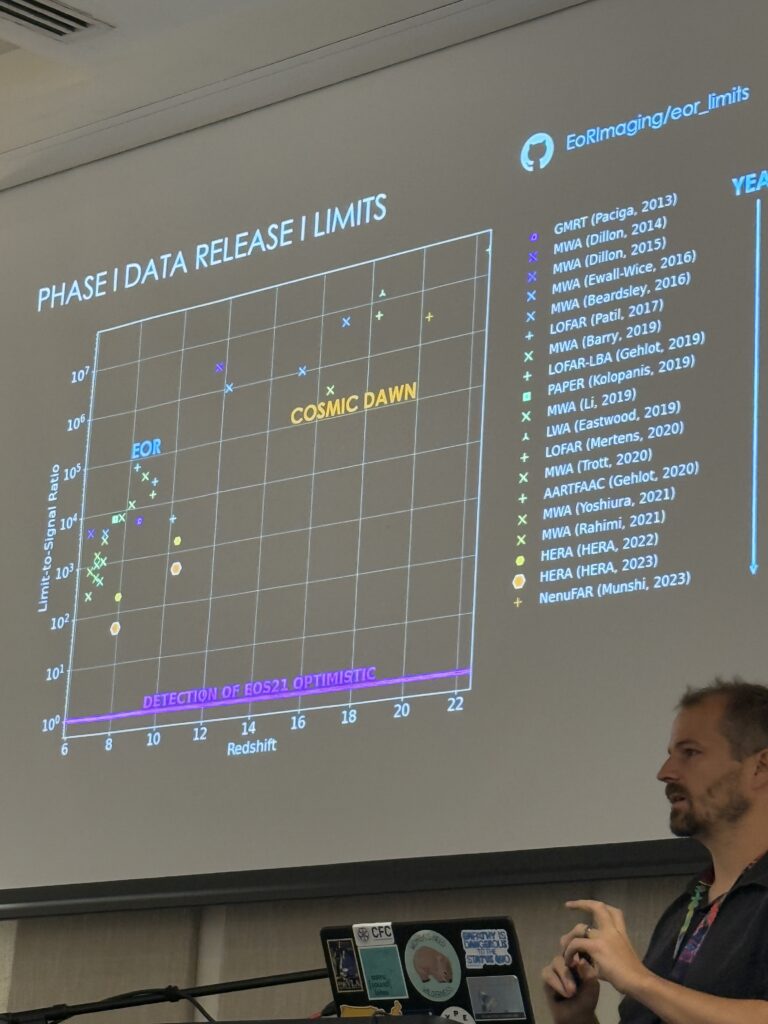
The day wrapped up with explorations beyond the standard power spectrum. Sukhdeep Singh (IIT Kharagpur) discussed how looking at higher-order patterns in the data can reveal subtle, non-Gaussian features of reionization. The so-called “21 cm forest”, narrow absorption lines against bright radio sources, was the subject of three last talks: Dr. Tomáš Šoltinský (invited speaker; INAF-Trieste) on detectability, Dr. Nithyanandan Thyagarajan (CSIRO) on prospects for 1D power spectra, and Dr. Hayato Shimabukuro (Yunnan University) on wavelet-scattering transforms to extract subtle non-Gaussian signatures.
From experimental updates to theoretical forecasts and machine-learning tools, the talks underscored the rapid pace and diversity of 21 cm cosmology. With current arrays refining techniques, the SKA and HERA opening new windows, and creative statistical methods emerging, the dream of mapping the cosmic dawn and epoch of reionization feels closer than ever.
Day 5 – Reionization VI: wait, what about the CMB?
By Liu, Weiyang
But how can the CMB photons that were released millions of years earlier be connected to reionization? Throughout its roughly 14 billion year history, our Universe has experienced two major phase transitions between the ionised and neutral states. About 300 thousand years after the Big Bang, the Universe became cooler and sparser, which allowed the electrons to be captured by the protons and form the first generation of neutral hydrogen atoms, rather than being scattered away by the photons. This photon decoupling enabled them to be detected as the first observable light of the Universe, encoding important information about the first phase transition. For historical reasons, astronomers call this event recombination, despite the fact that it is the first time the Universe became neutral. To observe these photons, an easy way is to switch to an empty television channel and see the snowflakes on the screen. Astronomers give it a fancy name, the Cosmic Microwave Background (CMB) radiation, to emphasise the fact that it exists everywhere.
The second phase transition occurred when the first generation of stars and galaxies formed. The nuclear reactions in these stars produced an enormous number of high-energy photons that could ionise the neutral hydrogen, eventually reionising almost the entire Universe back to the ionised state. This event, which took place about 400 million years after the Big Bang and lasted for about 600 million years, is called reionization.
But how can the CMB photons that were released millions of years earlier be connected to reionization?
The talks of Day 5 focused on probing reionization with CMB observations. As the CMB photons transmit through the regions in which the reionization takes place, they will inevitably interact with the ionised electrons through Thomson scattering. Consequently, the observed features of the CMB power spectrum will be partially smeared out due to the scattering. In this case, one may ask if the evolution history of reionization could be quantified via the observation of CMB?In order to answer this question, invited speaker, Dr. Adélie Gorce (invited speaker; Université Paris-Saclay) is trying to measure the so-called power spectrum of the CMB photons. The power spectrum represents the clustering level of the photons at different angular scales of the observation. Since the CMB photons are produced earlier, they are located further away from us. Therefore, these photons must pass through the regions where reionization is occurring before reaching us. Consequently, some of these photons could be scattered away by the ionised electrons (in jargon terms, this is Thomson scattering) and eventually affect the observed CMB power spectrum. Also, we can even measure the optical depth of the photons, i.e., how far the photons can travel before being scattered away by the ionised electrons. Considering that the measurement of the optical depth in CMB is an integration of the entire reionisation history, astronomers can only constrain the midway of the reionisation (i.e., the time when roughly 50% of the hydrogen was ionised), around which the atoms are reionised most rapidly. Current observations from the Planck telescope suggest that 50% of the hydrogen atoms were reionised about 700 million years after the Big Bang. “Although we are not sure how to interpret it in terms of reionization history, we are very sure of the value of the optical depth,” as Dr. Gorce said.
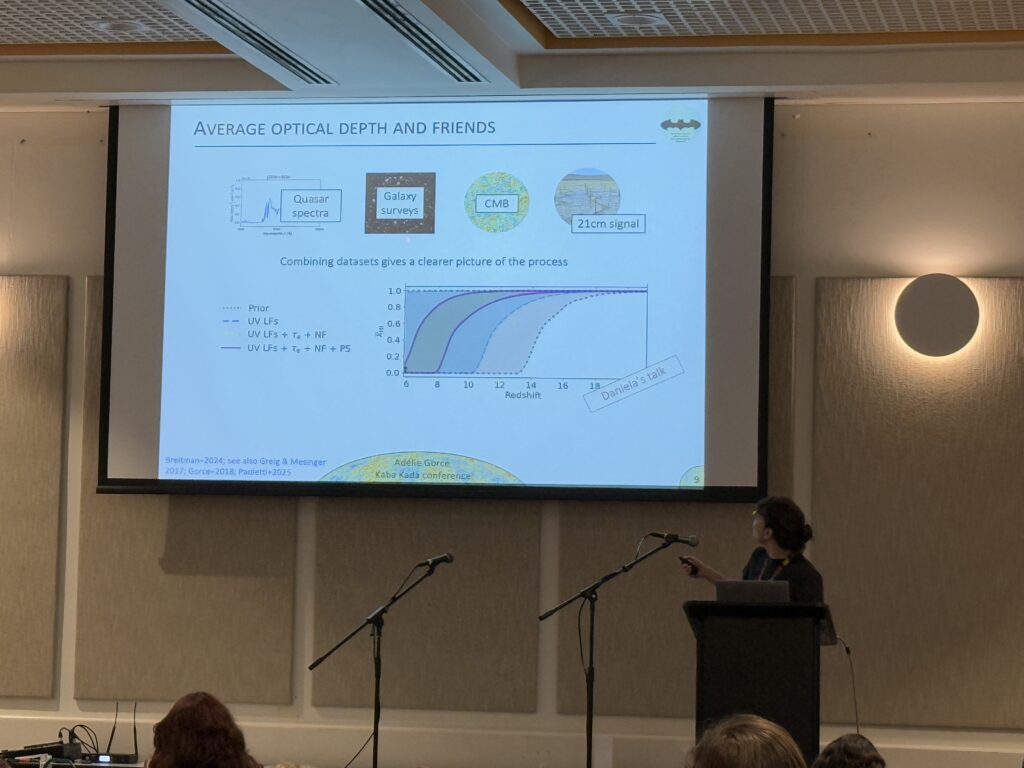
However, the story does not end here yet. Astronomers know that the reionization does not commence homogeneously. Rather, the reionised regions look like the holes in a piece of Swiss cheese, with expanding bubbles centred around their driving sources, such as galaxies. In turn, when the CMB photons pass through these bubbles, they will interact with the free electrons that move within the expanding bubbles, causing them to be slightly Doppler shifted during the process. This effect that alters the CMB power spectrum on small scales is called the kinematic Sunyaev-Zel’dovich (kSZ) effect, named after two Soviet astronomers, Rashid Sunyaev and Yakov Borisovich Zeldovich.
Dr. Marian Douspis (Université Paris-Saclay), put great effort into the measurement and simulation of the kSZ effect. Although this effect is considerably weak, their results place additional constraints on the optical depth and the start and end times of reionization. In particular, the kSZ effect is expected to be more precisely measured by the South Pole Telescope 3G (SPT-3G) and the upcoming 3G+ survey, as introduced by Dr. Christian Reichardt (Melbourne) and a key member of the SPT collaboration. In turn, astronomers hope to decipher the critical enigmas of reionization history, e.g., whether the main source of reionization deduced from the kSZ effect is consistent with the James Webb Space Telescope (JWST) observations of high-redshift galaxies (Garett Lopez, University of California, Riverside). Finally, since the kSZ signal is intrinsically weak and the 21 cm hydrogen emission line is heavily contaminated, Dr. Meng Zhou (National Astronomical Observatories, China), explained that the better choice to study reionization may lie in the high-order cross correlation of these probes.
Putting it all together
The week ended with a panel of the invited speakers (see the conference website for a list) led by Dr. Yuxiang Qin (Australian National University) asking what it will take to unravel the mysteries of the Universe’s first billion years. The discussion touched on subjects such as the physics approximated below the resolution of simulations in “subgrid models”, the limits of computational scaling as hardware shifts toward AI optimization, and what it would mean to understand when, where, and by what sources the Universe became reionized. Optimists predicted that the Square Kilometre Array-Low (SKA-Low) could detect the 21 cm signal within the next five years! Others reflected on remaining uncertainties about the roles of AGN and galaxies in reionization and the careful integration of AI tools into modeling. Even in this new era, the early Universe remains full of mysteries worth losing sleep over, potentially while traveling across international waters.
Astrobite edited by Sonja Panjkov, Yuxiang Qin, and Sabrina Berger
Featured image credit: Sabrina Berger
