
Title: The ALPINE-CRISTAL-JWST Survey: The Fast Metal Enrichment of Massive Galaxies at z∼5
Authors: Andreas L. Faisst , Lun-Jun Liu , Yohan Dubois , Omima Osman , Andrea Pallottini et al.
First Author’s Institute: IPAC, California Institute of Technology, Pasadena, CA, US.
Status: Preprint on arXiv.
In astronomy we call all elements heavier than helium “metals.” Stars make metals, supernovae and stellar winds return them to the gas between stars, and the build-up can be tracked with two relations. The mass–metallicity relation (MZR) shows that, on average, more massive galaxies have more metal-rich gas. The fundamental metallicity relation (FMR) adds star formation rate, at fixed mass, galaxies forming stars faster tend to have lower gas metallicity, a sign of recent inflow of relatively metal-poor gas. If these relations already look mature by redshift z ~ 5, roughly one billion years after the Big Bang, enrichment must have proceeded quickly. Today’s paper tests that idea by measuring the metal content of the gas in a sample of massive galaxies at z ~ 5 with James Webb Space Telescope (JWST). This is a regime that early JWST studies often did not cover in depth. (For more background on these relations, see these astrobites: here and here)
What was measured and how
The sample contains 18 typical star-forming galaxies with log(M⋆/M☉) ≈ 9.5–11 at 4.4 < z < 5.9 (where M☉ means solar mass). JWST/NIRSpec provides rest frame optical spectra, light that would fall in the visible if these galaxies were nearby. From the spectra, the team first corrected for dust, since blue light is absorbed more strongly than red. They compared Hα to Hβ (the Balmer decrement) and applied a standard attenuation curve to recover the intrinsic emission-line ratios. The corrected spectra were then used to measure bright emission lines of hydrogen and oxygen, for example [O II] 3727, [O III] 5007, Hβ 4861, and Hα 6563. The ratios of these lines trace how many oxygen atoms there are per hydrogen atom, providing an estimate of the gas-phase oxygen abundance, written as 12 + log(O/H). Metallicities were derived primarily from strong-line calibrations, that is empirical and theoretical recipes that convert line ratios into O/H. In five galaxies, very faint auroral lines such as [O III] 4363 were also detected; these are sensitive to the electron temperature of the gas and enable a direct abundance determination without relying on a calibration. The temperature-based and strong-line results agree within the stated uncertainties, confirming that the metallicity scale is robust for this sample.
What they found
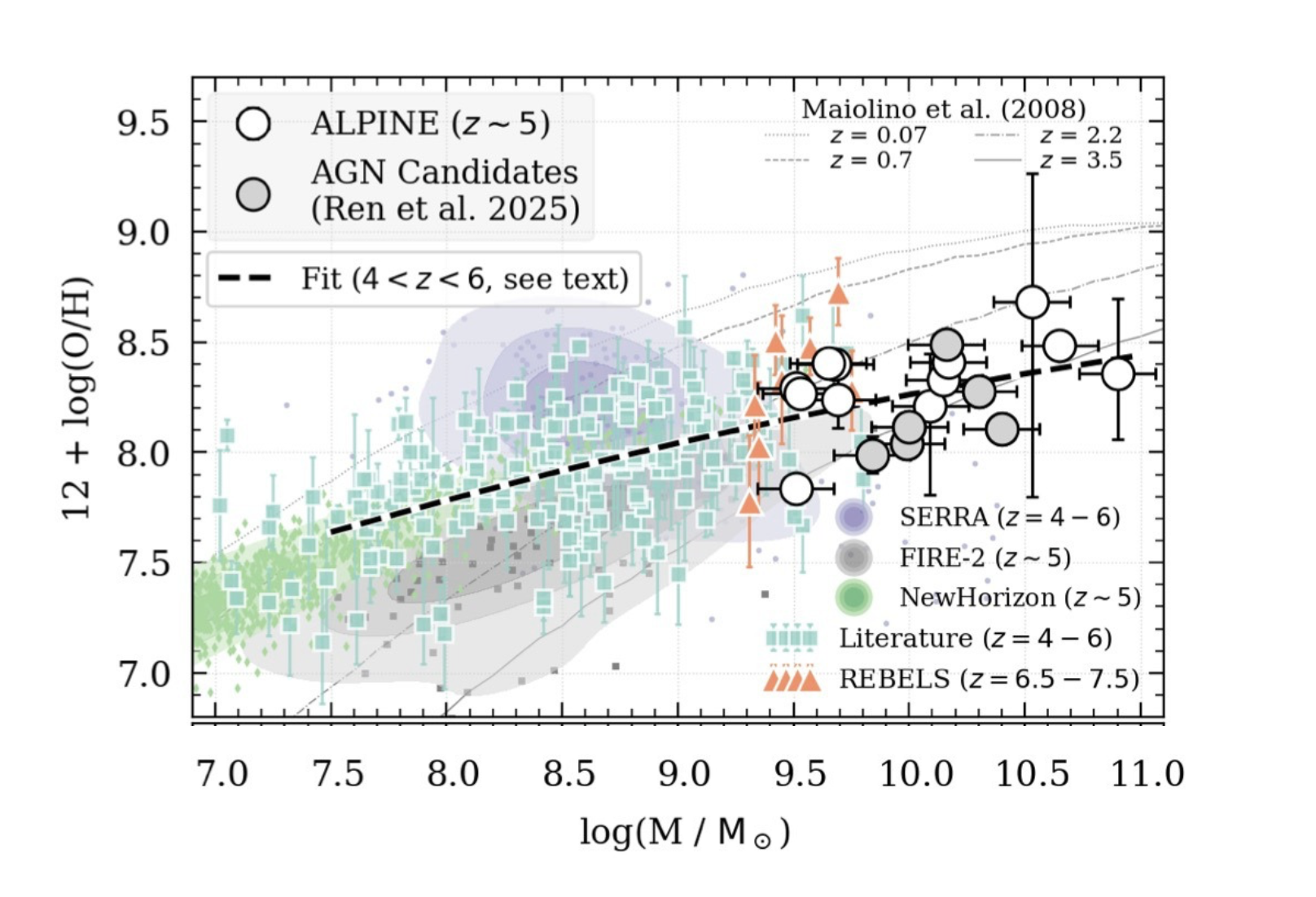
The High-mass MZR already looks mature. In the z ~ 5 sample, the most massive galaxies lie on a mass–metallicity relation that overlaps the z ~ 2 relation at high mass. This implies that metals built up rapidly in galaxies within the first billion years of cosmic time.
If galactic winds had removed most newly produced metals, or if large amounts of metal poor gas had kept flowing in, these galaxies would fall well below the z ~ 2 curve. They do not, see Figure 1.
The FMR is in place, with much larger scatter. At z ~ 5, when gas metallicity is plotted together with stellar mass and star formation rate (SFR), the points follow the familiar trend, but with a much wider spread than locally (Figure 2 left). To quantify this, the authors collapse mass and SFR to a single axis,( μ = log M⋆ − 0.66 log SFR), and measure the intrinsic scatter around the local calibration, finding it is about five times larger at z ~ 5 (Figure 2 right).
![Two panels. Left, 12+log(O/H) versus log(SFR [M☉ yr⁻¹]) with colored curves at fixed stellar mass and ALPINE points overplotted. Right, 12+log(O/H) versus μ = log(M/M☉) − 0.66 log(SFR), showing that z ~ 5 galaxies follow the trend but have about five times larger intrinsic scatter than the local relation.](https://astrobites.org/wp-content/uploads/2025/11/2.png)
Many systems lie below the expected metallicities of local galaxies at the same mass and SFR. This is expected in a young Universe where conditions change quickly. Small differences in how long stars have been forming already change how many metals have built up. Fresh, metal-poor gas flowing in can raise the SFR while diluting the metals. Outflows vary in strength from galaxy to galaxy, removing different fractions of enriched gas. Together these effects increase the scatter of the relation.
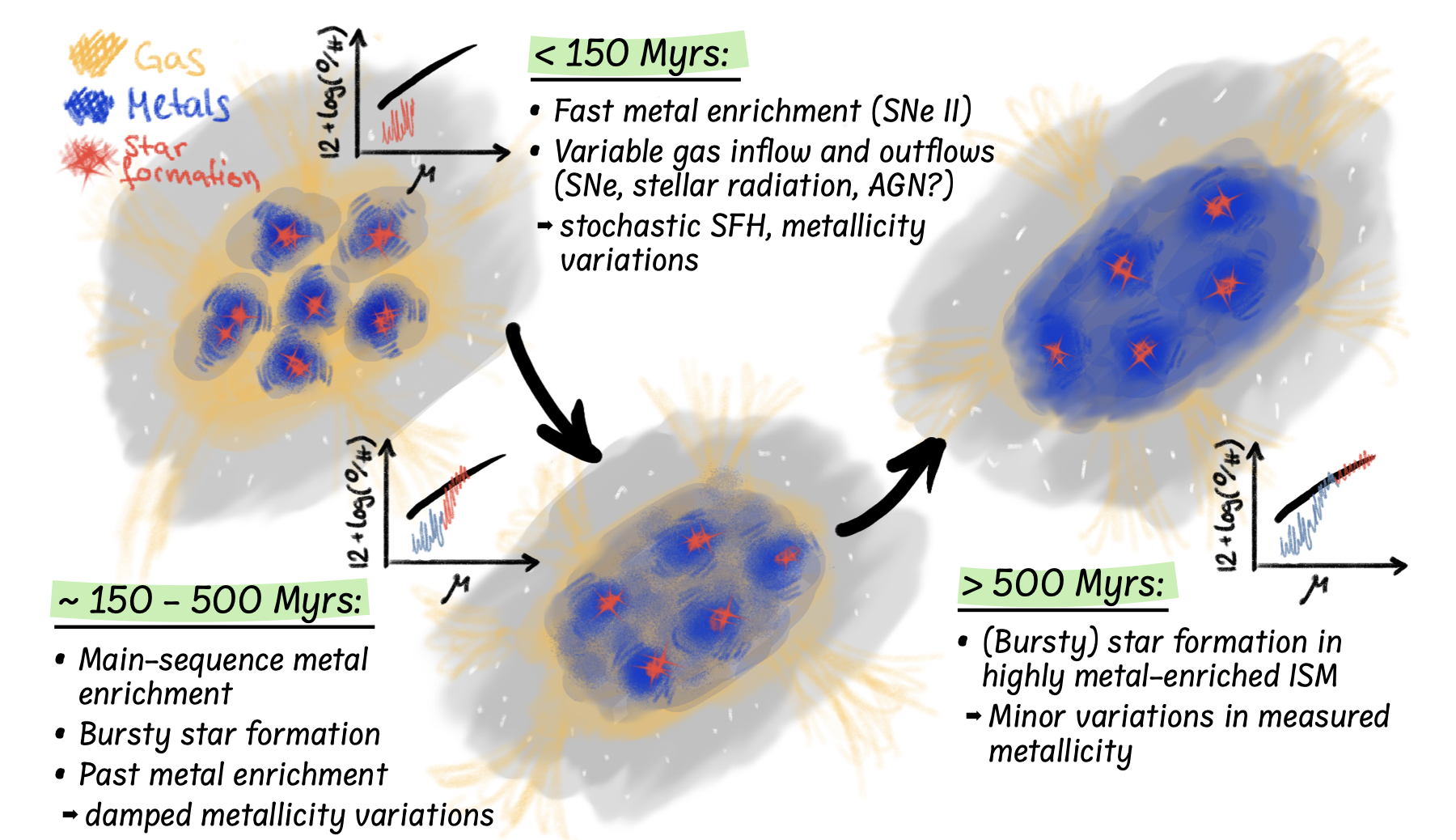
The schematic in Figure 3 shows why early galaxies scatter so much. Very young systems, less than about 150 Myr, enrich quickly through Type II supernovae while gas inflow and outflow vary strongly, so metallicity at fixed mass and SFR jumps around. Between 150 and 500 Myr, past enrichment starts to damp these variations. After 500 Myr, star formation continues in a metal-rich interstellar medium and the scatter shrinks. This cartoon links the observed spread to short timescales, variable gas supply, and feedback.
Models and theory in one picture. These observed patterns point to three main knobs that control a galaxy’s metallicity: how fast gas flows in, how quickly gas turns into stars, and how strongly winds carry gas out. The authors explore these with a simple gas regulator model. Think of a tank: gas flows in, some forms stars, some is pushed out by stellar explosions. Metals come from two sources, short-lived massive stars that explode as supernovae, and older AGB stars that shed enriched material.
The model reproduces the z ~ 5 MZR if the winds are weaker by about a factor of two than in several common feedback prescriptions, meaning less gas is expelled per unit star formation. With that setting, galaxies reach the observed metal content in under 200 million years after star formation begins, consistent with compact, intensely star forming systems that keep much of their metal-rich gas. The result agrees with DUSTY-GAEA tracks over a wide mass range and with broad trends in large cosmological simulations, although several runs still produce too few metals in low-mass galaxies, likely because their winds remove too much enriched gas or their volumes miss rare, very fast enrichers. One caveat remains: at the highest redshifts, simulation time steps are coarse, so the exact moment when galaxies settle onto the FMR is still uncertain.
Why this matters
These z ~ 5 galaxies reached high metal content fast, which means early feedback could not be too strong and much of the enriched gas was kept and recycled. More metals and dust let gas cool quickly, so stars and disks grow earlier than many models assumed. The broad spread in the FMR shows that growth is bursty, a galaxy’s metallicity is a snapshot in a short cycle of inflow, star formation, and outflow.
As larger and deeper samples arrive, we will see how far this fast enrichment extends across the full population of galaxies.
Astrobite edited by Ansh R. Gupta
Featured image credit: Niloofar Sharei (Made in Canva)
