
Title: Space waste: An update of the anthropogenic matter injection into Earth atmosphere
Authors: Leonard Schulz, Karl-Heinz Glassmeier, Moritz Herberhold, Adam Mitchell, Daniel M. Murphy, John M. C. Plane, Ferdinand Plaschke
First Author’s Institution: Institute of Geophysics and Extraterrestrial Physics, Technische Universität Braunschweig, Braunschweig, Germany
Status: Submitted to Advances in Space Research, available on arXiv
In the early morning of January 24, 1978, a Soviet nuclear-powered spy satellite crashed down into the Northwest Territories of Canada, spewing radioactive debris across the lands of the Dené people. The operation to retrieve the debris would involve hundreds of personnel and cover thousands of kilometers of northern Canada. Only an estimated 0.1 percent of the uranium reactor power source was recovered. The effects of Kosmos 954 are still felt by those living on the land today and in general space debris events like these can create a dramatic impression that the sky is falling. But it also begs the question, what happens to the debris that doesn’t make it back down to Earth?
Since 2019, with the first launch of SpaceX’s Starlink “mega-constellation” of internet satellites, the amount of objects in low Earth orbit (LEO) has significantly increased. As of the writing of this article, there are about 9000 Starlink satellites in orbit and a staggering 1-2 are retired each day, dragged back down through Earth’s atmosphere and burning up into striking fireballs. With SpaceX’s current domination of the space-launch sector, the company is able to send up new batches of satellites often, with a current launch cadence nearing every 2 days in 2025. These satellites are treated as relatively disposable; each new version can be deployed quickly while the old version is sent back down from LEO.
Mega-constellations have the potential for serious impacts on the night sky and astronomy, including leaving bright streaks in optical images and radio frequency interference, each of which are causing headaches for next-generation astronomy facilities such as the Vera. C Rubin observatory and the Square Kilometer Array.
Today’s paper investigates another effect of mega-constellations undergoing study: ablation, or what gets left behind when satellites burn up during re-entry.
Space Waste
Along with space debris (non-functional objects in orbit) and ground impacts (objects that survive re-entry), the authors define a new term, “space waste”—the orbital and suborbital objects that enter or re-enter the atmosphere and ablate. Space debris focuses on impacts with crowded orbits, while space waste focuses on impacts to the atmosphere.
Using a wide range of governmental, industry, and academic sources, they first estimate how much human-made stuff in general has been moved into the top of the atmosphere over the past decade. This mass is mainly made up of satellites and the upper stages of rockets. Since this paper only covers up until July 2025, the mass contribution for the rest of the year is extrapolated assuming the same rate as earlier in the year. The yearly mass deposited has stayed approximately constant, at about 1 kiloton (1 million kg) from 2015 to 2020, after which it begins increasing with the first launch of Starlink. The authors estimate a total mass contribution of 2.3 kilotons in 2025, more than double that of previous years.
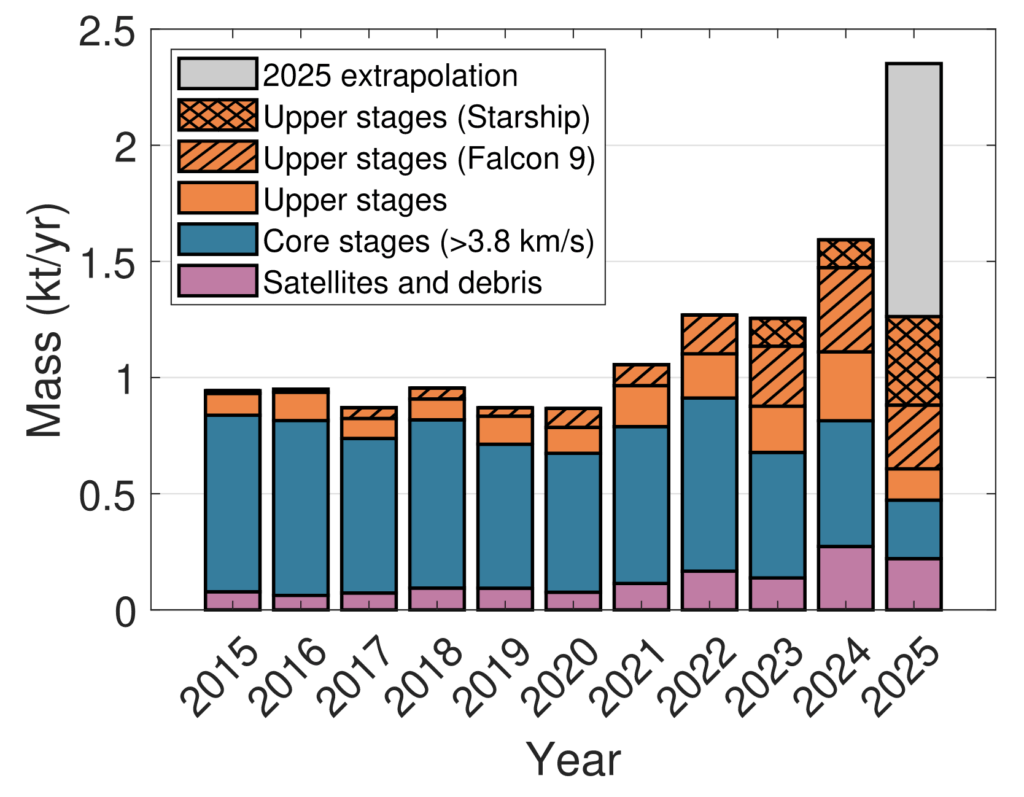
They also estimate the composition of these objects, mainly using manufacturer data where available, breaking them down into components like batteries, electronics, solar panels, pressure tanks, and more. The final factor needed for their analysis is the ablation rate. This defines how much of an object vaporizes as it burns up through the atmosphere. For satellites, they assume an ablation rate of 80%. The authors point out that though mega-constellation manufacturers make “claims of complete demise, constellation satellite remnants have been found on ground”. For instance, this laptop sized piece of a Starlink satellite which landed in a Saskatchewan farmer’s field in 2024.
Using the composition and the ablation rates, they find that of the total mass deposited into the atmosphere, about 40-60% ablates and is injected into the atmosphere, depending on the year. Since the mass that burns up depends on the total mass of objects, the ablated mass has also more than doubled from 2020 to 2025.
What about meteoroids?
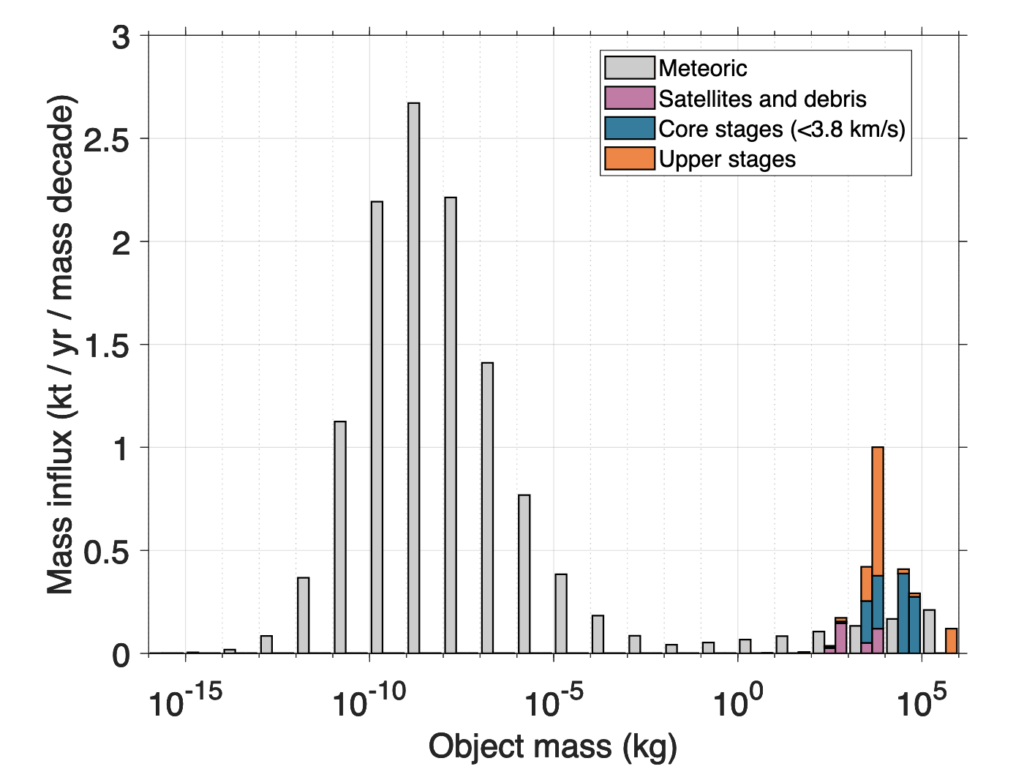
Humans aren’t the only source of material injected into the atmosphere. The atmosphere is also constantly bombarded by (mostly) small-sized meteoroids. The authors compare their estimates of the human-made mass to this “natural” mass. They find that the space waste mass, even though it has been generally rising, is an order of magnitude less than the natural mass (see Figure 2). In a worst-case future scenario, defined as 75,000 active constellation satellites—which is still a possibility based on the number of satellites proposed—the injected mass could rise to a third of the natural mass from ablating meteoroids.
While the total mass injection from satellites and rocket stages is still small compared to meteoroids, when you start looking element by element, the story changes. Even before mega-constellations, satellites were already injecting elements like aluminum, copper, and titanium in greater amounts than meteoroids. The authors estimate that in 2024, space waste contributed more mass than meteoroids for 24 elements, and that this number could increase to 30 in the worst-case future scenario. Aluminum, which is a popular material for spacecraft due to it being cheap and lightweight, makes up the majority of elements in space waste. During ablation, the aluminum reacts with oxygen, forming aluminum oxides. These aluminum oxides can catalyze chemical reactions, leading to increased ozone depletion. Similarly, transition metals like copper, titanium and niobium could lead to new chemical pathways in the atmosphere with possible effects on ozone or the climate.
Sustainability in Space?
It is important to note that due to the wide range of materials used to determine the mass and elemental composition of all these objects, as well as estimating how much they ablate, there were significant uncertainties for each part of this paper’s methods. However, they do find good agreement between their predictions and stratospheric data on aerosol particles, based on measurements from 2023. As the satellites ablate in the mesosphere, the metal vapors they release condense and are then transported through atmospheric processes to the stratosphere (the layer below) where they can be measured. The authors also conclude the greatest error in their analysis comes from a lack of established literature on ablation: the actual process of how satellites burn up in the atmosphere and how this is connected to the elements they release. Ground debris (like this large piece of space debris that crash-landed into Australia in October 2025) can be used to better understand how objects ablate as they travel through the atmosphere.
In general, the understanding of the effects of these elements being introduced to the upper layers of the atmosphere are still unknown. But as today’s paper clearly shows, as the number of satellites from mega-constellation increases, the amount of space waste injected is increasing, leaving behind metals with potentially harmful effects on the atmosphere and as a result, human health.
Notably, in the US, where Starlink is launched from and licensed to operate, the agency responsible for licensing satellites, the Federal Communications Commission (FCC), specifically excludes satellites from requiring comprehensive environmental review. While the FCC does require operators to dispose of low-Earth orbit satellites after 5 years, today’s paper brings into question the sustainability of this approach. While atmospheric burn up of satellites provides a convenient option for cleaning up space debris, the cumulative effects of what gets left behind is not so clear. What does sustainability mean for spacecraft? What is a good end-of-life process? These questions are in need of more investigation.
The “precautionary principle”, an environmental theory approach originating from the 1992 Rio Declaration—produced at the United Nations Conference on Environment and Development and signed by 175 countries—is relevant here. Used in many international treaties, the precautionary principle states:
In order to protect the environment, the precautionary approach shall be widely applied by States according to their capabilities. Where there are threats of serious or irreversible damage, lack of full scientific certainty shall not be used as a reason for postponing cost-effective measures to prevent environmental degradation.
In other words, when we don’t understand something, it is best to tread carefully. The results from today’s paper, in combination with other aspects of the satellite lifecycle, such as the potential for increased rocket launches to increase ozone depletion, suggest that there are still many unknowns related to mega-constellation satellites that warrant investigation and precaution.
Astrobite edited by Abbé Whitford
Featured image credit: NASA
