
Title: Report on LEO satellite impacts on ground-based optical astronomy for the Rubin Observatory LSST
Authors: Phanindra Kandula, Lee Kelvin, Erfan Nourbakhsh, Daniel Polin, Tom Prince, Meredith Rawls, Adam Snyder, Brianna Smart, Christopher Stubbs, Anthony Tyson, Zeljko Ivezic, Craig Lage, Clare Saunders
First Author’s Institution: University of California, Davis; University of Massachusetts, Amherst
Status: Available on arXiv [open access]
The Vera C. Rubin Observatory achieved first light earlier this year, and its revolutionary Legacy Survey of Space and Time (LSST) will soon begin its ten-year observing program. LSST will image the entire southern sky every few nights at an unprecedented level of depth, and will enable a huge range of science. Some of the key areas include understanding dark matter and dark energy, finding and tracking asteroids and comets, mapping the Milky Way, and exploring transients (objects that change brightness over time, like supernovae and gamma-ray bursts). LSST’s extreme depth (over such a large area of sky!) is also especially important for exploring low-surface-brightness objects, which are often too faint for current ground-based surveys.
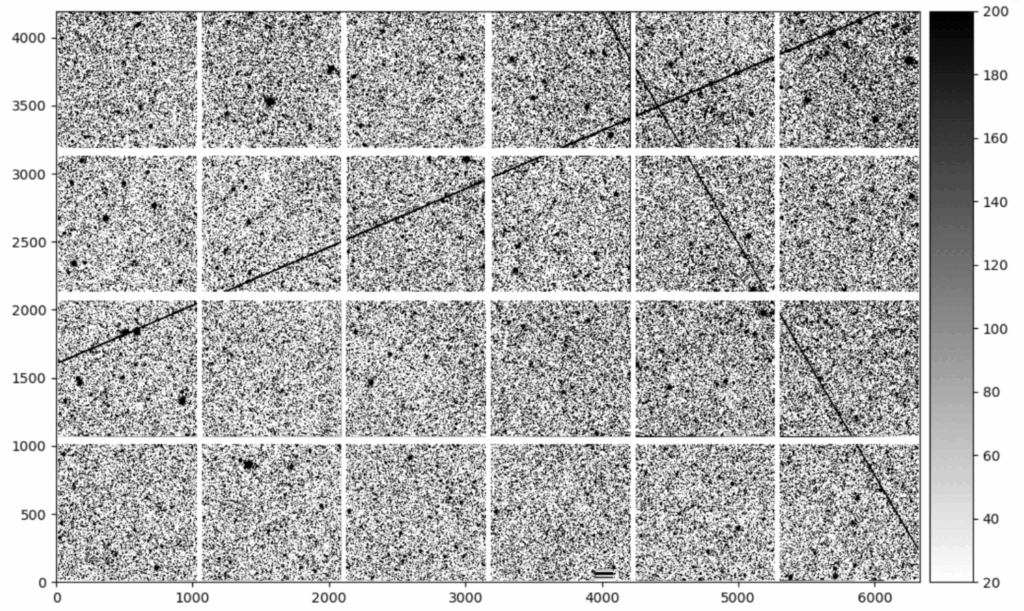
However, LSST’s unique science capabilities are being threatened by satellites in low Earth orbit. There are currently over 10,000 of these satellites, and forecasts predict that there may be more than 100,000 by 2030 (which will be just halfway through LSST’s ten-year survey). Satellite streaks (like those in Figure 1) don’t just block our view of interesting objects in the sky — they can be mistaken for astronomical objects that change brightness over time, like supernovae.
Today’s authors present a writeup from a three-day workshop at UC Davis in August 2025 that generated a series of recommendations to satellite builders and astronomers on how to prevent satellites from damaging LSST science. Representatives from several satellite companies were invited to attend, but only one engineer from SpaceX accepted.
All science will be affected, but low-brightness science will take a big hit
Since LSST was designed to explore low-surface-brightness objects, its image processing algorithms are optimized to preserve faint signals in the sky. Unfortunately, this will also preserve unwanted satellite tracks. Though the bright central regions of satellite streaks can usually be removed, their low-brightness wings extend pretty far (over multiple arcminutes!) and can be difficult to remove. When these faint features get added up over multiple images, they can masquerade as real low-brightness galaxy features like tidal streams, faint galaxy edges, or intracluster light (like the gorgeous image in Figure 2).
The analysis of these faint structures is crucial for understanding cosmology and the formation and evolution of galaxies. What can satellite builders and scientists do to prevent this loss of science?

When measuring satellite brightness, the entire satellite life-cycle should be taken into account
Most satellite brightness recommendations only address the operational altitudes of satellites. But in practice, satellites actually spend weeks to months in a lower transitional orbit. Also, when satellites are deorbited and burn up in the Earth’s atmosphere, they can appear as bright streaks in the sky.
Today’s paper urges satellite builders and scientists to look at the entire satellite life cycle when placing regulations on brightness. By 2030, it’s projected that there will be 50 satellite launches and 50 satellite deorbits per day, which means that there will be many bright streaks (of uncertain timing and location) dominating the night sky.
Companies should keep their satellite constellations at lower altitudes
This recommendation might seem counterintuitive, since lower satellites are brighter and leave wider streaks on astronomical images. However, lower satellites move faster across the sky, meaning that fewer satellites would be in LSST’s field of view at any given moment. If the entire Starlink V2 constellation was lowered from its current altitude of 550 km to an altitude of 350 km, the number of bright satellites entering LSST’s field of view would decrease by 40%.
Companies may want to keep their satellites in higher orbits because that reduces atmospheric drag and increases a satellite’s lifetime. However, when satellites are lower, their light is more defocused on the detector, which means that any given pixel on the camera gets fewer photons from these satellites. This reduces the satellite’s harmful effect on telescope imaging.
Overall, satellites should be fainter than a magnitude of 7 in the V-band
Today’s authors recommend that satellites should be dimmer than 7 mag in the V-band. This is roughly the threshold at which crosstalk artifacts (which are “ghost” images of a bright source that appear in other parts of the detector) can be successfully corrected. Satellite operators should conduct tests to determine which satellite designs would comply with this guideline.
The authors also emphasize that super-bright satellites should be avoided, even if there’s only a few of them. For example, Reflect Orbital plans to launch 4000 satellites that will intentionally illuminate specific locations on Earth after sunset, which would be ridiculously bad for astronomy.
Satellite orbits should be made public so that LSST can avoid them
It’s essential for satellite companies to publicly share the locations and trajectories of their satellites. The LSST feature-based scheduler can strategically avoid up to 1,000 of the brightest satellites in the sky, but it requires precise and accurate trajectory information to work.
The astronomy community should work together to figure out how to remove satellite streaks from images, and how to prevent satellites from being falsely identified as astronomical objects
While most of the paper’s satellite-migitation measures are directed at satellite companies, there are things that astronomers can do as well. The authors recommend that the astronomy community should work on identifying and characterizing false detections and systematic biases caused by satellites. It’s super important to understand exactly what kinds of artifacts satellites are creating in LSST images before we start doing science with them.
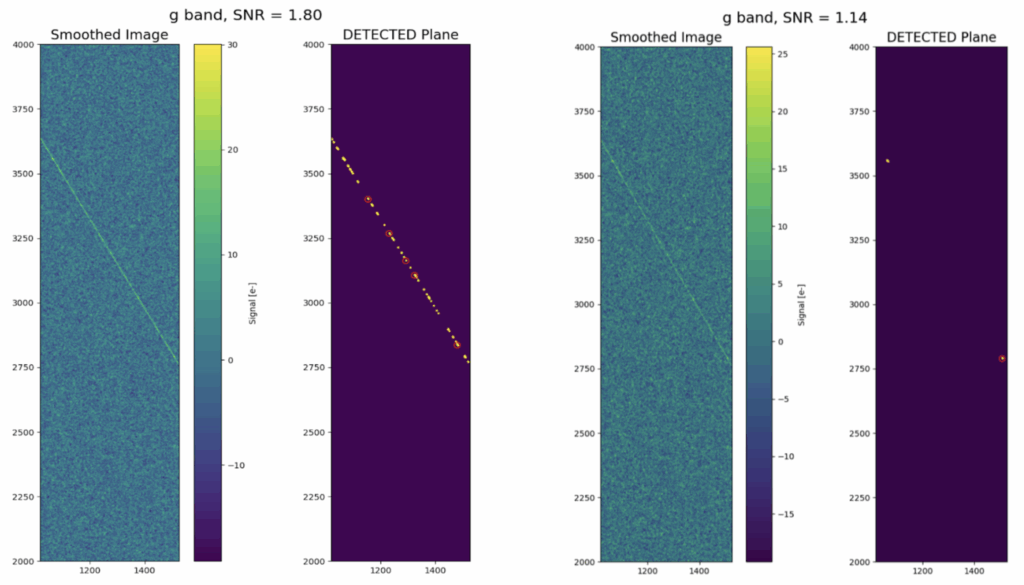
This involves coming up with algorithms that can properly deal with satellite tracks. Typical satellite streak detection algorithms don’t fully detect dim satellite trails, which means that they can be incorrectly flagged as astronomical objects (like in Figure 3).
Finally, astronomers and policymakers should continue to participate in international discussions about regulating satellite constellations and dealing with space debris. The number of satellites in orbit will only continue to increase, which makes it even more important for us to create regulations that will protect our night sky.
Astrobite edited by Ansh Gupta
Featured image credit: NOIRLab/NSF/AURA

It is critical that policymakers act now to protect the night.
A California startup, Reflect Orbital, plans to test a 60×60 ft space mirror in April 2026 as the first step toward a constellation of ~4,000 mirrors designed to beam sunlight onto Earth at night. Astronomers and ecologists warn this would catastrophically increase light pollution, disrupt ecosystems and human circadian health, and severely compromise astronomical research. [space.com], [smithsonianmag.com]
DarkSky International calls this an “unprecedented environmental intervention” and opposes orbital illumination on scientific grounds, noting proposed beams of 0.8–2.3 lux (several times brighter than a full moon)—a level known to alter wildlife behavior and degrade the natural night. This is a critical moment for evidence based environmental review and space governance. [darksky.org]
Call to action:
• Read DarkSky’s organizational statement and share it with decision makers.
• Add your voice urging transparent, science led review before any deployment.
Statement: https://darksky.org/news/organizational-statement-reflect-orbital/ [darksky.org]
Hashtags:
#SciencePolicy #EvidenceBasedPolicy #SpacePolicy #DarkSky #LightPollution #Astronomy #Astrophysics #EnvironmentalScience #ClimateScience #EcosystemHealth #CircadianRhythms #ResponsibleInnovation #TechAccountability #ProtectTheNight