
Authors: Federico Esposito, Almudena Alonso-Herrero, Santiago García-Burillo, Ismael García-Bernete, Françoise Combes, Richard Davies, Enrique Lopez-Rodriguez, Omaira González-Martín, Cristina Ramos Almeida, Anelise Audibert, Erin K. S. Hicks, Miguel Querejeta, Claudio Ricci, Enrica Bellocchi, Peter Boorman, Andrew J. Bunker, Steph Campbell, Daniel E. Delaney, Tanio Díaz-Santos, Donaji Esparza-Arredondo, Sebastian Hönig, Álvaro Labiano Ortega, Nancy A. Levenson, Chris Packham, Miguel Pereira-Santaella, Rogemar A. Riffel, Dimitra Rigopoulou, David J. Rosario, Antonio Usero, Lulu Zhang
First Author’s Institution: Observatorio de Madrid, OAN-IGN, Alfonso XII, 3, E-28014 Madrid, Spain
Status: Accepted to Astronomy & Astrophysics [open access]
Background
Galaxy quenching, or the process by which galaxies shut down star formation, is still a bit of a mystery. While we know that galaxy mergers, massive dark matter halos, and supernovae can shut down star formation, simulations still require a process called “AGN feedback” to prevent massive galaxies from starting up again. AGN feedback occurs when supermassive black holes at the centers of galaxies accrete gas, forming a bright, hot disk and launching winds or jets into the gas at the center of the galaxy. These “active galactic nuclei”—AGN for short—can therefore disrupt the clumps of cold gas in massive galaxies, and since these clumps would otherwise collapse to form stars, AGN feedback is thought to play an important role in shutting down star formation.
But there’s a catch: observational tests of AGN feedback paint nearly the opposite picture. AGN (especially bright AGN) tend to live in galaxies with lots of ongoing star formation, since the same gas that fuels the AGN also fuels star formation. AGN also only live for a short time relative to star formation—about 100,000 years, compared to the tens of millions of years it takes for galaxies to form new stars—so it’s likely that it takes several episodes of black hole activity for AGN feedback to take effect. So how do we observationally test theories of AGN feedback?
Enter the Galaxy Activity, Torus, and Outflow Survey, or GATOS. The GATOS team uses radio imaging to observe molecular gas in the vicinity of AGN in nearby galaxies. They look for signatures of AGN feedback on very small spatial scales (tens to hundreds of parsecs, where one parsec is about 3.25 light-years). These scales reflect the environment in which the AGN impacts and is impacted by gas during one episode of activity. In today’s work, the GATOS team uses molecular gas clumps where star formation is likely to occur to test whether AGN are able to disrupt star formation in the nuclei of nearby galaxies.
Measures of clumpiness
Clumpiness is already an important measure in astronomy. The techniques used in today’s paper were originally developed for measuring galaxy clumpiness, not gas clumpiness. Since stars form in groups in molecular gas clouds, star-forming galaxies tend to have bright clumps. As time goes on, the groups of stars drift apart, smoothing out the clumps and leading to a smoother light profile in non-star-forming galaxies. Similarly, clumps of molecular gas indicate regions where stars are likely to form in the future, while smoother molecular gas distributions indicate gas which is not collapsing under gravity to form stars. So how do we measure whether a material is clumpy or smooth?
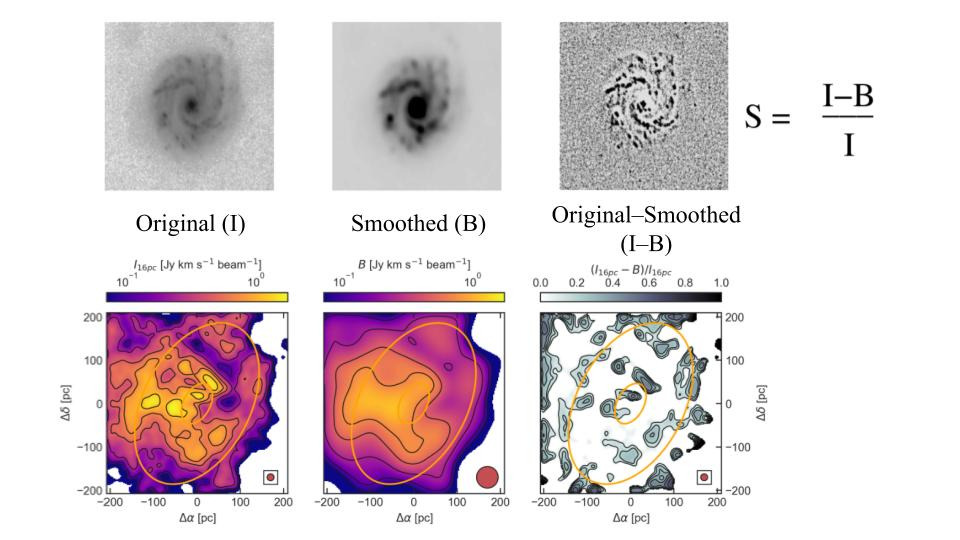
In Figure 1, you can see how the GATOS team measured clumpiness in their sample using a technique from galaxy studies. They started by adjusting all of their images to the same spatial resolution (16 parsecs). They then create a set of smoothed images using kernels of different sizes (think of a kernel as an “airbrush” function that smooths an image out to a desired lower resolution). They then subtracted those smooth images from the originals. When they do this, clumps smaller than the kernel size stand out in the image, while smooth background emission disappears. By using kernels of different sizes, they’re able to study the way AGN impact clumps on different scales.
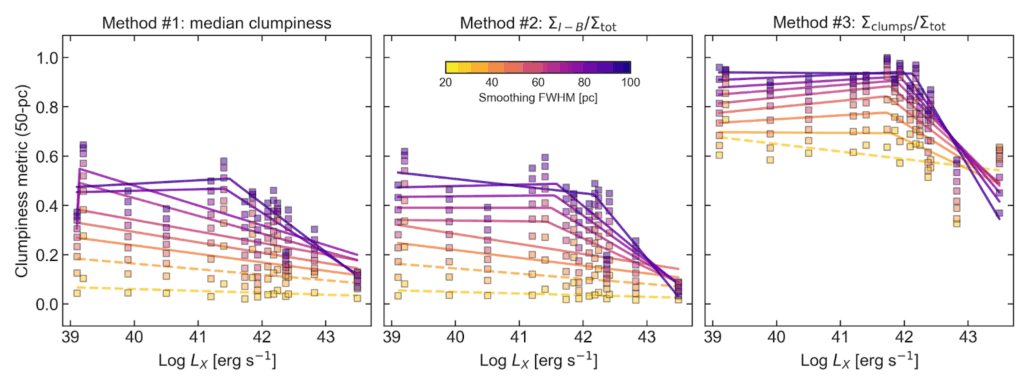
They use three different ways of calculating the clumpiness (Methods 1–3 in Figure 2). Method 1 is sensitive to the fraction of the nucleus that’s filled with clumps, while Methods 2 and 3 are more sensitive to the amount of gas in clumps versus in the background diffuse gas.
They use these three metrics for the whole nucleus as well as for the two apertures shown in Figure 1. These apertures are at 50 and 200 parsecs, representing the immediate environment of the AGN and the broader gas structures fueling the AGN, respectively.
Now that they have measurements of clumpiness on different scales and within two different apertures, the authors can study how the AGN impacts the molecular gas in the nucleus!
Results and interpretation
First, the authors measure the clumpiness within 50 parsecs and find that more luminous AGN have smoother gas in their immediate environments (Figure 2). They find that clumpiness on small scales is anticorrelated with luminosity. Clumpiness on larger scales has a mostly flat relationship with luminosity when AGN aren’t very bright, but once they cross a luminosity threshold around 10^42 erg/s (about a billion times the energy of the Sun), their clumpiness decreases dramatically. This is a similar threshold to that found in an earlier paper by the GATOS collaboration where gas becomes less centrally concentrated once the AGN is brighter than 10^41.5 erg/s. This may indicate that there is a threshold where the AGN begins to blow away and destroy gas in its immediate vicinity, carving a cavity in the nucleus. The gas that remains is heated by the AGN, which also makes it less likely to form stars.
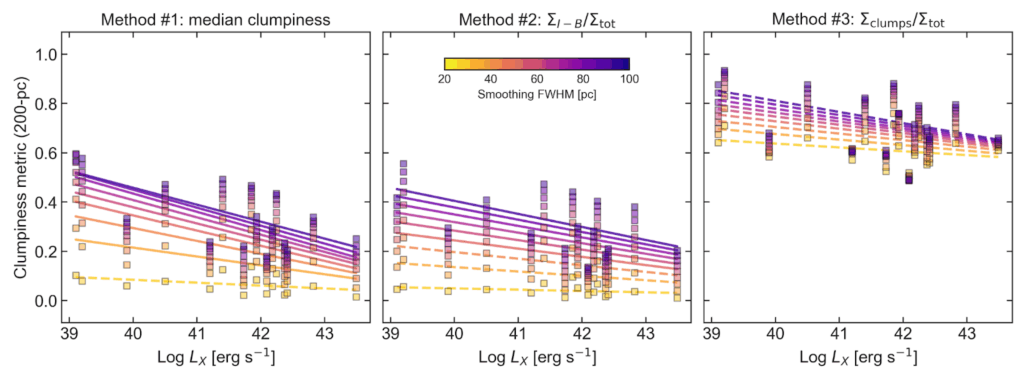
Next, the authors measure clumpiness in the 200 parsec aperture. They still find a negative correlation between clumpiness and AGN luminosity, but without the same luminosity threshold. When they measure only the clumpiness of the gas between 50 and 200 parsecs, they find almost no correlation between AGN luminosity and clumpiness, indicating that the negative correlation at larger scales is mostly driven by gas in the inner 50 parsecs.
The authors posit that gas in the inner 50 parsecs is a mix of inflowing gas from the galaxy and gas that’s been heated and blown away from the AGN. At low AGN luminosities, the AGN can somewhat impact the gas, dissolving some of the smallest clumps while larger clumps survive. At higher luminosities, the AGN overpowers the gas inflowing from the galaxy, destroying even the larger clumps where stars are most likely to form. The gas from 50 to 200 parsecs away from the AGN is less affected and reflects whatever state it was in when it started falling from the larger galaxy towards the black hole.
Conclusions
The results of this paper, as well as the results of previous work by the GATOS collaboration, show that AGN can have a powerful impact on the gas in galactic nuclei. By smoothing, heating, and expelling gas from galaxy centers, AGN might be suppressing star formation at small scales. However, the impact of several episodes of black hole accretion on larger spatial scales in massive galaxies are still an observational challenge. Luckily for those of us who study galaxy evolution, there’s still lots of work to be done testing models of AGN feedback with observational astronomy!
Astrobite edited by Brandon Pries
Featured image credit: NASA’s Goddard Space Flight Center’s Conceptual Image Lab
