
Title: Fast Radio Bursts from White Dwarf Binary Mergers: Isolated and Triple-Induced Channels
Author(s): Cheyanne Shariat, Claire S. Ye, Smadar Naoz, and Sanaea Rose
First Author’s Institution: Department of Astronomy, California Institute of Technology, 1200 East California Boulevard, Pasadena, CA 91125, USA
Status: Submitted to ApJ Letters [open access]

The history of fast radio bursts
Since the discovery of the Lorimer Burst in 2007, astronomers have studied fast radio bursts (FRBs) in extreme detail. However, these extragalactic millisecond-duration radio transients have remained an enigma. Like many astrophysical phenomena, their discovery was serendipitous. The most prolific FRB-discovery instrument, CHIME, was not originally built to study them; the acronym stands for “Canadian Hydrogen Intensity Mapping Experiment,” reflecting its original (and ongoing) mission to map the cosmological distribution of Hydrogen in the primordial universe. Since its construction, CHIME has discovered several thousand FRBs, and even identified a smaller fraction that are known to repeat, some with consistent periods and others that are sporadic and seemingly random (check out their live catalog of repeating sources).
Despite thousands of sources to study, the only thing we know fairly confidently about FRBs is that many of them are extragalactic, and some others are even at cosmological distances. If we don’t understand how FRBs are produced, how can we know their distance? FRBs display a unique signature in the radio spectrum, where higher frequencies arrive at the telescope first and lower frequencies arrive later, delayed by an inverse frequency-squared relationship. In a “dynamic spectrum”, this makes the pulse actually appear like a sweep from high to low frequency that follows the shape of a parabola; for example, the brightest pixels in Figure 1 of this Bite display this sweeping shape. This effect results from the FRB propagating through an ionized plasma with a specific density. Since the FRB is ultimately an electromagnetic wave, this slows down the speed of the FRB as a function of frequency. Measuring this effect, called dispersion, allows us to infer that the FRB signal passed through more plasma than can be accounted for within our own Milky Way galaxy, indicating that the FRB must have originated from much further away. So far, there is only one example of an FRB from within our own galaxy, which was identified as originating from a magnetar, a highly magnetic pulsar.
FRB progenitor candidates
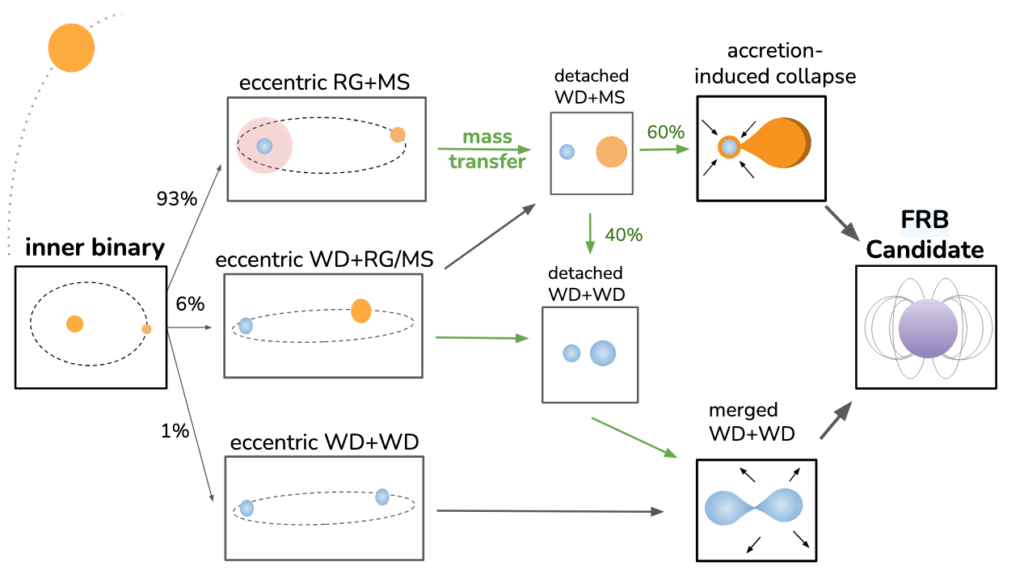
Although we know that most FRBs are located at extragalactic or even cosmological distances, it’s still not clear all of the possible objects that can generate them. Since magnetars and other compact objects are often considered reliable progenitors of FRBs, understanding their population and comparing them with observed FRBs may reveal the origin of FRBs. Candidate FRB progenitor systems are usually divided into “prompt” channels–like the collapse of a star into a magnetar during a core-collapse supernova–and “delayed” channels where the FRB engine is formed on longer timescales, like accretion-induced collapse (AIC) of white dwarfs (WDs) or compact object mergers. Figure 1 displays several of these channels, particularly those considered in today’s article, in which stellar evolution results in the transfer of material from one star to another (AIC) or gravitational radiation allows two objects to inspiral and merge. These events could create highly magnetized WDs or magnetars that may produce FRBs.
Simulating hierarchical triples
In today’s article, we’re considering the role of hierarchical triple star systems in producing FRB-emitting objects. A hierarchical triple consists of an inner binary and a distant, tertiary star; see the first panel of Figure 1. These systems may play an important role because many stars that become WDs of at least 0.8 solar masses exist in hierarchical triples: 35% of 2-solar-mass stars and 50% of 8-solar-mass stars are in triples, both of which will end their lives as WDs. The tertiary star plays an essential role in increasing the likelihood of the inner binary interacting: the eccentric Kozai-Lidov (EKL) mechanism causes the inner orbit to oscillate between highly inclined (with respect to the tertiary) and highly eccentric. Unlike isolated binaries that aren’t excited in this way, the eccentric orbit phase causes the inner stars to pass much closer to each other, increasing the likelihood of interaction or even a merger that could produce an FRB-emitting remnant.
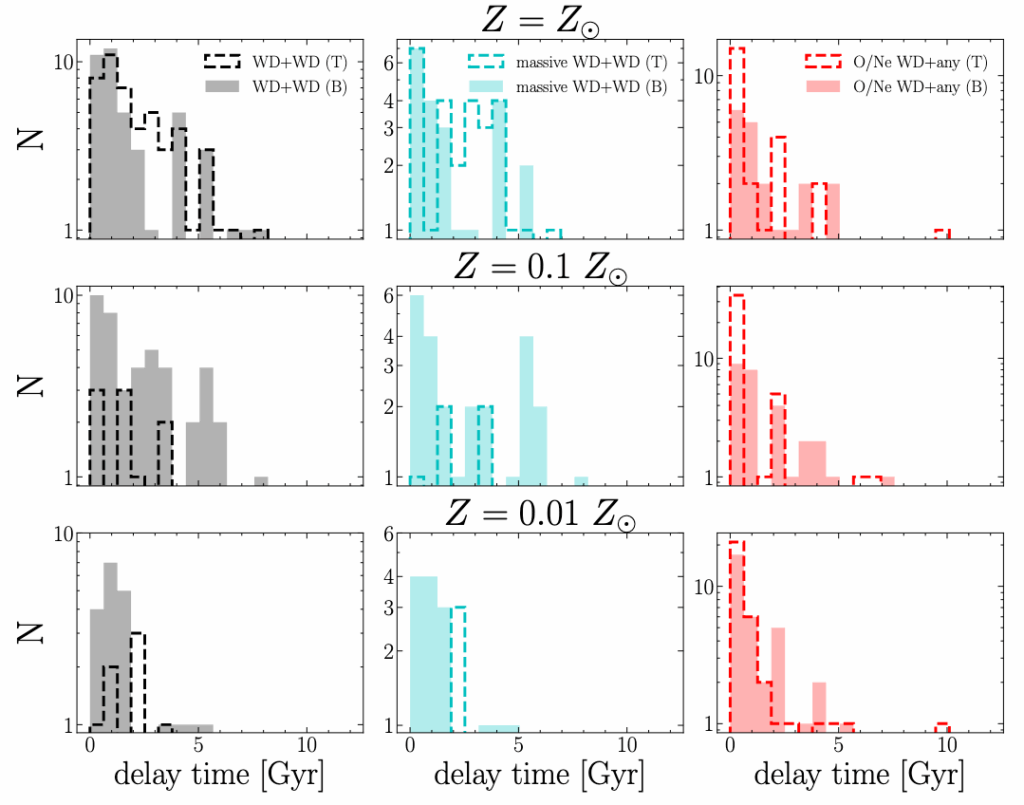
The authors of today’s article produced a realistic population of triple systems by sampling from empirically measured distributions of masses, periods, and orbital eccentricities. These distributions were derived from observations collected by the Gaia satellite, an all-sky optical telescope that has now observed over one billion stars in the Milky Way. The authors also created a “control” sample of isolated binaries by removing the tertiary star from the same sample of systems. The systems were then evolved for an age randomly selected between 0 and 12.5 billion years to simulate “constant” star formation similar to that in the Milky Way. Finally, they reapply these simulations at three different “metallicities”–the fraction of elements other than Hydrogen or Helium relative to that of the Sun. Figure 2 displays these two populations: the isolated binaries are shown as filled histograms, and the hierarchical triples are shown as dotted histograms. Each column represents the three different progenitor classes considered in Figure 1. At solar metallicity, the delays to merging are greater in triples than in secular binaries, leading to more mergers overall (top left panel). At lower metallicities, there are fewer mergers in all progenitor pathways in triples than in isolated binaries due to changes in stellar evolution attributed to weaker winds and larger pre-WD masses.
A cosmic population of FRBs
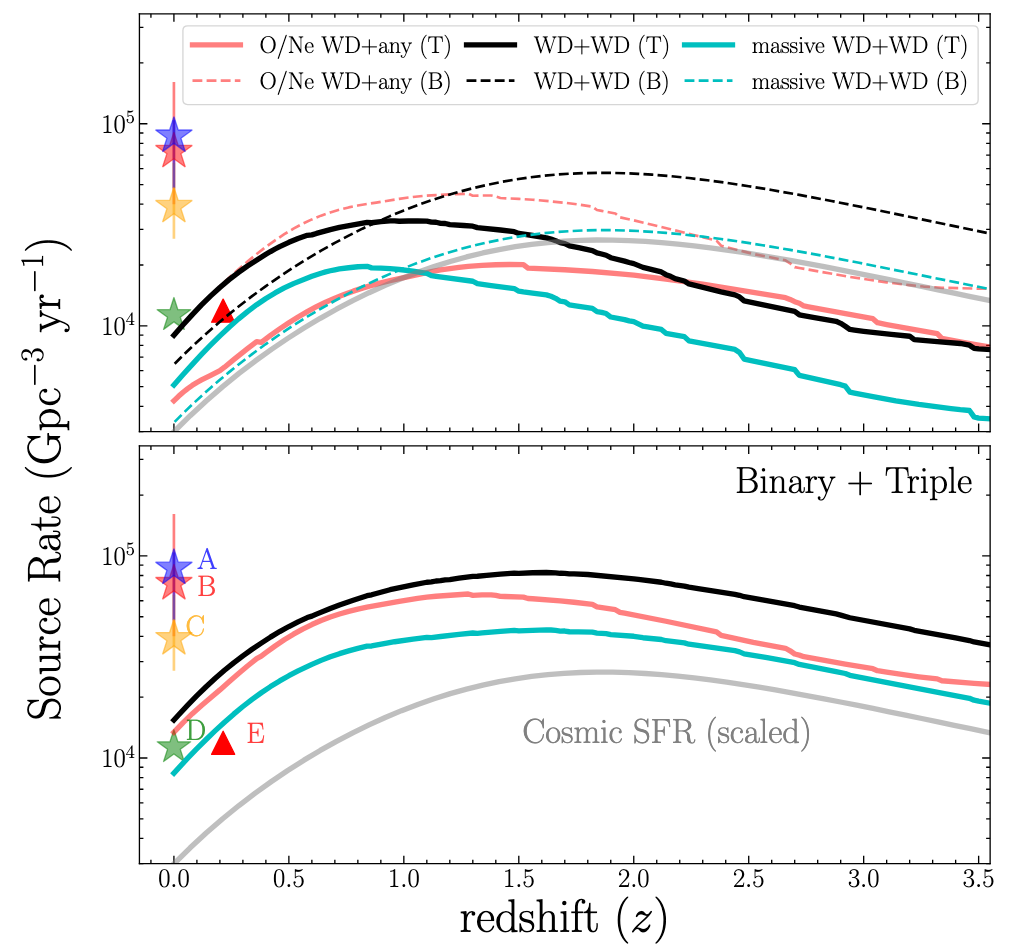
Since we can’t realistically track individual star systems from their formation to the end, we need to convert the delay-time distributions shown in Figure 2 to an observable. To do this, the authors combine the results of their simulations with measurements of the cosmic star formation rate–how many stars form per unit time as a function of the Universe’s age–and the evolution of the Universe’s metallicity as stars fuse Hydrogen into heavier elements and re-introduce it back into the interstellar medium as they end their lives in shedding red giants or supernovae. This analysis produces the number of FRBs that should be observed as a function of distance or lookback into the Universe’s history, which is displayed in Figure 3.
This analysis reveals key measurable differences between lone binaries and hierarchical triples: most notably, binary WD+WD mergers peak later in the Universe (redshift z~1), while single binaries peak earlier (redshift z~2). These results highlight the importance of including triples in FRB progenitors because they are more likely to contribute to populations at later times–and therefore nearby and more easily detectable–in the total population of FRBs. Future instruments like CHIME with the new outriggers and the DSA-2000 will expand the sample of FRBs to reach further cosmological distances, with better localizations, enabling more statistically motivated tests of different formation pathways.
Edited by Catherine Slaughter

Great summary of the WD/NS merger channels! What strikes me is that all of these scenarios ultimately circle back to magnetars — either as birth products or as collapse engines. The WD/NS pathways are “birth channels,” where accretion‑induced collapse or mergers create new magnetars that might emit FRBs. But there are also “death channels” that seem under‑explored: a supramassive magnetar losing angular momentum and collapsing into a black hole, one accreting from a red dwarf or main‑sequence companion until it tips past stability, or even a magnetar nudged over the edge by a super‑Jupiter merger. In each case the magnetar’s magnetic reservoir provides the energy, and the collapse violently disrupts the magnetosphere, producing a one‑off, non‑repeating FRB. It seems worth considering these magnetar‑collapse pathways alongside the merger birth scenarios, since they naturally explain the catastrophic class of FRBs.