
In this series of posts, we sit down with a few of the keynote speakers of the 247th AAS meeting to learn more about them and their research. You can see a full schedule of their talks here, and read our other interviews here!
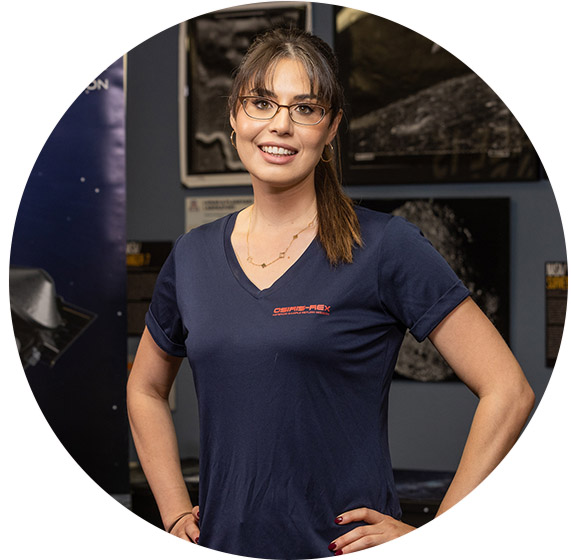
Dr. Daniella DellaGiustina, a professor at the University of Arizona’s Lunar and Planetary Laboratory, will be giving the very first plenary talk of AAS 247, “From Launch to Legacy: How OSIRIS-REx Changed Our Understanding of Asteroids.” The OSIRIS-REx mission, launched in 2016, paid a visit to the near-Earth asteroid Bennu and not only examined the asteroid up close but returned a sample of its material back to Earth in 2023.
The hard part of giving a talk on OSIRIS-REx, according to DellaGiustina, the mission’s Deputy Principal Investigator? There’s simply so much to say, thanks to how much we learned from the mission!
Bennu was chosen as the target of the mission since it was accessible from Earth and its dark color (with an intriguing blue tint) indicated it was likely carbon-rich – and thus perhaps had organic molecules. The OSIRIS-REx spacecraft spent 2018 to 2021 orbiting Bennu, doing flybys, and collecting the sample. This stage of the mission revealed surprises regarding Bennu’s surface and structure: the surface was very rough, in a way Earth-based observations hadn’t predicted, and the material making up the asteroid was much more weakly held together than astronomers had anticipated. “That’s kind of revolutionized, along with some other small-body missions like Hayabusa-2, our understanding of what these small, near-Earth asteroids are like,” says DellaGiustina. “They may be very, very weakly, loosely bound together collections of collisional debris.” Knowledge of near-Earth asteroids’ structure informs what we might do to mitigate the threat if we found an asteroid on a collision course with Earth.
Once the spacecraft returned its sample of Bennu to Earth, the focus of the mission switched. “We are now, in a lot of ways, an astrobiology mission, and that’s been so cool for me,” says DellaGiustina. Studying asteroids can address major unanswered questions including how life got started on Earth and where the seeds for life came from. “In order for life to form and evolve on Earth, there’s certain precursors, the key ingredients for life as we know it, and Bennu seems to harbor these…not just the precursors for life, but the building blocks, like amino acids.” Many of the materials being found in the Bennu sample have never been seen before in materials originating in space. Meteorites can tell us about the composition of asteroids, but plenty of molecules and organic compounds wouldn’t survive the fiery trip through Earth’s atmosphere on a meteorite, or would be quickly broken down by processes on Earth’s surface. Careful contamination control and documentation of the spacecraft also allows the researchers to be sure that compounds in the sample really came from space, whereas a meteorite could have picked up something new on Earth.
Following its trip to Bennu, the same spacecraft from OSIRIS-REx will travel onwards to the near-Earth asteroid Apophis as the OSIRIS-APEX mission, for which DellaGiustina is the Principal Investigator. Apophis is a similar size to Bennu, but that’s where the similarities end: it has a different shape, rotational state, and spectral class (stony instead of carbonaceous). What really makes Apophis special, though, and the reason it’s getting a visit, is that it will pass within about 32,000 kilometers of the Earth in 2029. That’s not only more than ten times closer to the Earth than the Moon: it’s nearer to the Earth than some man-made satellites. As Apophis passes so close to the Earth, it’s expected to be altered by Earth’s gravity. But this type of event is extremely rare – once in about 7,500 years – so we’ve never observed one before. “We have a lot of ideas, and there’s lots of papers that have been written, on what is likely to happen when Apophis gets this close to the Earth, but they don’t agree!” says DellaGiustina. By visiting Apophis shortly after its closest approach, OSIRIS-APEX will be able to find out what ideas turned out to be right, and give us a front-row seat to an incredibly rare event.
Regarding her career path, DellaGiustina’s overarching description is: not a straight line. “I really never thought, when I was a young person, that I would end up in the sciences. I was really drawn to philosophy, and psychology, and more of the liberal arts, and I had this idea in my mind that that is where you go if you want to answer the big questions, like where did we come from, and what is our destiny, what is our origin, why does life exist. And during my freshmen year of college at a community college, I took an astronomy class just to get my general science requirements out of the way, and it was the first time that I had a realization that a lot of these big questions actually have answers in the sciences. And so I completely pivoted.” The happiness of getting to address these really big questions in research fueled her through catching up on math and physics. “I’m also an instrumentalist, and I’m very, very, just from a philosophical perspective, interested in how we acquire information, and how we build instruments to do that, and what are the limitations of that,” says DellaGiustina. All in all, regarding her work, “I’ve found a nice home where I can kind of merge all these different interests, and I feel pretty lucky.”
Dr. DellaGiustina will be giving the Fred Kavli Plenary Lecture on Monday, Jan. 5th, from 8:00-9:10 AM MT in West Building 301AB.
Edited by: Lindsey Gordon
Image Credits: AAS
