
Title: A Bimodal Metallicity Distribution Function in The Ultra-Faint Dwarf Galaxy Reticulum II
Authors: Alice M. Luna, Alexander P. Ji, Anirudh Chiti, Joshua D. Simon, Daniel D. Kelson, Minsung Go, Guilherme Limberg, Ting S. Li, and Anna Frebel
First Author’s Institution: Department of Astronomy & Astrophysics, University of Chicago, Chicago, IL, USA
Status: Published in The Open Journal of Astrophysics [open access]
Star formation in galaxies is a complex process; a push-and-pull between the collapse of dense, cool gas reservoirs encouraging it, and the effect of feedback processes, which heat up and disperse gas, suppressing it. Depending on which side of this tug-of-war is winning a galaxy can be considered currently star-forming, or quenched. For the smallest, faintest galaxies in our universe (ultra-faint dwarfs, or UFDs), a big question is when exactly that quenching occurs, and whether or not UFDs can make a comeback to go on to form stars once again. The authors of today’s paper take a look at the stars in Reticulum II (Ret II), a nearby UFD, to try to piece together its star formation history.
Reionization and UFDs
The biggest quenching event in our universe was reionization, the period when the first stars and galaxies formed from the collapse of neutral Hydrogen gas. As these stars formed, their emission heated up the surrounding gas, ionized the atoms, and transformed the gas back into electrons and protons, just as they had originally been in the first few minutes of the universe (hence the re part of reionization).
For massive galaxies, their large gravitational potential allowed them to hold onto that hot gas in order for it to eventually go on to form more stars once it cools. However, extremely low-mass galaxies like UFDs are so loosely bound that it is believed that all their ionized gas would have been dispersed and completely lost, preventing them from forming any more stars since reionization. Most observations of UFDs support this, as the stars are all extremely metal-poor, as you would expect if they formed from gas that had never been enriched by supernovae.
Reticulum II
It is often very difficult to study the complete metallicity distribution of the stars in UFDs since there are so few to begin with, and because many of them are also extremely dim and difficult to detect. The authors of this paper however, aim to get the most complete stellar spectroscopic survey of the stars in Ret II, a Milky Way satellite galaxy with a stellar mass of only about 3000 solar masses.
Using the Magellan Baade telescope at Las Campanas Observatory in Chile the authors obtained spectroscopic data for 167 stars in Ret II, which is 6.5 times more than previous literature studies! After converting their spectra to metallicites, they were able to plot the metallicity distribution function (MDF) for Ret II, which, with the addition of these new stars, is the most complete spectroscopic MDF for a UFD to date.
A Not-So-Simple Stellar Population
If Ret II formed all its stars in one burst we would expect its MDF to follow a single-peaked Gaussian distribution, but instead the authors find that the MDF is bimodal. They find two distinct high- and low-metallicity stellar populations: one with an average metallicity of [Fe/H] = -3.0 to which 76% of the stars belong, and another with an average metallicity of [Fe/H] = -2.1 to which 24% of the stars belong, as shown in Figure 1.
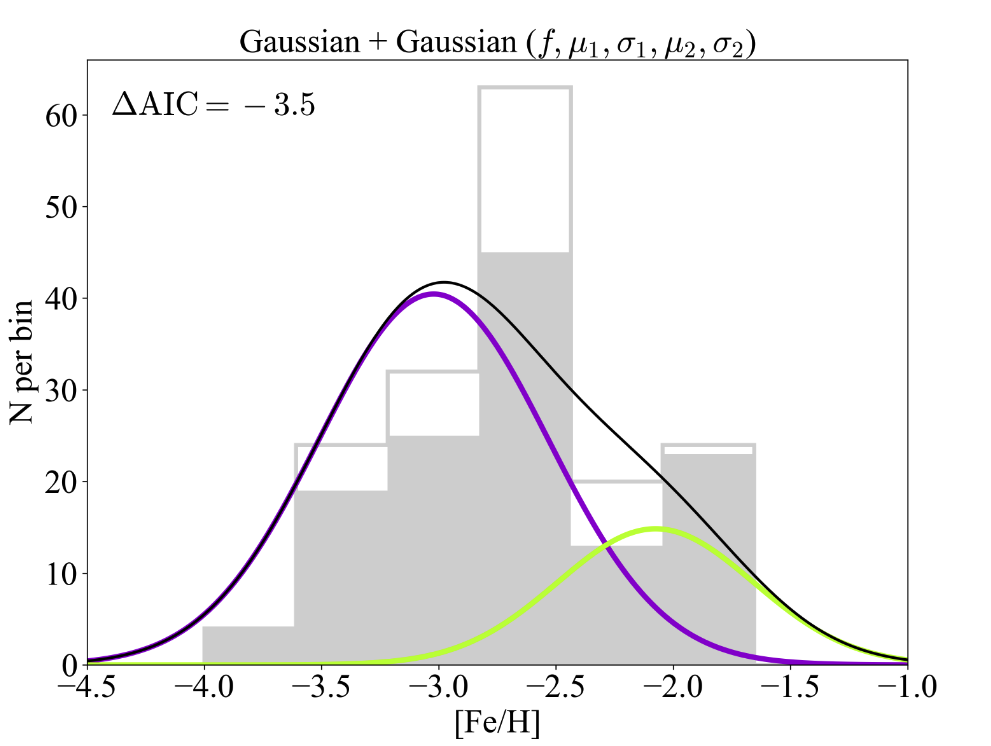
The metallicity gap between these two peaks in the MDF is a little over a factor of 10 in [Fe/H], something that could be produced by two bursts of star formation. In this scenario massive stars from the first burst would age and go supernova at the end of their lifetimes, enriching any surrounding gas, and resulting in more metal-rich stars being eventually formed in a second, smaller burst of star formation. Based on how wide the observed metallicity gap is the authors estimate that the time between star formation bursts could have been as much as three billion years, which would mean Ret II would have formed a quarter of its stars after reionization!
Are Your Metal-Rich Stars Home-Grown or Imported?
However, this interpretation of the MDF is assuming the metal-rich stellar population was formed in-situ within Ret II, which is not a given. Galaxy mergers are a huge driver of galaxy evolution at all mass scales, and can deposit stars formed ex-situ from other galaxies and environments into the one we are observing today. If Ret II is the product of a galaxy merger then the metal-rich stars may not actually be younger, they may just be coming from an accreted galaxy that had more enriched gas available to form its stars.
However, there are a couple of reasons why the authors still favour the two-burst star formation scenario rather than a merger. First, after a merger we tend to be able to observe a difference in the spatial distribution of the stars as a function of metallicity, with in-situ stars being more centrally concentrated and ex-situ stars being more on the outskirts. They found that the metal-rich and metal-poor stars are instead pretty evenly distributed in Ret II, as shown in Figure 2.
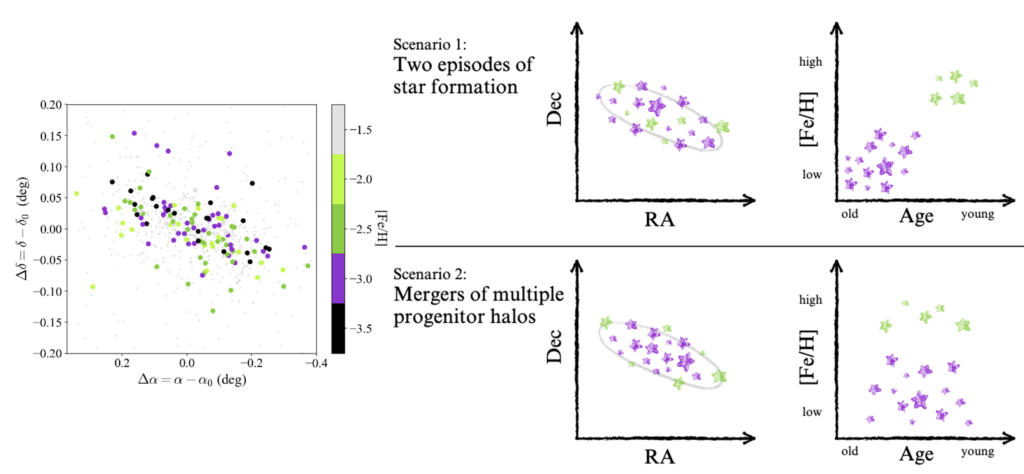
Second, galaxies tend to follow a global mass-metallicity relation, with more massive galaxies having more metal-rich stars, on average, than very low-mass galaxies. In a merger scenario the accreted stars would need to have come from a galaxy even smaller than Ret II, meaning it is unlikely that it would bring in higher metallicity stars than were already there.
What’s The Verdict?
If you’re going to say you found observational evidence of post-reionization star formation in a UFD you better have confident age estimates of your stars to back up your claim. In this work the authors estimated when the second star formation burst happened based on the expected age-metallicity relation for the stars in Ret II, assuming a two-burst star formation history. They acknowledge however, that independent age estimates will be necessary to completely rule out a merger scenario and confirm that the second burst occurred 3 billion years after the first.
Either way, this is the most in-depth study of the MDF for a UFD so far and hopefully is the first of many. With current and upcoming large sky surveys like Roman, Rubin, and Euclid we’ll be able to study more and more low-luminosity galaxies and their stellar populations in the coming years.
Astrobite edited by Neev Shah
Featured image credit: Wikimedia Commons
