
Title: JWST Confirmation of a Runaway Supermassive Black Hole via its Supersonic Bow Shock
Authors: van Dokkum, P., Jennings, C., Pasha, I., Conroy, C., Kaul, I., Abraham, R., Danieli, S., Romanowsky, A., & Tremblay, G.
First Author’s Institution: Astronomy Department, Yale University, 219 Prospect St, New Haven, CT 06511, USA
Status: submitted to ApJ Letters [open access]
Watch out! There’s a supermassive black hole on the loose, tearing through the universe at over 3 million kilometres an hour! Luckily, it’s at least 7 billion light years away from us, so we can observe it from a safe distance.
Runaway supermassive black holes (SMBHs) have long been predicted to exist as a consequence of galaxy mergers, and in 2023, we got a tantalizing hint from the Hubble Space Telescope that we might have spotted one. Now, data from the James Webb Space Telescope (JWST) has confirmed that the object is travelling supersonically through space, disturbing the diffuse gas surrounding the galaxy (known as the circumgalactic medium, or CGM), and creating a bow shock. The object is likely to be a supermassive black hole, flung out of its galaxy and flying through the CGM.
A Chance Discovery
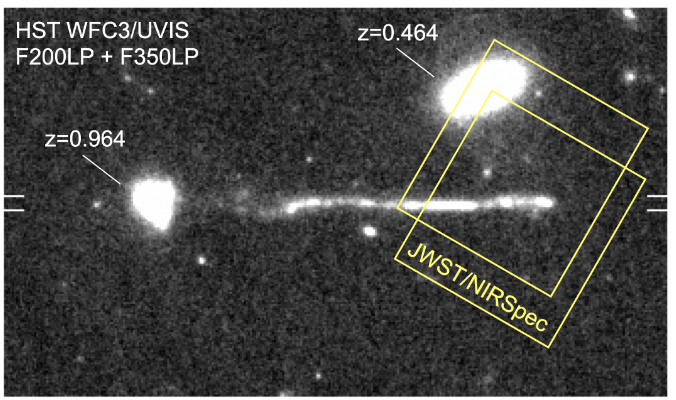
The runaway SMBH was found by chance in a Hubble image (Figure 1) that revealed a strange linear structure that seemed to be coming directly out of (or towards) a nearby galaxy (labeled with z=0.964 in Figure 1). Follow-up spectroscopy of this object (which you can read more about in this astrobite) revealed that the structure was consistent with a runaway SMBH travelling at supersonic speeds and shocking the CGM. But the spectra could not rule out alternative explanations, such as the possibility that it was a disc galaxy with no central bulge being viewed exactly edge-on.
The Signature of a Supersonic Bow Shock
To learn more about this mysterious object and rule out alternative explanations, the authors obtained follow-up observations of the object using JWST NIRSpec’s Integral Field Unit (IFU). An IFU is able to take an image where each pixel contains a spectrum (also known as a “spaxel”), allowing astronomers to compare the spectrum of an object at different physical locations.
Due to the Doppler effect, light will be shifted to shorter wavelengths (blueshifted) if the source is moving towards us, and longer wavelengths (redshifted) if the source is moving away from us. The faster the source is travelling, the larger the shift in wavelength. At the tip of the feature, the authors find that the velocity of the gas changes by more than 600 km/s over just 1 kiloparsec. Such a steep velocity gradient right at the tip of this linear feature is the key sign that this object is a supersonic bow shock. No other effect or object could cause such a drastic change in the gas velocity over such a (astronomically speaking) small scale.
![A figure with three panels. The top panel is a colour map showing the brightness of H-alpha and [O III] in each spaxel. The brightest region is the tip of the shock. The middle panel compares the velocities predicted by a model to the observed velocities as a function of distance from the host galaxy. In both cases, the velocity is roughly constant closer to the galaxy and then sharply increases near the tip of the shock. The bottom panel zooms in to the region where the velocity increases, showing good agreement between the model and the data.](https://astrobites.org/wp-content/uploads/2026/01/vanDokkum_fig7-485x1024.png)
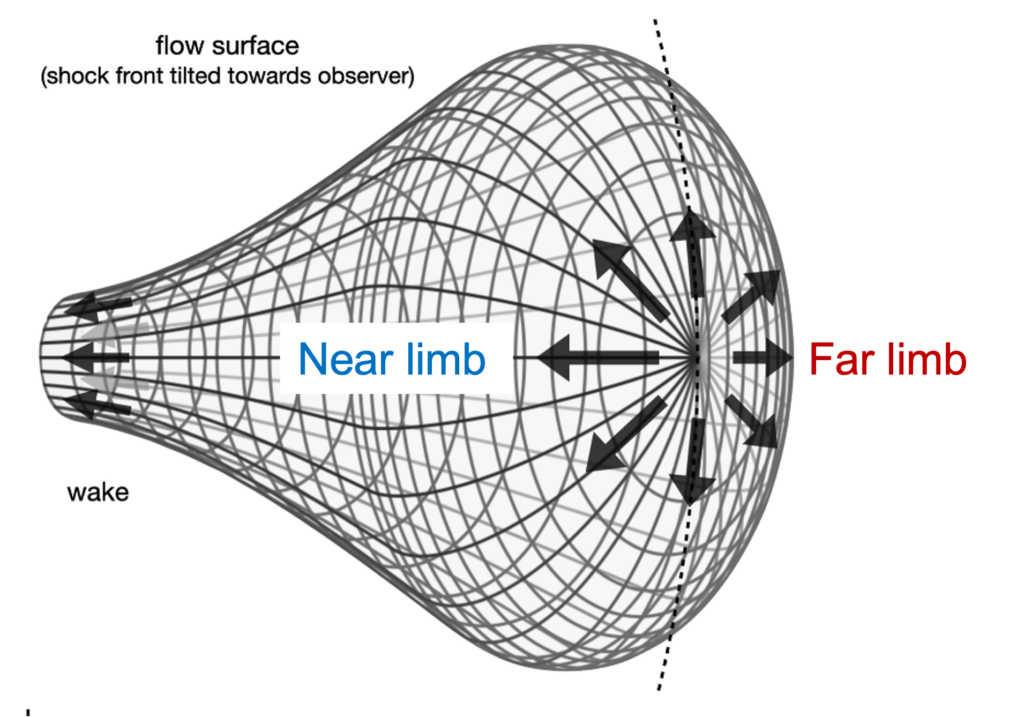
By carefully modelling the expected kinematics of a bow shock (the shape of which is shown in Figure 2), the authors predict how the velocity should vary in different spaxels. The shock isn’t moving perfectly parallel to the plane of the sky; instead, it’s tilted towards us by ~30 degrees. As a result, one side of the bow shock is moving towards us (the “near limb”) and the other is moving away from us (the “far limb”). The angle of the shock means that we should see a lot of blueshifted emission from the near limb and a little bit of redshifted emission from the far limb.
The authors simulate the bow shock and try to match the observed kinematics with their model. You can see the results of this in Figure 3. The top panel shows the brightness of two emission lines in each spaxel, to show you where along the shock and wake. The second panel shows the predicted velocity at different distances along the shock and wave. The sharp increase from negative (blueshifted) velocities to a positive (redshifted) velocity shows you where you’re looking across from the near limb to the far limb. The bottom panel zooms in to the tip of the shock to demonstrate how well their model fits the data.
Star Formation in the Wake of a Runaway Black Hole
As the black hole travels through the CGM, it leaves a thin wake of hot gas. Over time, more gas from the CGM mixes into the wake, making it a long-lived structure. Gradually, the gas cools and gets dense enough to form stars in the wake. By measuring the amount of light being emitted by the wake, the authors estimate that the wake contains 200 million solar masses worth of stars! This is uncomfortably close to the amount of gas that could mix into the wake over its lifetime, perhaps suggesting that conditions in the wake make it so that more high-mass stars are formed than is normally expected. Higher mass stars emit much more light per unit of mass, meaning that a lower total mass of stars could produce the same amount of light if the distribution of stellar masses is skewed more towards high mass stars.
Cause of Ejection
There are two main ways that a SMBH could be ejected from its host galaxy: gravitational wave (GW) recoil or three-body interactions. As two SMBHs of similar mass and opposite spins spiral in towards each other, they’ll emit more gravitational waves in one direction than the other. The asymmetry creates a recoil force in the opposite direction, meaning that once the black holes merge, the resulting black hole can be kicked out of the galaxy at very high speeds. Such a setup is probably quite rare, but we think that almost all galaxy mergers should eventually result in an SMBH merger, so there should still be a population of SMBHs flung out of their galaxy by gravitational wave recoil. Alternatively, a system where three SMBHs are orbiting each other can be quite unstable and end up with the lowest mass SMBH being ejected from the galaxy.
The authors make a simple estimate of the SMBH’s mass using conservation of energy. As the black hole travels through the CGM, it heats the gas, thus transferring some of its kinetic energy. By measuring the energy transferred to the CGM in the bow shock and wake, the authors place a lower limit on the mass of the black hole at around 10 million times the mass of the Sun. This mass is similar to the SMBH mass you would expect given the mass of stars in the host galaxy’s bulge. Therefore, they conclude that it’s unlikely that the SMBH we see is the lowest-mass SMBH ejected from a triple system. Instead, they argue it’s more likely the result of a GW recoil event.
So case closed?
Not quite. There are still some open questions about this object. It’s especially difficult to definitively prove that there is a black hole embedded in this structure. If there is one, it’s likely surrounded by an envelope of hot gas that’s much, much larger than the black hole, making it impossible to directly observe. However, the observations align very well with what we expect from a runaway supermassive black hole, making this the most concrete evidence of a runaway SMBH to date. Undoubtedly, more data will be taken of this object, which will reveal more details!
Astrobite edited by Cesiley King
Featured image credit: van Dokkum et al, (2025)
