

This guest post was written by Tibby Finn Leeming. Tibby is an Astrophysics PhD student at the University of East Anglia in Norwich, UK. Her research involves the analysis of pulsars and the investigation of variations within the observed pulsar population. She is also a keen contributor to her university’s outreach projects, encouraging engagement with physics in her community.
Paper title: Two long-term intermittent pulsars discovered in the PALFA Survey
Authors: A. G. Lyne, B. W. Stappers, P. C. C. Freire, J. W. T. Hessels, V. M. Kaspi, B. Allen, S. Bogdanov, A. Brazier, F. Camilo, F. Cardoso, S. Chatterjee, J. M. Cordes, F. Crawford, J. S. Deneva, R. D. Ferdman, F. A. Jenet, B. Knispel, P. Lazarus, J. van Leeuwen, R. Lynch, E. Madsen, M. A. McLaughlin, E. Parent, C. Patel, S. M. Ransom, P. Scholz, A. Seymour, X. Siemens, L. G. Spitler, I. H. Stairs, K. Stovall, J. Swiggum, R. S. Wharton, W. W. Zhu
First Author’s Institution: Jodrell Bank Centre for Astrophysics, Manchester, UK
Status: Published in ApJ [open access]
Now you see me, now you don’t
Pulsars are amongst the most stable rotators of the known cosmos. Previously discussed in this astrobite, they are the highly magnetized, rapidly rotating lighthouse-like remnants of supernova explosions. They are powerful astrophysical tools for as long as their emission remains visible to us, and this paper sheds light on how the observed pulsar population may be shaped by changes in that emission. What might we have missed when searching for a lighthouse that has been operating for over ten million years and starts to lose lamp light?
Pulsar discoveries of recent years have offered a roadmap for standard pulsar behaviours during their evolution, and consequently non-standard ones too. Figure 1 is a simple continuous signal from a normal pulsar, it shows how pulses can look very different from each other in both shape and intensity and demonstrates the periodicity of pulsar signals. Astronomers monitor changes to the pulse arrival times (timing), the pulse shape (profile), or the observed emission intensity (flux). Variations in these properties reveal intriguing characteristics of the pulsar.
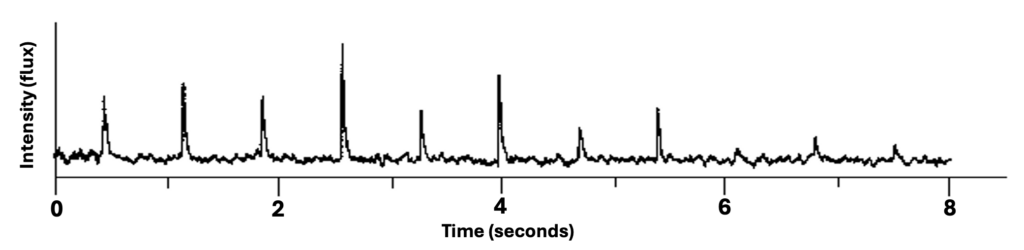
One phenomenon that involves changes to both the profile shape and flux is known as “nulling”. During a null, the signal appears to significantly dissipate very rapidly before returning to standard intensity—i.e. they switch “ON” and “OFF”. Many pulsars exhibit nulling behaviour on timescales of seconds to hours, and nulling has been identified in approximately 8% of the 3000+ pulsar population. Only a handful, however, stay dim for weeks or months at a time.
Intermittent pulsars like the ones discussed in today’s bite behave similarly to these nulling pulsars, but switch OFF for far longer, and the pulsar’s ON /OFF state seems to be correlated with its rotation rate, in a way we don’t typically see in other pulsars. The first of its kind, discovered in 2006, PSR B1931+24 was found to behave synonymously to ordinary isolated radio pulsars for 5 to 10 days, but then rapidly switch OFF for 25-30 days, before switching ON again. The OFF states appeared to last five orders of magnitude longer than those of typical nulling pulsars, and the ON /OFF switching occurred quasi-periodically. PSR B1931+24’s rotation was observed to decrease at a rate 50% faster when it was in its ON state compared to when it was OFF, giving concrete support to theories that a pulsar’s slowing rotational rate is related to its emission.
Two pulsars and their vanishing acts
PSR J1910+0517 and PSR J1929+1357 (henceforth J1910 and J1929) are two similarly long-term intermittent pulsars, discovered at the now-decommissioned Arecibo observatory in Puerto Rico. Using several years of data, compiled from follow-up observations made by Arecibo and the UK-based Lovell telescope, the authors investigated how often each pulsar switched ON and OFF. Figure 2 plots the cumulative number of detections against observations over the 4-year period for each pulsar, and the slope of the data represents the duty cycle–essentially, how often the pulsar is ON. J1910 was detected regularly, and it appeared ON roughly a third of the time. Also, because the slope of this plot is linear, we can see that J1910’s behavior did not notably change over the 4 years of observation. However, the same cannot be said for J1929: the data appears to show two distinct phases, with a sudden uptake in detection rate around observation number 750.
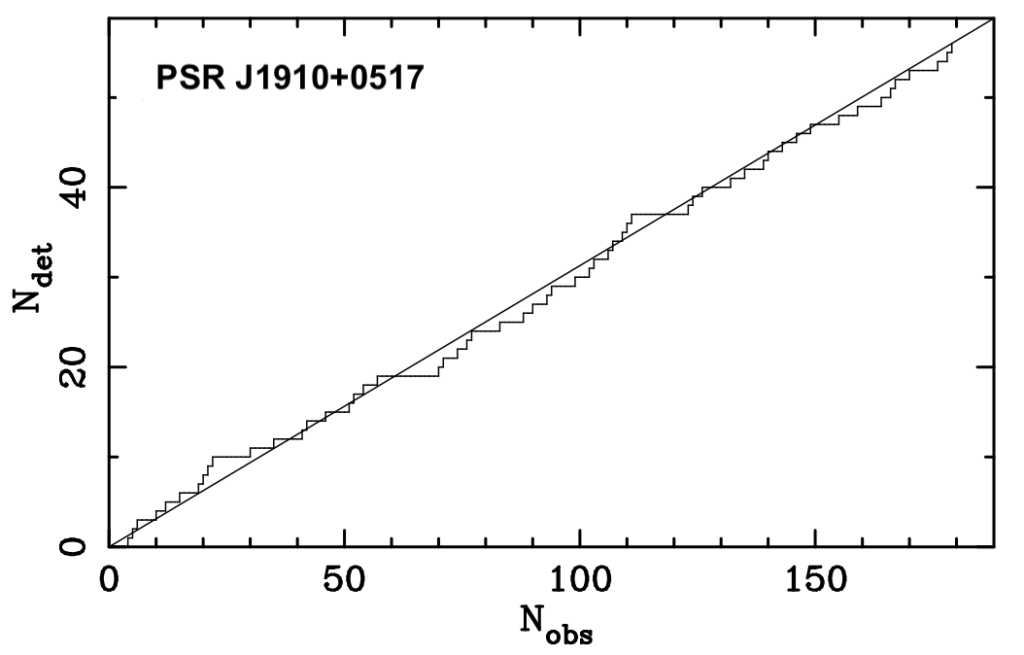
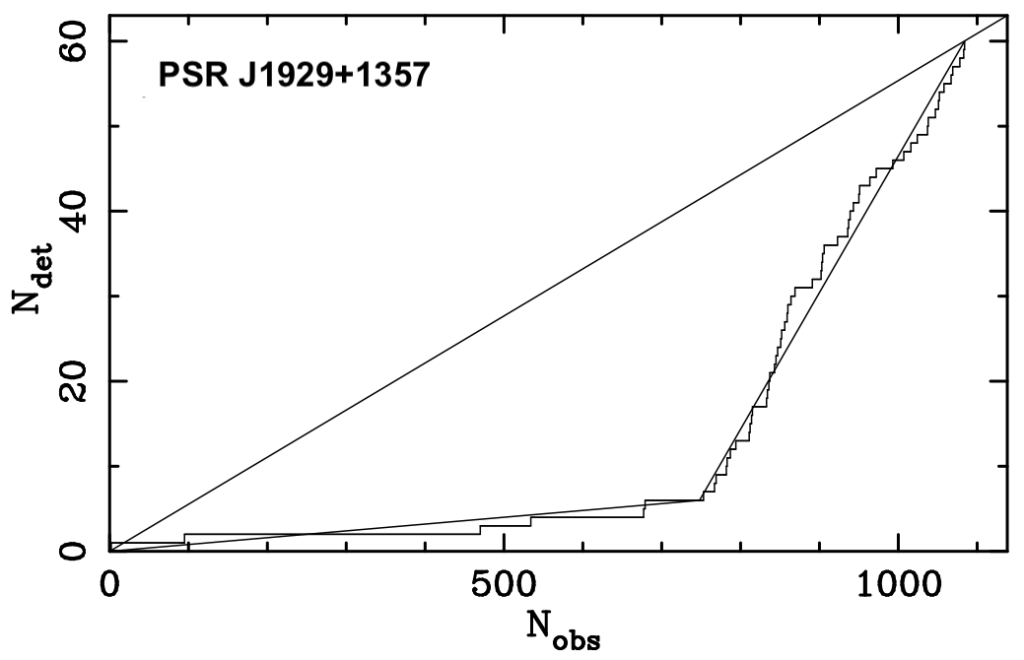
Figure 2: The detection history of J1910+0517 (left) and J1929+1357 (right). Cumulative plot of detection count against the observation count. Taken from figures 3 and 5 in the paper.
J1929 exhibits two ON states with varying activity. For the first 750 observations, the pulsar was ON less than 1% of the time–almost always undetected. Then for the remainder of the data, its activity increased by over an order of magnitude to 16%. So why is this important? Although both pulsars are intermittent, J1910 has a steady duty cycle, whereas J1929’s duty cycle shows a statistical long-term variation. The two distinct activity cycles are measurably affecting the pulsar’s rotation, and the associated spin-down rates in each activity phase have been identified. J1929 is slowing down 1.8x faster when it is in its more active ON state compared to its rarely detected ON phase. This provides a direct connection between the pulsar’s emission and spin-down rate, which is rarely evidenced and hugely important in understanding pulsar evolution.
It’s all about timing
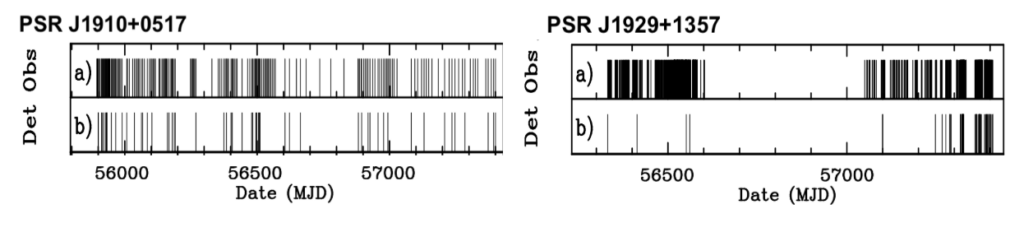
In the case of J1929, the authors raise the case that it was fortunate observations of the source were continued for as long as they were. Figure 3 tracks the observation and detections of each pulsar. In the case of J1910, consistent observation led to consistent (though intermittent) detection. However, despite a much more frequent initial observing cadence for J1929, after the first two detections, it was not detected again in over 90 separate observations taken over three months. Despite its now identified signal strength, had the first five reobservations come up empty, J1929 might never have been confirmed as a pulsar at all. The likelihood of confirming the discovery of J1929 was around 1 in over 3000. With that in mind, there may be as many as several thousand strong pulsars akin to J1929 that are evading detection due to poor timing (pun intended), which would subsequently almost double the known pulsar population.
The conventional understanding of the lone pulsar’s evolution is that they are formed with fast rotation periods, on the order of tens of milliseconds, and, maintaining brightness, they gradually slow down as they age. However, the distribution of observational data, coupled with the existence of intermittent pulsars like the ones discussed in today’s paper, shows us that pulsar brightness is not necessarily maintained. Thus, we need an alternative theory to explain why pulsar brightness eventually decreases to undetectability. This decrease may be continuous, or as the authors suggest, it is possible that this transition occurs in a stuttering manner as the pulsar starts nulling, for increasing lengths of time, until an increase in the nulling fraction eventually brings it permanently to the OFF state. Continued investigation of intermittent pulsars will be vital to identify the processes influencing why we see the population of pulsars that we do.
Disclaimer: The author of this Astrobite works with Dr Robert Ferdman but was not involved in this research.
Astrobite edited by Katherine Lee
Featured image credit: Bill Saxton, NRAO/AUI/NSF
