
Title: Still Accelerating: Type Ia supernova cosmology is robust to host galaxy age evolution
Authors: Phil Wiseman, Brodie Popovic, Mark Sullivan, Adam G. Riess, Dan Scolnic, Rebecca C. Chen, Tamara M. Davis, Lluís Galbany, Isobel M. Hook, Saurabh W. Jha, Lisa Kelsey, Yukei S. Murakami, Mickaël Rigault, Benjamin M. Rose, Brian Schmidt, Mat Smith, Maria Vincenz
First Author’s Institution: School of Physics and Astronomy, University of Southampton, UK
Status: Submitted to arXiv and MNRAS
An Expanding Universe and Standard Candles
Measuring the expansion rate of the universe is a foundation of modern cosmology, and also the source of some tension in the community. The expansion rate is parameterized by what we call the Hubble constant (H0), which measures how much faster distant galaxies move away from us compared to close ones. There are two main methods used to measure H0. One uses the cosmic microwave background to fit various cosmological models, and the other measures the distances and recession speeds of galaxies. These two methods should give the same answer, but they don’t (and their error bars don’t overlap), resulting in the infamous “Hubble tension”. There is plenty of healthy debate occurring for those who fall within one of these camps, and that is the focus of today’s paper.
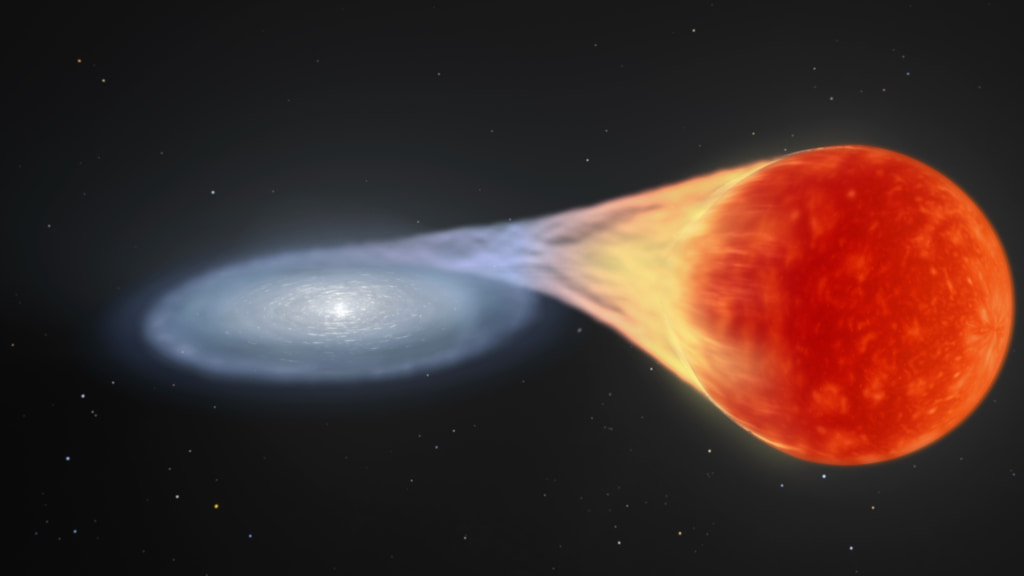
You see, in order to calculate H0 using galaxies, we need to determine how far away they are. The primary way this is done is by using standard candles: objects who have a constant intrinsic brightness. If we know how bright they’re supposed to be, and compare it to how bright they look to be in our data, we can calculate their distance. One of the main standard candles in cosmology are Type Ia supernovae, which happen when a white dwarf becomes too big to be stable and explodes (see Figure 1). But how do we know if these standard candles truly are standard? What if their intrinsic brightness varies, and what if we’re not accurately accounting for that in our attempt to use them to measure distance?
Are We Missing Something?
This was the focus of a paper that came out last year by Son et al. As explored more in this Astrobite, that paper suggested that there is a relationship between the brightness of a supernova and the age of its host galaxy. Without correcting for this, there could be a significant bias in our distance calculations. In order to account for this bias, they added a correction term based on the redshift of the galaxy, which they used as a tracer for its age. The work found that correcting for this apparent bias resulted in major cosmological implications: that, in fact, the universe’s expansion is not accelerating (as understood by our leading cosmological model), but rather is currently deccelerating!
But not everyone is convinced by these results, and that’s where today’s paper comes in. The authors of this work argue that by using more modern and up-to-date approaches to calculating distances, the “age bias” goes away. So let’s break down what they did.
Correction Terms Galore
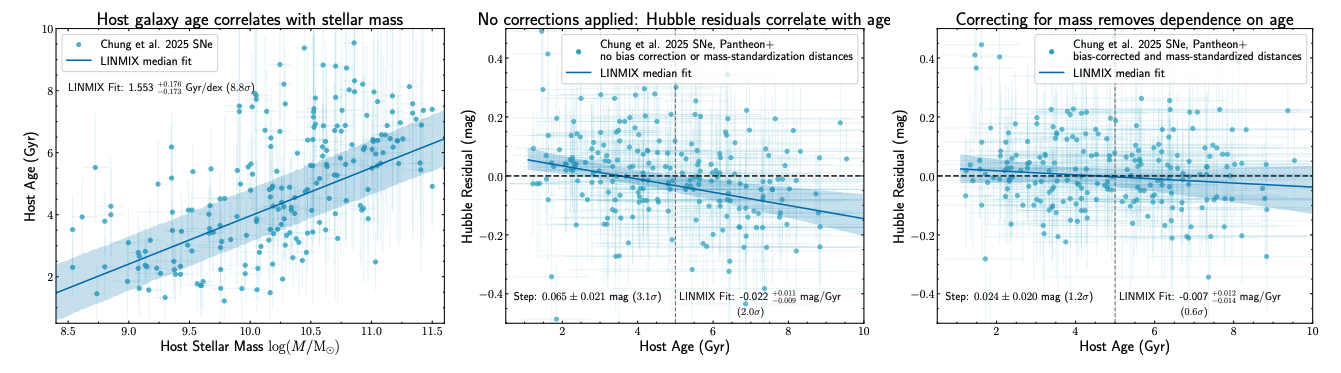
The first section of the paper explores how exactly we calculate distances to these supernovae. In the Son et al. paper, they modify the distance modulus equation (the equation that turns supernovae brightnesses into distances) to add a term that shifts the calculated distance that depends on the redshift of the supernova. Today’s work argues that this approach isn’t optimal. In other modern papers that use supernovae to calculate distance, it is common to include a term that is based on the properties of the host galaxy. However, instead of this just being dependent on redshift, as in Son et al., the term usually relies on a galaxy’s stellar mass. As shown in Figure 2, since stellar mass is related to age, correcting by stellar mass as has already been done by other teams gets rid of any age bias in the calculation. It is also common in modern approaches to add a correction term for how selection effects might skew the sample, an additional component not included in the Son et al. paper. With this more standard methodology, we don’t see such drastic implications for cosmology and the expansion of the universe, unlike the Son et al. paper.
Today’s paper also looks for other evidence that there might be some dependence of supernova properties on galaxy age by examining different types of nearby galaxies (that have different ages of stellar populations), finding no significant differences between them. Combined, these tests suggest that the current standard methodology for calculating supernova distances, accounting for stellar mass alone, already accounts for any effects that were seen in the Son et al. work.
Progenitor Age, Galaxy Age, and Redshift: Are They Really Connected?
This paper also critiques how the correction term was developed in the Son et al. paper. In that work, they assume that the redshift, age of the galaxy, and age of the star that caused the supernova (called the progenitor) are all linked. However, the physics of supernovae is complicated and not entirely understood, and it may not be true that older galaxies have older progenitors and younger galaxies have younger progenitors. The authors behind today’s work modeled a population of galaxies and found that in their simulation the age of the host galaxy and the age of the progenitor are not interchangeable. They also find that there is not nearly as strong of a redshift evolution for progenitor ages as was found in the Son et al. paper. This suggests that the host galaxy age does not drive the luminosity of the supernova, so applying corrections based on that property is incorrect.
They do note that there are correlations between galaxy age and Hubble residual, as seen in the middle panel of Figure 2, but they highlight that we don’t know why these relationships exist and so we have to be careful about causality. Applying a correction term based on redshift assumes that the underlying mechanism that causes this relationship is itself redshift-dependent in the same way as the host galaxy age, which we simply don’t know to be true. They also point out that there may be other systematic effects that we have yet to uncover that aren’t linked to age at all.
Cosmological Implications
Robustly examining our data for biases and exploring different methodologies is part and parcel of doing good science. There have been some recent challenges to our standard model of cosmology, so considering things we might be missing is a good thing. Today’s paper is just an example of how sometimes things that we “missed” have actually already been accounted for in established methodologies. And with these more robust methodologies, the threat to our standard model is not nearly as significant. The evidence just isn’t strong enough.
Astrobite edited by Cole Meldorf
Featured image credit: NASA SVS
