Title: A UV-Luminous Galaxy at z = 11 with Surprisingly Weak Star Formation Activity
Authors: Yuichi Harikane, Pablo G. Perez-Gonzalez, Javier Alvarez-Marquez, Masami Ouchi, Yurina Nakazato, Yoshiaki Ono, Kimihiko Nakajima, Hiroya Umeda, Yuki Isobe, Yi Xu, Yechi Zhang
First Author’s Institution: Institute for Cosmic Ray Research, The University of Tokyo
Status: Preprint on ArXiV
When JWST launched in late 2021, the advanced telescope’s capabilities promised a plethora of high-quality observations, providing us with a never-before-seen view into the Universe. Just over four years later, JWST has already changed both observational and theoretical astronomy. Yet, as is often true in science, its discoveries can create more questions than answers.
One such discovery involves a population of galaxies at high-redshift (redshift over 10). What does this mean? Well, due to the expansion of the universe, the light we observe from stars stretches out to a redder wavelength than initially emitted, and the longer the light takes to get to us, the redder it is. This means that galaxies at high-redshift are far away, and, more importantly, the light from such galaxies is old. So, when we look at a high-redshift galaxy, we observe light from the early universe – light formed only a few hundred million years after the big bang! Thus, high redshift galaxies are a window into early galaxy formation.
Before JWST, theorists had already developed robust models for early galaxy formation that they hoped could predict the properties of these galaxies. However, JWST had other plans. Many of the high-redshift galaxies discovered are UV-luminous, producing a high amount of ultraviolet light: a population that is hard to explain with pre-JWST models.
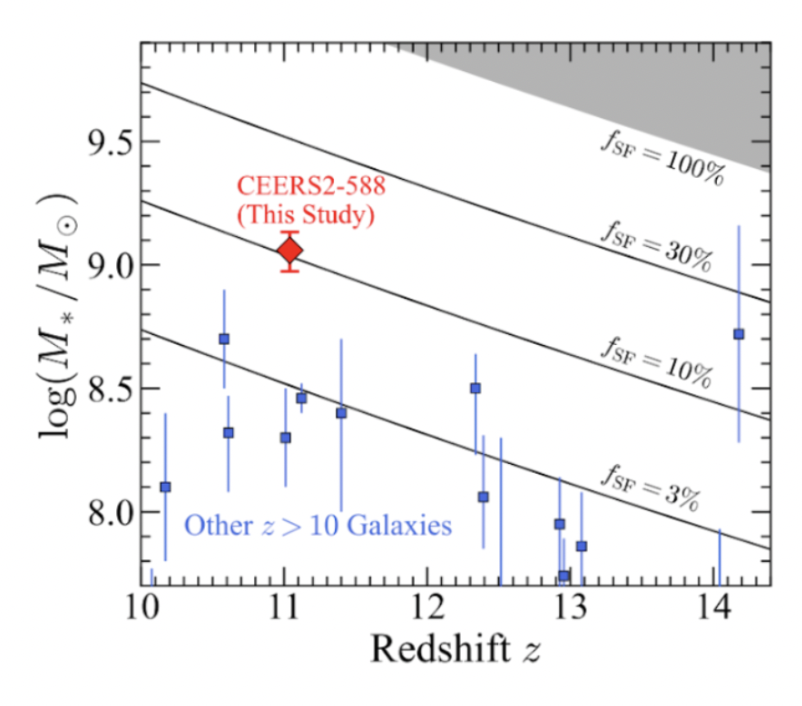
Furthermore, this unusual population of galaxies has one galaxy that’s even weirder than the rest: CEERS2-588. CEERS2-588 has an absolute ultraviolet magnitude of -20.4 mag and a redshift of 11.04, making it both UV-luminous and highly redshifted. Yet, it is remarkably different from other galaxies with similar properties: unusually high mass, high metal abundance and low star formation rate. Before we get to why these properties are so weird, let’s talk about how we know them!
A Spectroscopic View into Galactic Structure
To figure out the characteristics of a given galaxy, astronomers use spectroscopy to analyse the connection between the light emitted from a galaxy and its matter content. In matter, transitions between energy states lead to the emission of light at a given wavelength. Thus, if this given wavelength of light (an “emission line”) is heavily produced, astronomers can determine the chemicals present in a given galaxy!
In the case of CEERS2-588, one notable spectroscopic feature is the lack of emission lines from highly-ionized matter. In particular, this implies that CEERS2-588 does not have a strong active galactic nucleus (AGN). An AGN is a galactic center with high amounts of electromagnetic radiation not caused by stars, some of which is caused by transitions in highly-ionized matter. Without these transitions, there is no emission line.
Spectroscopy is also used to determine the mass of the galaxy, in which the entire distribution of electromagnetic energy is analyzed as a whole to determine key galactic properties. This is called Spectral Energy Distribution (SED) fitting, and was used to determine that the mass of CEERS2-588 is roughly a billion times that of our sun. This is a shocking result, as this means CEERS2-588 is the most massive galaxy at z>10 without AGN activity.
The Three Lines
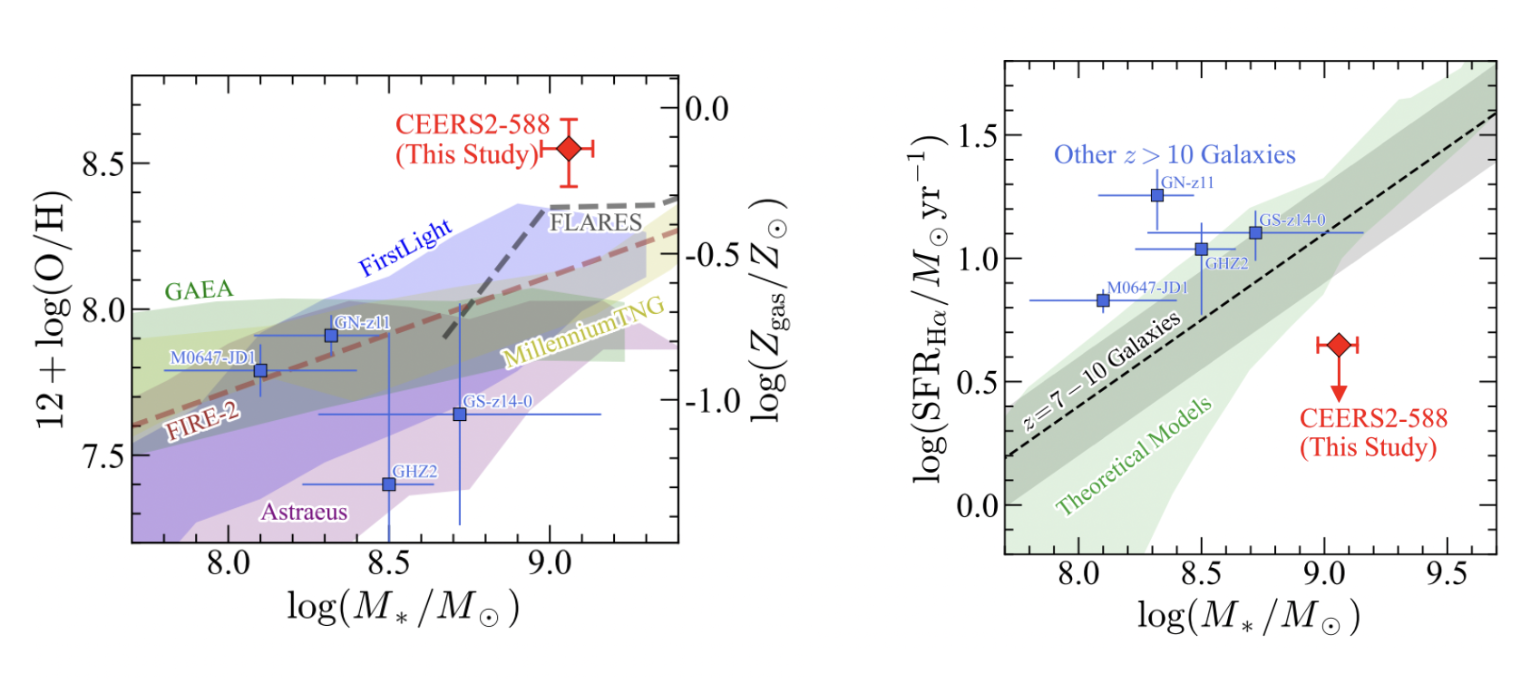
Yet, despite this significant result, perhaps the most surprising spectroscopic feature of CEERS2-588 has to do with three key emission lines — H-alpha, which indicates the presence of hydrogen; [OII], which indicates the presence of ionized oxygen; and [OIII], which indicates the presence of doubly ionized oxygen. All three of these lines are useful in evaluating metallicity (measure of elements heavier than helium), with H-alpha additionally being a useful tool for looking at star formation.
Of these three lines, only the [OII] line is present in CEERS2-588. This implies two significant results. The first is that the metallicity of the galaxy is close to that of our own sun, much more metal-rich than expected for early galaxies. Furthermore, the lack of H-alpha lines suggests a much lower star formation rate than any other galaxy at high redshift. Both of these results, when taken in tandem with the mass result, lead to inconsistencies with theory.
A Burst of Theoretical Uncertainty
Indeed, CEERS2-588 seems almost impossible: how is there a UV-bright, massive, metallic, early galaxy with neither significant AGN activity or a high star formation rate? One would think that either would be necessary to produce such a high mass or metal abundance in such a young galaxy. Yet, there is a scenario which may make sense of these results.
If early galaxy formation is “bursty”, meaning that galaxies go through phases of rapid and efficient star formation followed by rapid quenching, then we could be observing CEERS2-588 during a “quenching” phase. Such efficient star formation would create a high mass, while the quenching would reduce the current measured formation efficiency. However, this would require that star formation is both more efficient and rapidly quenched than our models predict.
Combined with the need for high metal enrichment, these results amplify the need to look at new processes to explain such observations. Clearly, galaxy formation theorists have their work cut out for them.
Astrobite edited by Jayde Willingham and Lucie Rowland
Featured image credit: Adapted from Figure 4 of Finkelstein et al. (2023)