

This guest post was written by Michelle Park, a co-terminal master’s student at Stanford University in Computational and Mathematical Engineering and Engineering Physics. Her research has focused on understanding how the first galaxies emerged with galaxy formation simulations. Outside of astrophysics, Michelle enjoys bird-watching, growing her CD collection, and getting new high scores in Subway Surfers.
Paper title: Giant clumps in the FIRE simulations: a case study of a massive high-redshift galaxy
Authors: Antonija Oklopčić; Philip F. Hopkins; Robert Feldmann; Dušan Kereš; Claude-André Faucher-Giguère; Norman Murray
First Author’s Institution: Anton Pannekoek Institute for Astronomy at University of Amsterdam, Amsterdam, Netherlands
Status: Published in MNRAS [open access]
Many young galaxies in the early universe aren’t smooth disks like the Milky Way, but are dotted with blazing, giant star-forming clumps. These storms of star birth shine intensely and give early galaxies an uneven appearance. Despite being common, the role of these clumps in galaxy evolution remains poorly understood. Understanding how clumps form, evolve, and dissolve is key to explaining how galaxies transition from chaotic early stages into today’s ordered systems. To trace clumps in detail throughout cosmic time, the authors of today’s paper used the FIRE cosmological simulations to learn in high resolution about how clumps quickly form, grow, and die in a massive simulated galaxy.
Finding clumps
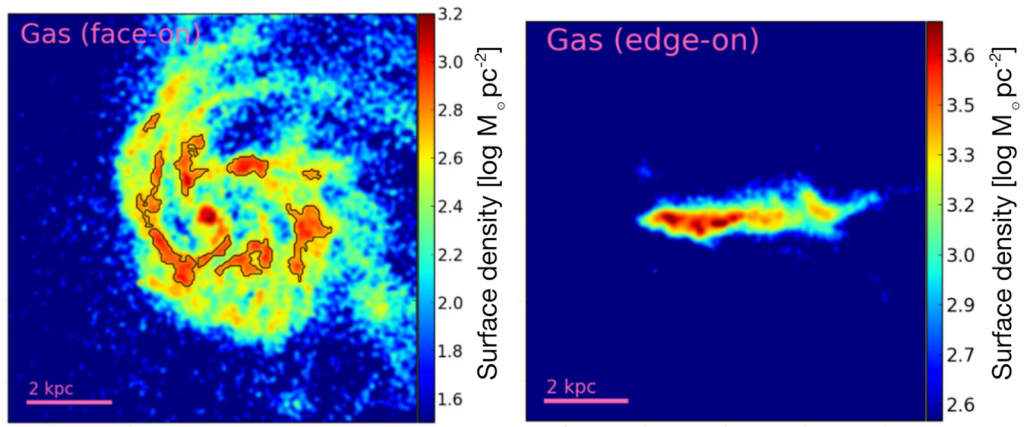
Using parsec-scale resolution and taking snapshots every 1 million years (Myr), the authors analyze m13, a massive spiral galaxy of roughly the Milky Way’s mass at present day (~6 × 10¹⁰ M☉) in the FIRE project. The high resolution and fast sampling allow them to track individual clumps as they evolve over short timescales. To identify clumps, the authors flag regions where the gas surface density is at least one standard deviation above the mean, which also matches with visually identified clumps. Altogether, 506 gas clumps were found across all snapshots.
How long do clumps last?
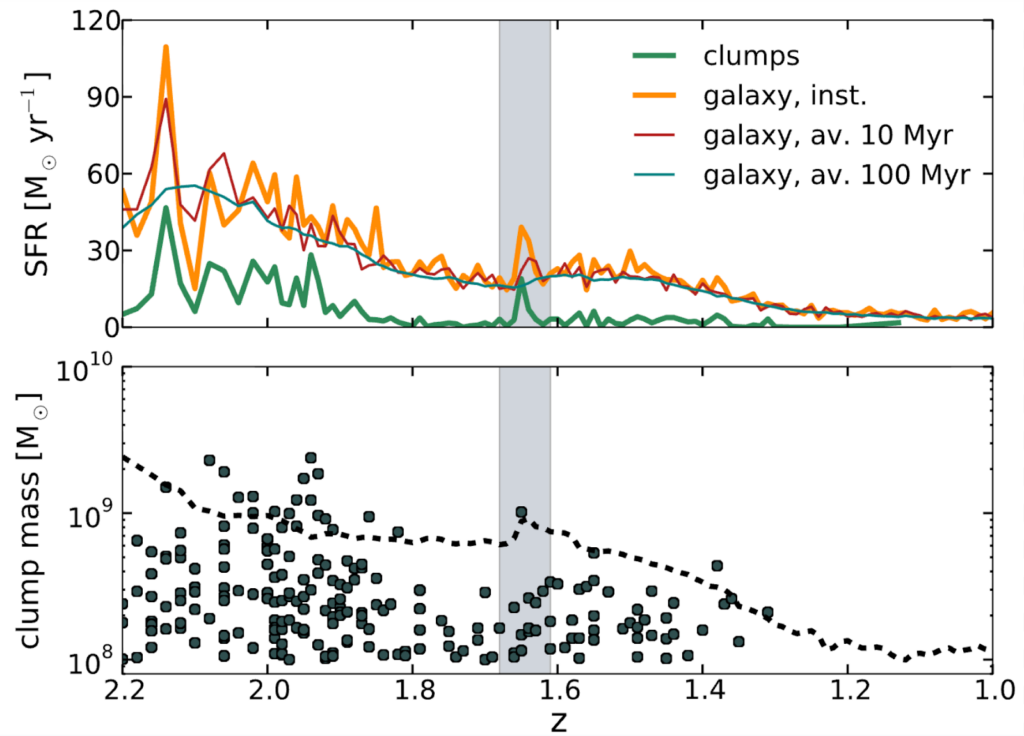
The paper finds that galaxies remain in an actively “clumpy” state for more than a billion years (redshift z ~ 2.2 to z ~ 1.3), but individual clumps are short-lived for only tens of millions of years. The stars formed in these clumps produce feedback in supernovae, radiation pressure, heating, and stellar winds, which easily breaks down their weakly bound structure. Previous work suggested that clumps migrate inward to form galactic bulges, but this study refutes this: clumps dissipate too quickly to reshape the galaxy’s structure.
Then, what role do clumps play in galaxy formation?
Despite their short lifetimes, clumps excel at forming new stars. The authors find that during the galaxy’s clumpy stage, clumps make only a few percent of the galaxy’s mass but contribute 10–60% of its total star formation rate (SFR). In fact, they can produce up to 10¹⁰ M☉ of new stars, equal to the mass of an entire small galaxy, before stellar feedback tears them apart. This efficiency matches that of giant molecular clouds in present-day galaxies, but because this occurs in the early universe, clumps play an outsized role in driving galaxy growth.
But, there’s one more twist: the stars inside clumps are much older than the clumps themselves. Stellar ages in the clumps typically reach a few hundred Myr, while clumps themselves last only tens of Myr. This indicates that as clumps dissolve, their stars migrate throughout the galaxy or accrete onto other clumps. As a result, stars observed in a clump include a mix of both newborn and older stars, making stellar age an unreliable indicator of clump age.
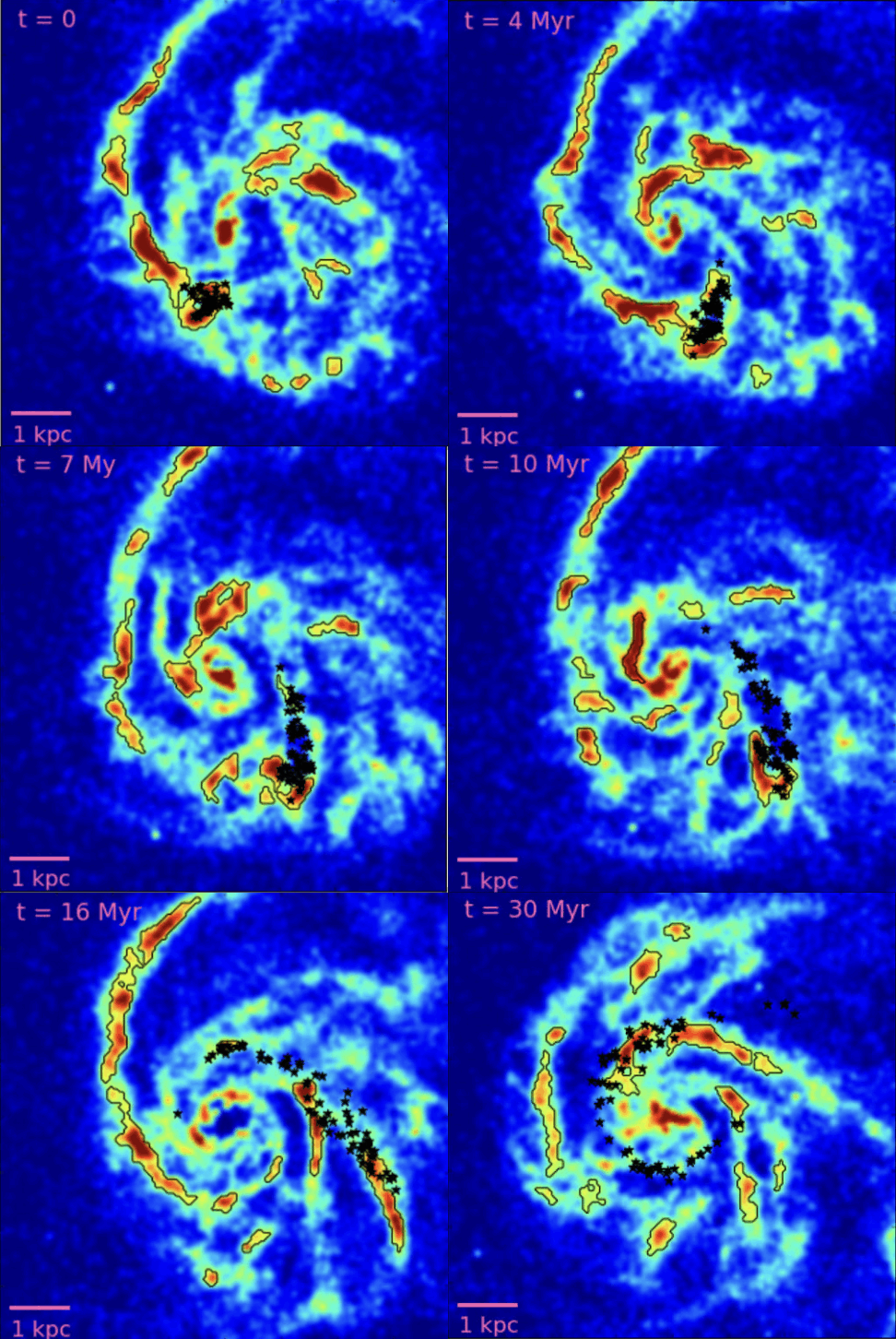
In summary, this paper finds that giant clumps in FIRE simulations are (1) short-lived as stellar feedback tears them apart before they can shape galactic structure. (2) Yet, these clumps are the primary engines of star formation in early galaxies, but (3) stars in these clumps can be orders of magnitude older than the clumps themselves, as stars are swept up and migrate during clump formation. Future work will test these conclusions across more high-resolution FIRE galaxies and compare with alternative models which predict long-lived, migrating clumps. Therefore, early galaxies built themselves through brief firestorms: giant clumps that blazed with stellar formation and left their stars behind to assemble the galaxies we see today.
Astrobite edited by Mckenzie Ferrari
Featured image credit: Figure 12 from the paper
