
Authors: F. Loi , P. Serra, M. Murgia , F. Govoni, V. Vacca, F. Maccagni, D. Kleiner, and P. Kamphuis .
First Author’s Institution: INAF – Osservatorio Astronomico di Cagliari, via della scienza 5, Selargius, Italy
Status: Published in Astronomy & Astrophysics [open access]
by Affan Khadir

Affan is a PhD student at McGill University, studying the magnetized hot gas around galaxies using fast radio bursts, working with the Canadian Hydrogen Intensity Mapping Experiment (CHIME) and the upcoming Candian Hydrogen Observatory and Radio-transient Detector (CHORD). Outside of astronomy, Affan spend’s most of their time reading, cooking, baking and hiking. Affan’s recent obsession has been Stephen King horror novels.
Studying the largest structures in the Universe
Our own Milky Way is just one of the billions of galaxies out there in the Universe. Many of these galaxies are bound together by the powerful attractive pull of their own gravity—forming galaxy groups and even larger galaxy clusters, which are the largest structures in our Universe. Most of the baryonic matter in clusters is located as hot, ionized and magnetized gas between the galaxies, quite like a soup (the gas is the liquid and the galaxies are the small isolated solid pieces).
Because of this, galaxy clusters are ideal laboratories for studying the baryonic matter in the Universe and the formation and evolution of this matter on the largest scales. Because most of the matter in clusters is magnetized, investigating their magnetic fields is an ideal way to probe the gas in clusters.
Lighting up the Fornax cluster with radio galaxies!
How do we study the magnetic field of clusters though? We utilize radio galaxies (massive elliptical galaxies that host active galactic nuclei that emit radio jets) in the background to the cluster that act as backlights—as polarized light passes through the magnetized environment of the cluster, the polarization angle undergoes rotation. The amount of rotation is quantified by the rotation measure (RM). This quantity involves a calculation that is proportional to the integral of the electron density times the magnetic field along the sightline. You can read more about rotation measure here. Radio astronomers use RMs to inform them about the magnetized matter between the background source and our telescopes. Most famously, pulsar RMs (pulsars are rapidly spinning and blinking neutron stars; think of a lighthouse) have been used by pulsar astronomers to study the local magnetized interstellar medium.
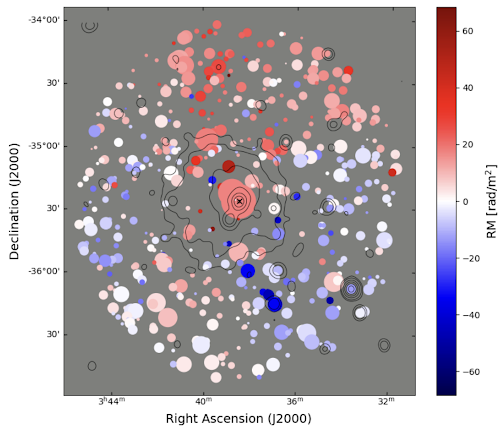
So far, there have only been a few galaxy clusters that have been studied with rotation measures, and all of them have only been studied with at most 10 background sources. The MeerKAT telescope, which detects radiation in radio wavelengths, surveyed the Fornax cluster— one of our most nearby galaxy clusters — in unprecedented detail. This study provides a significant improvement on previous works that study the RM, through obtaining the densest RM grid of all time, with ~ 500 RMs! The Fornax RM grid is depicted in Figure 1.
The flow of matter along the cosmos
What does the MeerKAT RM grid say about Fornax? Firstly, the magnetic field strength is not spherically symmetric, as would be expected in a simple model of a cluster. Instead, we see clear regions where the magnetic field is stronger. In an earlier RM study of this cluster by Anderson et al. (2021), researchers noted the Fornax cluster is experiencing a quite turbulent time, with possible mergers with other groups of galaxies. The deep RM grid of MeerKAT confirms these findings through the stripe of incredibly strong RMs that stretches across the cluster. The MeerKAT team concluded that this enhancement in the magnetic field is caused by matter feeding into the cluster along cosmic filaments (see Ian’s astrobite on the detection of dark matter filaments in particular).
This study demonstrates that clusters are complex environments, which are able to continually grow by accreting mass along filaments. It also highlights the presence of large-scale coherent magnetic fields in these environments. The work by the MeerKAT team marks a clear step forward into the understanding of the hot, magnetized matter in our Universe (which makes up more than 99% of the ‘normal’ matter we can see!).
What’s next for Fornax?
Very recently, there has been a deep look into the Fornax cluster in the X-ray wavelengths using the unprecedented resolution of the SRG/eROSITA mission by Reiprich et al. (2025), as depicted in Figure 2. They found tendrils of hot gas that are feeding into Fornax, which aligns with and supports what has been seen by MeerKAT in the radio wavelengths, indicating that Fornax is actively accreting matter along cosmic filaments.
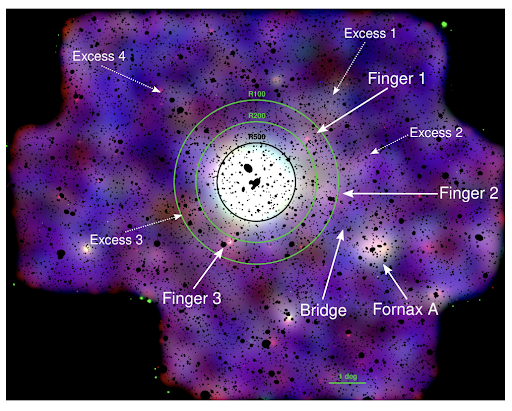
With this latest study of Fornax, we see the future of cluster science being multi-wavelength in nature. Radio wavelengths inform us and allow us to study the magnetic fields in these environments, (and matter if your background sources are fast radio bursts!), and the X-ray wavelengths gives us an additional probe of the distribution of matter.
Edited by: Abbé Whitford
Featured image credit: by CTIO/NOIRLab/DOE/NSF/AURA (CC by 4 license), Image processing: T.A. Rector (University of Alaska Anchorage/NSF’s NOIRLab), J. Miller (Gemini Observatory/NSF’s NOIRLab), M. Zamani (NSF’s NOIRLab) & D. de Martin (NSF’s NOIRLab)
