
Title: Enrichment by the first stars in a relic dwarf galaxy
Authors: Anirudh Chiti, Vinicius M. Placco, Andrew B. Pace, Alexander P. Ji, Deepthi S. Prabhu, William Cerny, Guilherme Limberg, Guy S. Stringfellow, Alex Drlica-Wagner, Kaia R. Atzberger, Yumi Choi, Denija Crnojević, Peter S. Ferguson, Nitya Kallivayalil, Noelia E. D. Noël, Alexander H. Riley, David J. Sand, Joshua D. Simon, Alistair R. Walker, Clecio R. Bom, Julio A. Carballo-Bello, David J. James, Clara E. Martínez-Vázquez, Gustavo E. Medina & A. Katherina Vivas
First Author’s Institution: Kavli Institute for Particle Astrophysics and Cosmology, Stanford University, Stanford, CA, USA
Status: Published in Nature Astronomy (submitted version on arXiv)
The quest for understanding the origin of elements in our Universe is one of the longstanding goals in modern astrophysics research. In the past few decades, through collective effort across theory and observations, we have made large strides in unraveling this mystery. We now know that the Universe consists mostly of hydrogen and helium created during Big Bang nucleosynthesis (along with a tiny bit of Lithium). Almost everything heavier than helium, which astronomers term as “metals,” is synthesized in the hearts of stars over their lifetimes. At the end of their lives, these metals are returned to the interstellar medium (ISM), becoming a part of future generations of stars that might form. Thus, the Universe gets progressively polluted by these metals. Astronomers use this information as a clock: the fewer metals a star has, the earlier it may have formed. Winding this clock all the way back, one can ask the question: When did the first stars (termed Pop III) form? This simple question leads to numerous other questions such as: i) Where did the Pop III stars form? ii) What is their role in the formation of the first galaxies, and in the reionization of the Universe? and iii) How did the first stars enrich the environments in which they lived?
Many studies of the distant Universe, especially in the era of JWST, aim at tackling this question by searching for the earliest galaxies. However, today’s authors take a complementary approach by searching for, and, successfully finding the signatures of the first stars in our own backyard! But how did they do that?
Step 1: Where do you look for signatures of the first stars?
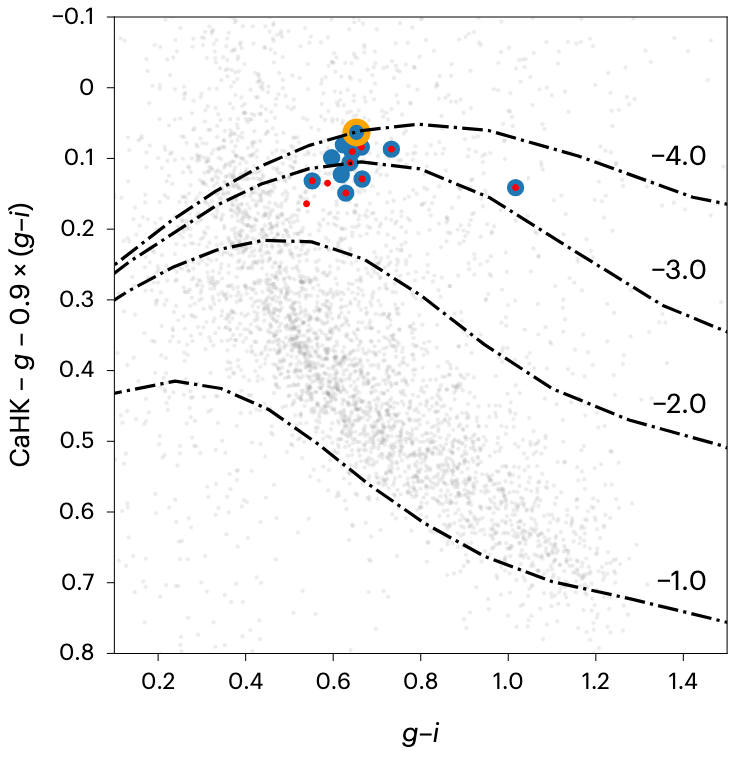
To search for signatures of the first stars, we want to find the oldest systems out there that contain barely any metals. In the nearby Universe, these are the ultrafaint dwarf galaxies (UFD). They are very small, extremely faint, and also pristine metal-poor environments that have not had any star formation for billions of years. Everything that we may want! Today’s authors use the Mapping the Ancient Galaxy in CaHK (MAGIC) Survey to look at stars in one such galaxy, the Pictor II UFD. They observe with a narrow filter that contains the Calcium (Ca) II H and K absorption features, as their strength strongly depends on metallicity. To remove foreground stars, they use proper motion data from Gaia to select for members that actually seem to belong to Pictor II. Based on the observed color of the stars and the strength of the Ca II H and K lines, they find PicII-503 (Fig. 1), which is their lowest metallicity candidate.
Step 2: Perform High-Resolution Spectroscopy
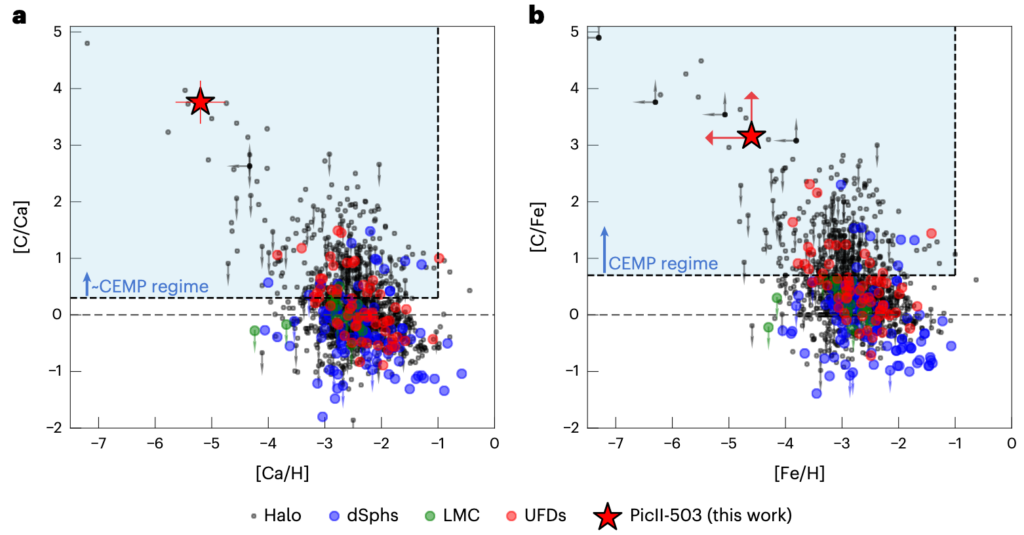
Now that we have a candidate for an extremely metal poor star, we still need to verify its true metallicity. To do this, the authors obtain high-resolution spectra with the 6.5m Magellan/Baade Telescope and the 8.2m Very Large Telescope, both located in the Atacama desert in Chile. With the spectra, they confirm that PicII-503 indeed belongs to the Pictor II UFD, and has an exceptionally low metallicity (Fig. 2). By comparing the observed spectra with theoretical models, they find that its iron and calcium abundances are the lowest ever seen outside the Milky Way, being less than 1/43,000th and ~1/160,000th respectively of what we see in our own Sun. Intriguingly, the stellar spectrum also shows that given its paucity in metals, it is significantly enhanced in carbon, showing >3000-relative enhancement compared to the Sun. Such stars are referred to as Carbon-enhanced Metal Poor Stars (CEMPs).
Step 3: Interpret your findings
So we know that PicII-503 is a CEMP: extremely metal poor, and enhanced in carbon. Several such stars have been known to exist in our own Galaxy. However, their origins remain uncertain. There exist two competing hypotheses: 1) their metal content reflects enrichment from supernovae of the first stars, and 2) these stars accrete material from a binary companion on the asymptotic-giant branch (AGB). In the latter scenario, the stars would also show an overabundance of s-process (slow neutron capture) elements. However, PicII-503 has a barium (a tracer for the s-process) abundance much lower than seen in all the CEMP stars in the Milky Way halo. Thus, the most likely explanation for the chemical nature of PicII-503 is that it is a direct descendant of the first stars!
When the first stars end their life in a supernova, they release the lighter elements fused in their cores back to the interstellar medium. The second generation of stars that are born out of this material will carry these signatures with them, i.e they will appear as CEMP stars. This is exactly what we see in PicII-503! In fact, the authors also conclude that the Pictor II UFD must have been enriched by a low energy supernova. Since the UFD has such a low mass (less than a few thousand solar masses), its gravitational potential is very feeble and any energetic supernova would expel material out of the UFD – failing to enrich its ISM.
The discovery of the CEMP star PicII-503 presents a remarkable opportunity to understand the properties of the first supernovae, understand enrichment processes in the smallest UFDs, interpret observations of metal-poor high redshift galaxies and open pathways to find more such CEMP stars in other UFDs. Perhaps, eventually we will find the elusive first stars (Pop III) that have so far evaded our direct detection.
Astrobite edited by Munira Hoosain
Featured image credit: Neev Shah
