
Title: The Landscape of Undergraduate Astronomy and Astrophysics Degree Requirements
Authors: The AAS SURGE Team: Kate Follette, Carl Ferkinhoff, Michael Foley, Meridith MacGregor, Melissa Morris, Karen Masters, Tom Rice, Colin Wallace
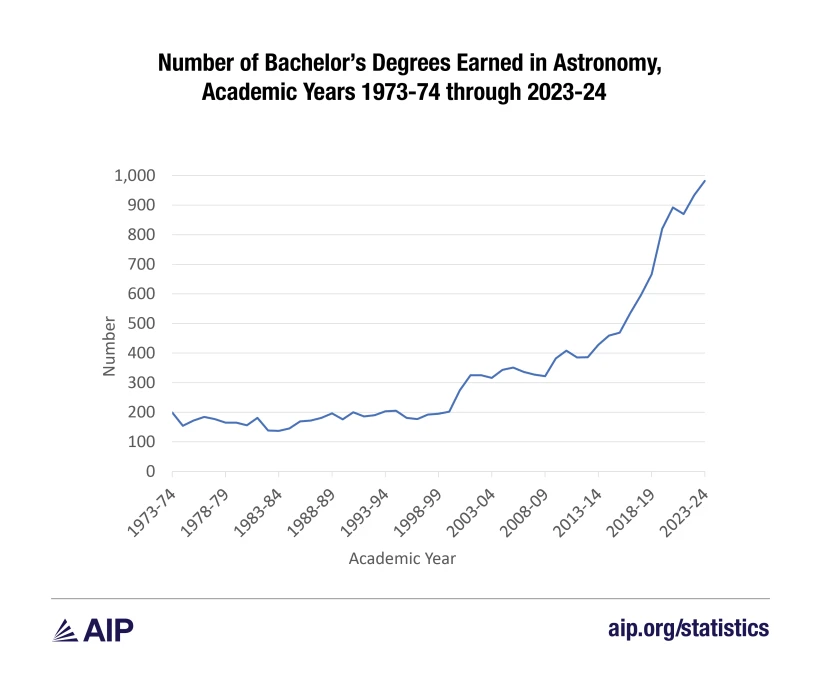
Astronomy and astrophysics degrees have become increasingly popular in the United States, with five times as many degrees given in 2024 as in 2000 (see Figure 1). This rapid growth in the number of astronomy students presents both an exciting opportunity and new challenges to the field. As bachelor’s programs specifically in astronomy are relatively new, they lack the systemic structure or coordination that is often found in more established programs like physics. In 2025, the American Astronomical Society’s (AAS) Education Committee Subcommittee on UndeRgraduate and Graduate Education (SURGE) administered a survey collecting information on undergraduate astronomy or astronomy-related degree programs. 88 individuals from 78 institutions across the United States responded, providing a wealth of information to better understand the current landscape of undergraduate astronomy programs. SURGE has compiled these responses in order to figure out how these programs can be improved, supported, and developed going forward. They’ve identified key findings and developed suggestions for the community, and here we summarize some of their most interesting results and discuss what they mean for the field.
Degree Types and Titles
A degree in astrophysics can go by many names. About half of astrophysics undergraduates are pursuing a Bachelor of Arts (BA) and the other half are pursuing a Bachelor of Science (BS) degree. Of the departments that offer a degree in astronomy or astrophysics, the majority (68%) actually offer both BAs and BSes. BS degrees tend to require a larger number of courses than BAs and are slightly more popular in departments that offer both BAs and BSes. The majority of surveyed departments offered some kind of explicitly astronomy-focused degree, but the authors acknowledge that such departments are much more likely to respond to their survey, and they are likely missing survey responses from a number of departments that only offer physics degrees. However, due to the growing popularity of astronomy degrees, SURGE encourages departments without astronomy degrees to start offering them if possible.
The name of the major can also vary across institutions; the most common names are “Astronomy” and “Astrophysics”, which are equally popular, while titles like “Physics with a concentration in Astronomy” and “Astronomy and Astrophysics” are less common. The authors find that the name of the major doesn’t reflect any meaningful differences in terms of course requirements, but people tend to perceive a degree in Astrophysics as being more rigorous than a degree in Astronomy. As a result, SURGE recommends that departments switch to using the term Astrophysics to improve consistency across departments.
Course Requirements
Generally, degrees in Astrophysics require courses across several departments. In this survey, they were divided into Mathematics/Statistics/Computer Science, Physics, Astronomy, and Electives. They found that there was very little consistency across institutions, with differential calculus, integral calculus, introductory mechanics, and introductory electricity and magnetism being the only courses that were required by every single program.
Figure 2 shows the percentage of programs that require different mathematics, physics and astronomy courses. As shown, there is a huge range across different degree programs. It’s interesting to note that less than 10% of programs require a statistics course and only ~30% require computer science, despite both fields being very important in modern astrophysics work. There is less variation in physics requirements compared to astronomy, but still, no upper-division course is required by more than 70% of programs.
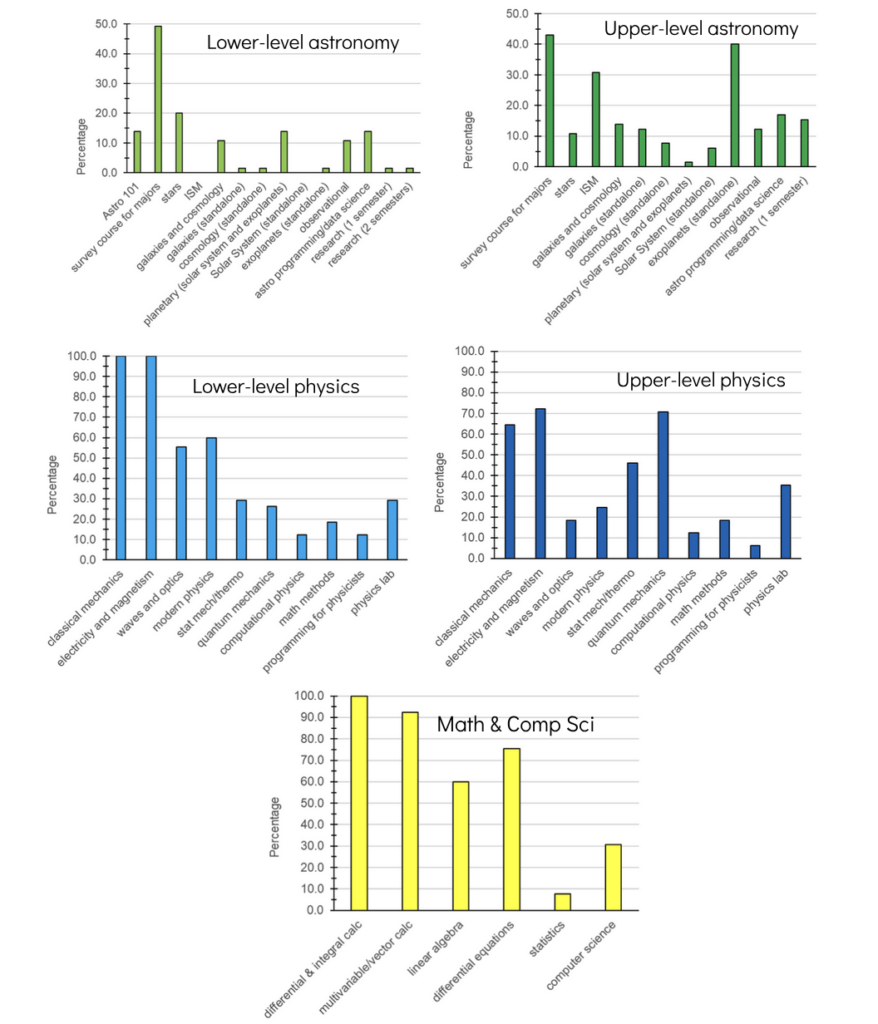
Having so few shared requirements poses a problem if we want to ensure that a degree in Astrophysics represents a meaningful qualification. To that end, the SURGE team recommends that the AAS endorse a shared set of requirements. They provide a proposed list that considers both content (i.e. an intermediate quantum mechanics course, a course on stellar structure and evolution, and a course on observational/laboratory techniques) and competency, ensuring that skills such as scientific writing, communication, group work, and advanced mathematical techniques are at the very least woven into existing courses. They also highlight that their suggestions are not meant to represent a requirement for admission to graduate programs (see below for further discussion).
Learning Goals
The survey also asked whether the degree had explicit learning goals set by the department, and in general, what students should know or be able to do by the end of the program. 30% of respondents said their department did not have formal learning goals, and 11% said they weren’t sure. The SURGE team recommended that all departments formally adopt learning goals to clarify the expectations for students in the program. The survey also found a significant mismatch between formal goals and the more informal learning goals/abilities listed. Both data/computational/programming skills and astronomy knowledge were often listed in the informal goals (shared by ~60% of respondents) but showed up less frequently in formal goals (47%). Physics knowledge was much more common in the formal goals (64%) than the informal ones (31%). In general, the SURGE team highlighted that these should ideally be better aligned. They also pointed out that computational skills are incredibly important both in the field of astronomical research and in other disciplines, and should be more incorporated into both the course requirements and learning goals of Astrophysics degrees.
Engaging in Research
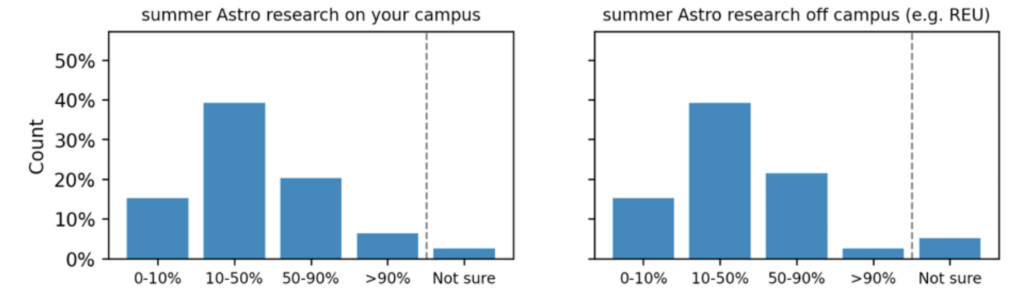
The departments’ responses reflect the fact that students take a variety of paths through their astronomy degrees and pursue a range of opportunities post-graduation. Many departments integrate research into the degree through capstone projects (including theses) and coursework, and encourage students to engage in summer research projects, both at their home institution and at other institutions. Additionally, students tend to have a strong appetite for research and actively seek out opportunities to do undergraduate research. Unfortunately, the demand for research opportunities often outpaces the supply as faculty do not have enough time to mentor all undergraduates who are interested in research, and summer Research Experiences for Undergraduates (REUs) continue to be strongly oversubscribed (and underfunded). Figure 3 shows the percentage of students who participate in summer research, with a majority of departments reporting less than 50%.
Research develops many of the key skills and competencies that make a degree in astronomy so valuable, and most departments strongly emphasize undergraduate research. Integrating research into coursework and developing formalized mentoring structures that encompass faculty, postdocs, graduate students, and undergraduates can help get more students involved in research in a more sustainable way.
Graduate School
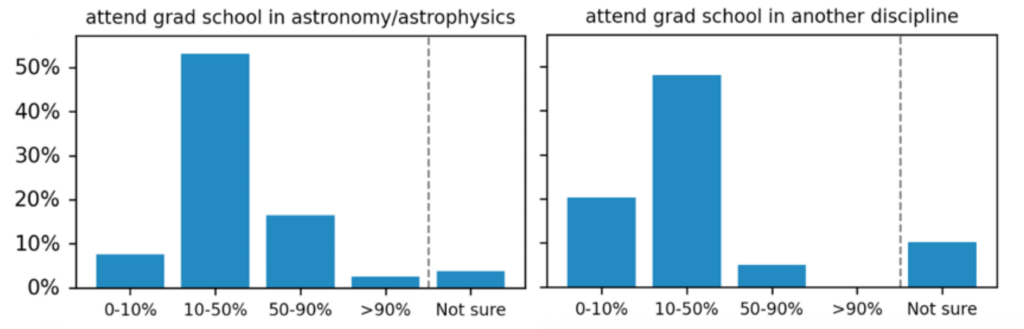
Attending graduate school and pursuing research is seen as one of the primary things you can do with a degree in astrophysics, but not every major can follow this path. PhD programs admit around 200 people a year, which represents only ~20% of the graduating undergraduate majors. Figure 4 shows that it is very rare for a majority of students in a department to attend grad school. The SURGE team suggests that students who intend to go to graduate school should receive advice on further courses they should take so that they can enter graduate school fully prepared to engage in research and more advanced courses.
Given the limited number of PhD positions, it is crucial that astrophysics degrees prepare students for more diverse career paths. The technical, problem-solving, and communication skills students develop in an astrophysics degree can be applied to many fields and jobs. SURGE highlights that there is no “typical” path through or following an astronomy degree, so departments need to cater to a wide range of interests and adequately prepare students for career paths beyond academia/research. Helping students develop industry and professional knowledge and skills is of great importance, and is currently not considered a priority by many departments.
Summary
Overall, this report provides a fascinating insight into the landscape of undergraduate Astrophysics degree programs. There is extreme variation in course requirements, learning goals, research experience, and post-graduation preparation, which ideally should be brought into better alignment. As more students choose to major in Astrophysics, departments will have to cater to a wider variety of interests, academic experience, and career goals. This includes training students in skills and techniques that are useful in many fields such as writing, communication, and coding. It will be interesting to see how the recommendations of the SURGE group are implemented by the AAS and how astrophysics degrees will evolve in the coming years. How does your experience or perception of a degree in astrophysics compare to the findings of this study?
Astrobite edited by Anavi Uppal
Featured image credit: NASA and Nathalie Korhonen Cuestas

