
On April 1, 2026, over 10 million people sat on the edge of their seats to watch the launch of Artemis II as it carried a crew of brave astronauts toward the Moon for the first time in over 50 years. For many, it was their first glimpse of human space exploration. For others, it rekindled the awe they first felt watching those missions unfold in the 1960s and ’70s. What made it remarkable was how it united us – No matter who we are or where we live, we all stare up at the same sky in wonder.
This launch on April fool’s day was no joke. It took years of hard work, dedicated researchers, and billions of dollars spent not just on the spacecraft but also the countless scientists behind this effort. The real April fools joke came two days later, when the President’s Budget Request (PBR) was released. This 90-paged document proposed, amongst many things, sweeping cuts to NASA and the NSF – the very agencies whose work got us to the Moon in the first place. For many in the scientific community, this announcement came as a gut punch. The world was witnessing a triumph of science as the Trump administration proposed to gut the institutions behind it. For others, it came as little surprise. Similar cuts had been proposed by the Trump administration in the FY2026 budget as well. Last year, astronomers like you and me helped prevent these cuts by advocating our science directly to Congress. This year, we will do it again. This Astrobite will lay out the effects these cuts would have on astronomers across the country, explain what the PBR is and how the congressional appropriations process works, and outline what we can do to fight back.
The Impact of Cuts to NASA and NSF
Both NASA and the NSF have released detailed versions of their budget requests, which allow us to see exactly what programs would bear the brunt of the president’s proposed budget cuts. While we’ll focus on the astronomy programs in this coverage, it is worth remembering that there are sweeping cuts across all scientific disciplines, many of which are closely linked to astrophysics such as geology and climate science.
The PBR includes $4 billion for the NSF, which is a 55% cut from fiscal year 2026. This would mean a devastating reduction in the number of research grants funded, supporting less than a third of the number of people who were connected to the NSF last year. In fact, they estimate that this budget request would reduce the number of people involved in NSF activities from 300,000 in 2025 to only 90,000 in 2027. That’s a 60% drop. Even more, they estimate that the overall funding rates (the percent of research proposals that are funded) will drop from about 18% to 7%. Directly related to astrophysics is the cut of the Astronomy and Astrophysics Postdoctoral Fellowship, which many post-graduate researchers rely on.
A lot of cuts to specific projects we saw proposed last year are making a return in this request, including several that are directly related to astronomy. The NSF is a key funder of many of our largest ground-based observatories, all of which face budget cuts relative to FY25 with the exception of the Vera Rubin Observatory. This includes a 40% cut to the gravitational wave detector LIGO, a 20% cut to the Atacama Large Millimeter Array, and a 40% cut to the GEMINI observatories, amongst others. These cuts would severely impact our ability to conduct astrophysics research across the electromagnetic spectrum and beyond.
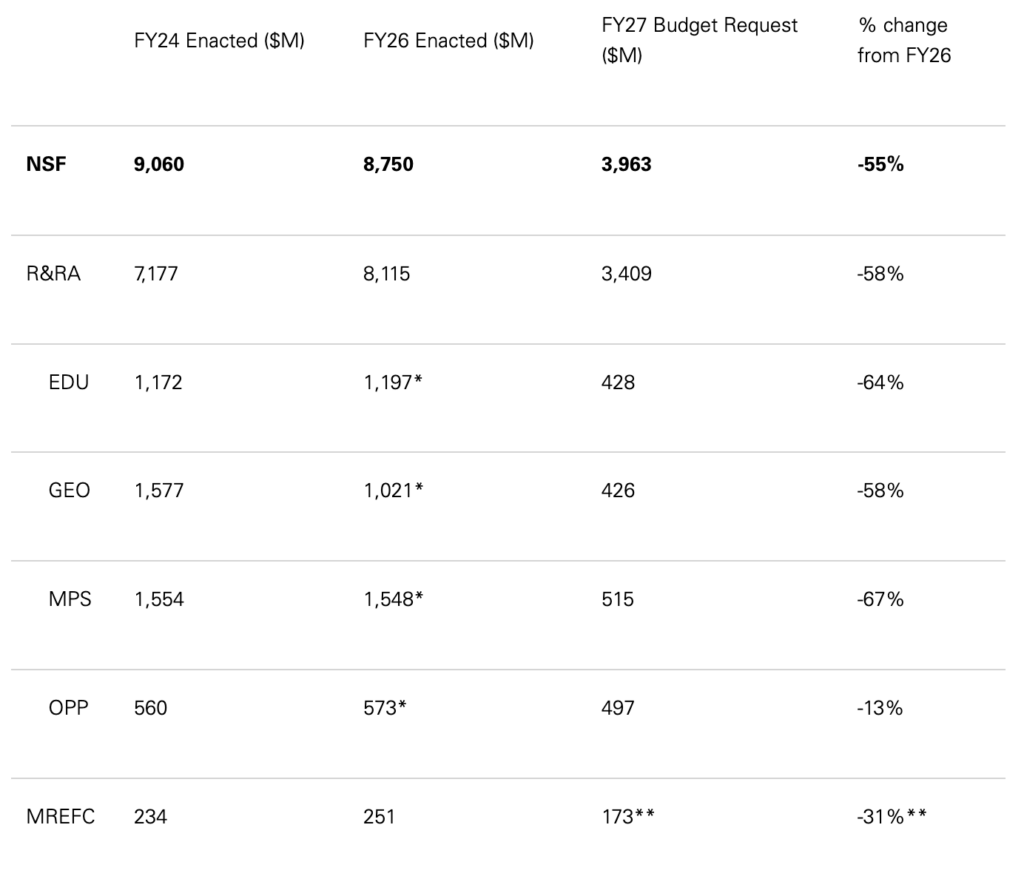
NASA is facing similarly devastating cuts. While the PBR suggests increased support for crewed solar system exploration, NASA Science Mission Directorate is cut by 47%. This section of NASA is responsible for much of the funding astronomy researchers rely on. While the Artemis program continues to have strong support in this PBR, it is important to note that the funding of basic science is key to the success of lunar and Mars exploration. These cuts would significantly reduce our ability to understand what crewed missions might discover, and would limit our capacity to send uncrewed instruments ahead of time to explore and reduce risk.
In terms of science cuts, the Astrophysics division budget is cut by 65%, Heliophysics by 52%, and planetary science by 26%. Following the 2026 PBR, key missions such as Chandra (X-rays), Fermi (Gamma-rays), and UVEX (Ultraviolet) are cut, as is support of the ESA-led Euclid telescope. XRISM (X-rays), which is led by Japan’s national air and space agency, is not mentioned at all. These international collaborations are central to our desire to understand the universe. Further, flagship observatories such as Hubble and the Habitable World Observatory (which will be the first observatory capable of detecting signs of life on exoplanets) would also receive cuts. On the planetary science side, missions that were cancelled in the 2026 PBR are not mentioned at all, again suggesting they would be cut, including New Horizons, DAVINCI, VERITAS, and Mars Odyssey. For a full breakdown of funding levels by mission, see this AAS article. Beyond specific missions, the PBR also cuts general research funding. This includes lowering the Astrophysics Research and Analysis budget to $46.6 million, down from $116.7 million in FY24. For a further breakdown of the cuts, please refer to Figures 1 and 2, and check out this link!
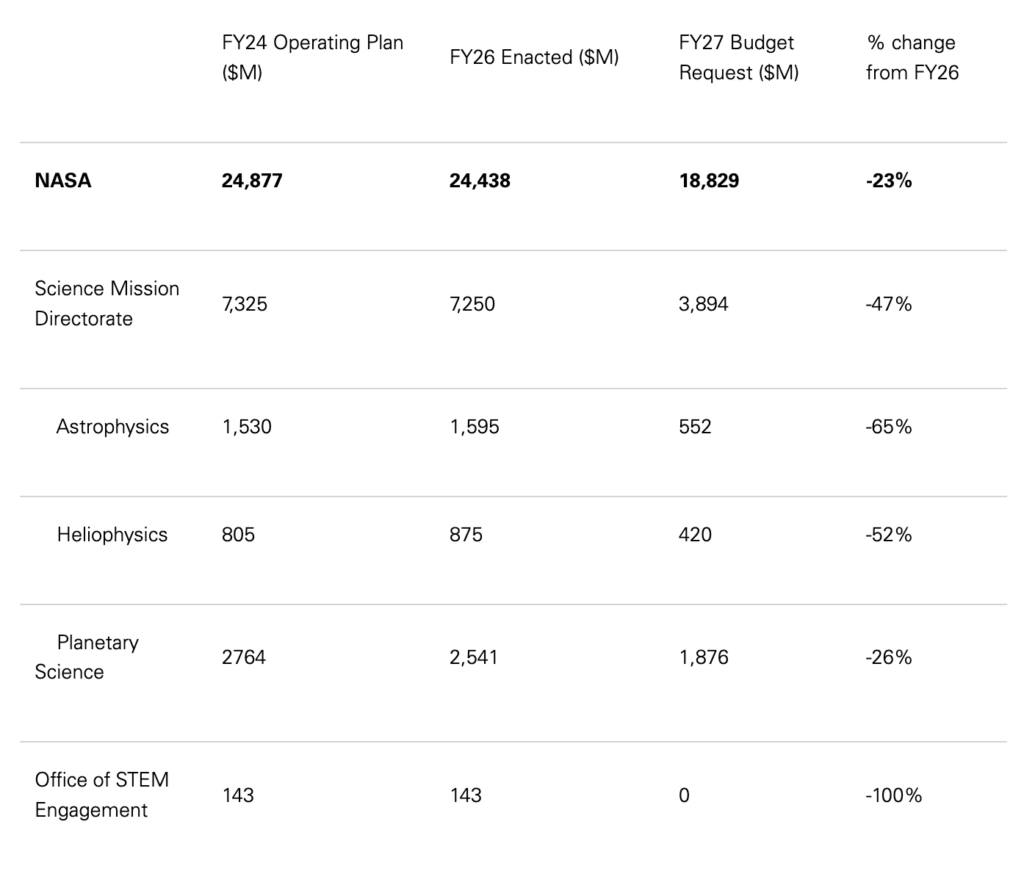
Further, the PBR guts the entirety of funding for STEM engagement and outreach, in both NASA and the NSF. NASA’s stem engagement is a huge driver of getting students from all backgrounds into successful astronomy research and careers. Last year’s PBR cut almost every single NSF program to broaden participation in science, and these programs aren’t even mentioned in this year’s. This would make it more difficult for the public to understand the value of research going forward, and makes scientific career paths less accessible, especially to people from historically underrepresented backgrounds. Imagine if Christina Koch had never gone to the NASA Academy!
These reductions in funding to both the NSF and NASA would have serious consequences for astrophysics research in the United States and beyond. And cuts this extreme aren’t just bad for those of us in the field: astronomical research can have practical benefits for everyone. Luckily, there is some good news: we can still change Congress’ mind.
Schoolhouse Rock: How the PBR Works
Each year, the President of the United States submits the President’s Budget Request (PBR), a proposal to Congress outlining their desired spending and policy priorities for the federal government in the upcoming fiscal year. Think of it like a wish list, but instead of writing to Santa for a pony, the President is writing to Congress for billions of dollars. And just like a wish list, nothing is guaranteed. That’s because Congress holds the power of the purse. Members of Congress may look to the PBR for guidance, but they ultimately make the spending decisions.
In practice, after the PBR is released, Congressional committees review each agency’s proposed budget line by line. They hold hearings, call in agency heads to testify, and negotiate among themselves before drafting their own spending bills known as Appropriations Bills. Once both chambers agree on a final bill and the President signs it, that becomes law. This means that the cuts proposed in the PBR are just the starting point. And that’s where we come in.
Call to Action
It’s up to us to prevent these cuts and save science. Now that the ball is in Congress’ court, we must make our case to them that funding science is a worthwhile cause. To do this, the American Astronomical Society (AAS) has proposed some action items that we can all participate in to appeal to Congress. These actions are part of the 2026 Week of Action in Support of Federal Funding for the Sciences (but you can do them anytime!). Writing emails and making calls to your representatives is a great way to start, and the AAS has provided some tools to guide you along. With the AAS Action Alert, you can email your members of Congress in a matter of minutes using their auto-generated text – however, adding in your own personalization on why funding the sciences matter to you will have an even greater impact. You can also use the “Phone” button on the Action Alert to call your representatives and urge them to reject these cuts to NASA and the NSF. Further, you can even schedule a meeting with your representatives at their local offices. You can either contact your representative directly through filling out a meeting form on their website, or email [email protected] for assistance. If you feel empowered by these actions, you should write an op-ed for your local or school newspaper, or host an advocacy event! These are great ways to create more activists and get the attention of Congress. For more information and helpful tips on all of these avenues for advocacy, please use this link.
The fantastic news is that this sort of advocacy works! Last year, the astronomy community and general public pushed back hard against a PBR that had almost identical cuts to what we’re seeing this year. Congress listened, and ultimately enacted bills that systematically rejected almost every single cut to astrophysics research. Funding science is important, and most politicians recognize that and are not interested in supporting these budget slashes. But it’s up to us to remind them that their constituents are paying attention, and that we care about research in this country. So take a few minutes to explore the AAS action items and share why funding astronomy is important to you. Thank you for saving science with us!
Astrobite edited by Caroline von Raesfeld and Mckenzie Ferrari
Feature Image Credit: NSF/NASA

